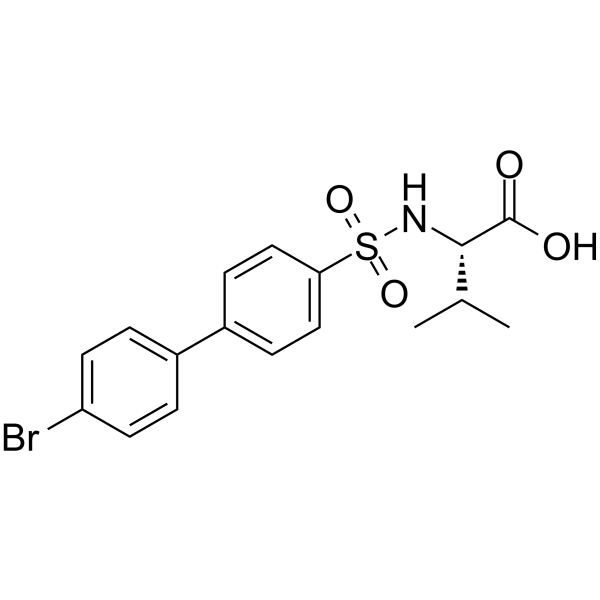
Physicochemical Properties
| Molecular Formula | C17H18BRNO4S |
| Molecular Weight | 412.29 |
| Exact Mass | 411.014 |
| CAS # | 199850-67-4 |
| PubChem CID | 9887870 |
| Appearance | White to pink solid powder |
| Density | 1.457g/cm3 |
| Boiling Point | 562.069ºC at 760 mmHg |
| Melting Point | 192-193℃ |
| Flash Point | 293.729ºC |
| Vapour Pressure | 0mmHg at 25°C |
| Index of Refraction | 1.597 |
| LogP | 4.975 |
| Hydrogen Bond Donor Count | 2 |
| Hydrogen Bond Acceptor Count | 5 |
| Rotatable Bond Count | 6 |
| Heavy Atom Count | 24 |
| Complexity | 515 |
| Defined Atom Stereocenter Count | 1 |
| SMILES | CC(C)[C@@H](C(=O)O)NS(=O)(=O)C1=CC=C(C=C1)C2=CC=C(C=C2)Br |
| InChi Key | GJOCABIDMCKCEG-INIZCTEOSA-N |
| InChi Code | InChI=1S/C17H18BrNO4S/c1-11(2)16(17(20)21)19-24(22,23)15-9-5-13(6-10-15)12-3-7-14(18)8-4-12/h3-11,16,19H,1-2H3,(H,20,21)/t16-/m0/s1 |
| Chemical Name | (2S)-2-[[4-(4-bromophenyl)phenyl]sulfonylamino]-3-methylbutanoic acid |
| Synonyms | PD166793; PD 166793; PD-166793 |
| HS Tariff Code | 2934.99.9001 |
| Storage |
Powder-20°C 3 years 4°C 2 years In solvent -80°C 6 months -20°C 1 month |
| Shipping Condition | Room temperature (This product is stable at ambient temperature for a few days during ordinary shipping and time spent in Customs) |
Biological Activity
| ln Vitro | In rat cardiac homogenates, PD-166793 (0.1 μM) results in a 20% reduction of AMP deaminase (AMPD) activity [2]. In normal human cardiac fibroblasts, PD-166793 (100 μM; 36 hours) dramatically lowers MMP-9 activity [2]. |
| ln Vivo | PD-166793 (1 mg/kg/d; daily gavage for 10 weeks) largely prevents the typical adverse remodeling in aortoluminal (AV) fistula models [3]. PD-166793 (5 mg/kg; oral gavage) exhibits excellent pharmacokinetics in rats (t1/2=43.6 h, Cmax=42.4 µg/mL, AUC0-∞=2822 µg·h/mL )[1]. |
| Animal Protocol |
Animal/Disease Models: Male SD (SD (Sprague-Dawley)) rats (6 weeks) were induced to chronic biventricular volume overload [3] Doses: 1 mg/kg Route of Administration: Daily gavage starting 2 weeks before surgery and continuing until 8 weeks after surgery Weekly Experimental Results: Prevents ventricular dilation and attenuates hypertrophy commonly caused by chronic volume overload. |
| References |
[1]. Structure-activity relationships and pharmacokinetic analysis for a series of potent, systemically available biphenylsulfonamide matrix metalloproteinase inhibitors. J Med Chem. 2000 Jan 27;43(2):156-66. [2]. Inhibiting metalloproteases with PD 166793 in heart failure: impact on cardiac remodeling and beyond. Cardiovasc Ther. Spring 2008;26(1):24-37. [3]. Effects of matrix metalloproteinase inhibition on ventricular remodeling due to volume overload. Circulation. 2002 Apr 23;105(16):1983-8. |
Solubility Data
| Solubility (In Vitro) | DMSO : ~100 mg/mL (~242.54 mM) |
| Solubility (In Vivo) |
Solubility in Formulation 1: ≥ 2.5 mg/mL (6.06 mM) (saturation unknown) in 10% DMSO + 40% PEG300 + 5% Tween80 + 45% Saline (add these co-solvents sequentially from left to right, and one by one), clear solution. For example, if 1 mL of working solution is to be prepared, you can add 100 μL of 25.0 mg/mL clear DMSO stock solution to 400 μL PEG300 and mix evenly; then add 50 μL Tween-80 to the above solution and mix evenly; then add 450 μL normal saline to adjust the volume to 1 mL. Preparation of saline: Dissolve 0.9 g of sodium chloride in 100 mL ddH₂ O to obtain a clear solution. Solubility in Formulation 2: ≥ 2.5 mg/mL (6.06 mM) (saturation unknown) in 10% DMSO + 90% (20% SBE-β-CD in Saline) (add these co-solvents sequentially from left to right, and one by one), clear solution. For example, if 1 mL of working solution is to be prepared, you can add 100 μL of 25.0 mg/mL clear DMSO stock solution to 900 μL of 20% SBE-β-CD physiological saline solution and mix evenly. Preparation of 20% SBE-β-CD in Saline (4°C,1 week): Dissolve 2 g SBE-β-CD in 10 mL saline to obtain a clear solution. Solubility in Formulation 3: ≥ 2.5 mg/mL (6.06 mM) (saturation unknown) in 10% DMSO + 90% Corn Oil (add these co-solvents sequentially from left to right, and one by one), clear solution. For example, if 1 mL of working solution is to be prepared, you can add 100 μL of 25.0 mg/mL clear DMSO stock solution to 900 μL of corn oil and mix evenly. (Please use freshly prepared in vivo formulations for optimal results.) |
| Preparing Stock Solutions | 1 mg | 5 mg | 10 mg | |
| 1 mM | 2.4255 mL | 12.1274 mL | 24.2548 mL | |
| 5 mM | 0.4851 mL | 2.4255 mL | 4.8510 mL | |
| 10 mM | 0.2425 mL | 1.2127 mL | 2.4255 mL |