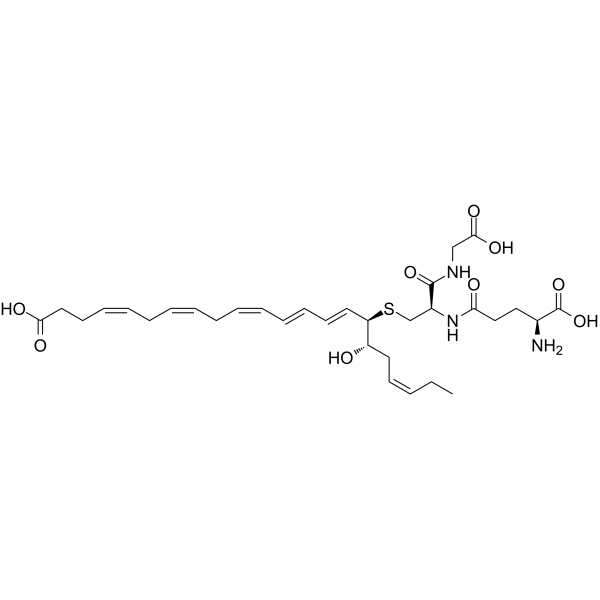
Physicochemical Properties
| Molecular Formula | C32H47N3O9S |
| Exact Mass | 649.303 |
| CAS # | 1810710-59-8 |
| PubChem CID | 132562746 |
| Appearance | Typically exists as solid at room temperature |
| LogP | 0.5 |
| Hydrogen Bond Donor Count | 7 |
| Hydrogen Bond Acceptor Count | 11 |
| Rotatable Bond Count | 25 |
| Heavy Atom Count | 45 |
| Complexity | 1100 |
| Defined Atom Stereocenter Count | 4 |
| SMILES | CC/C=C\C[C@@H]([C@@H](/C=C/C=C/C=C\C/C=C\C/C=C\CCC(=O)O)SC[C@@H](C(=O)NCC(=O)O)NC(=O)CC[C@@H](C(=O)O)N)O |
| InChi Key | RYALZZFZNGJXAF-BQBCQESNSA-N |
| InChi Code | InChI=1S/C32H47N3O9S/c1-2-3-14-17-26(36)27(18-15-12-10-8-6-4-5-7-9-11-13-16-19-29(38)39)45-23-25(31(42)34-22-30(40)41)35-28(37)21-20-24(33)32(43)44/h3,5-8,10-15,18,24-27,36H,2,4,9,16-17,19-23,33H2,1H3,(H,34,42)(H,35,37)(H,38,39)(H,40,41)(H,43,44)/b7-5-,8-6-,12-10+,13-11-,14-3-,18-15+/t24-,25-,26-,27+/m0/s1 |
| Chemical Name | (4Z,7Z,10Z,12E,14E,16R,17S,19Z)-16-[(2R)-2-[[(4S)-4-amino-4-carboxybutanoyl]amino]-3-(carboxymethylamino)-3-oxopropyl]sulfanyl-17-hydroxydocosa-4,7,10,12,14,19-hexaenoic acid |
| HS Tariff Code | 2934.99.9001 |
| Storage |
Powder-20°C 3 years 4°C 2 years In solvent -80°C 6 months -20°C 1 month |
| Shipping Condition | Room temperature (This product is stable at ambient temperature for a few days during ordinary shipping and time spent in Customs) |
Biological Activity
| ln Vitro | PCTR1 is a lipid mediator that contains peptides. PCTR1 facilitates the clearance of bacterial infection and is temporally regulated during self-limited inflammation. Prostaglandin (PG)E2 (48%), PGD2 (64%), PGF2α (38%), and thromboxane B2 (40%), were considerably reduced by PCTR1. PCTR1 speeds up the removal of E and raises the numbers of exudate macrophages. coli infection, reduces the synthesis of local inflammatory mediators, and encourages resolution[1]. PCTR1 exhibits agonist activity against human keratinocyte migration due to its distinct structural characteristics. Human keratinocyte migration is enhanced by PCTR1 in a cAMP/PKA-dependent way. cAMP levels are markedly increased when PCTR1 (10 nM) is used to stimulate keratinocytes for 15 minutes[2]. |
| ln Vivo | During infection, PCTR1, a lipid mediator, has basic anti-inflammatory and pro-resolution effects[3]. PCTR1 (50 ng/mice) increases the survival rate in a model of acute inflammation caused by lipopolysaccharides (LPS)[3]. |
| Cell Assay |
Cell Viability Assay[2] Cell Types: Primary human epidermal keratinocytes (HPEKp) Tested Concentrations: 0.1, 1, and 10 nM Incubation Duration: 24 hrs (hours) Experimental Results: In comparison with untreated cells in which approximately 25% of the initially wounded area was covered by cells 24 hrs (hours) after wounding, 10 nM Dramatically enhanced migration such that approximately 46% of the wound area was covered by cells at 24 hrs (hours) after wounding. |
| Animal Protocol |
Animal/Disease Models: C57BL/ 6J wild-type male mice (8-10 weeks old, 22-25 g)[3] Doses: 50 ng/mice Route of Administration: Administered via the tail vein 1 h after LPS (15 mg/kg) intraperitoneal (ip) injection. The survival rate was recorded every day for 7 days Experimental Results: Compared with the LPS group, the survival rate was Dramatically higher in the LPS + PCTR1 group, indicating that PCTR1 markedly increased the survival rate. |
| References |
[1]. Sesquile Ramon, et al. The Protectin PCTR1 Is Produced by Human M2 Macrophages and Enhances Resolution of Infectious Inflammation. Am J Pathol. 2016 Apr;186(4):962-73. [2]. Brian E Sansbury, et al. PCTR1 Enhances Repair and Bacterial Clearance in Skin Wounds. Am J Pathol. 2021 Jun;191(6):1049-1063. [3]. Yong-Jian Liu, et al. PCTR1 ameliorates lipopolysaccharide-induced acute inflammation and multiple organ damage via regulation of linoleic acid metabolism by promoting FADS1/FASDS2/ELOV2 expression and reducing PLA2 expression. Lab Invest. 2020 Jul;100(7) |
Solubility Data
| Solubility (In Vitro) | May dissolve in DMSO (in most cases), if not, try other solvents such as H2O, Ethanol, or DMF with a minute amount of products to avoid loss of samples |
| Solubility (In Vivo) |
Note: Listed below are some common formulations that may be used to formulate products with low water solubility (e.g. < 1 mg/mL), you may test these formulations using a minute amount of products to avoid loss of samples. Injection Formulations (e.g. IP/IV/IM/SC) Injection Formulation 1: DMSO : Tween 80: Saline = 10 : 5 : 85 (i.e. 100 μL DMSO stock solution → 50 μL Tween 80 → 850 μL Saline) *Preparation of saline: Dissolve 0.9 g of sodium chloride in 100 mL ddH ₂ O to obtain a clear solution. Injection Formulation 2: DMSO : PEG300 :Tween 80 : Saline = 10 : 40 : 5 : 45 (i.e. 100 μL DMSO → 400 μLPEG300 → 50 μL Tween 80 → 450 μL Saline) Injection Formulation 3: DMSO : Corn oil = 10 : 90 (i.e. 100 μL DMSO → 900 μL Corn oil) Example: Take the Injection Formulation 3 (DMSO : Corn oil = 10 : 90) as an example, if 1 mL of 2.5 mg/mL working solution is to be prepared, you can take 100 μL 25 mg/mL DMSO stock solution and add to 900 μL corn oil, mix well to obtain a clear or suspension solution (2.5 mg/mL, ready for use in animals). Injection Formulation 4: DMSO : 20% SBE-β-CD in saline = 10 : 90 [i.e. 100 μL DMSO → 900 μL (20% SBE-β-CD in saline)] *Preparation of 20% SBE-β-CD in Saline (4°C,1 week): Dissolve 2 g SBE-β-CD in 10 mL saline to obtain a clear solution. Injection Formulation 5: 2-Hydroxypropyl-β-cyclodextrin : Saline = 50 : 50 (i.e. 500 μL 2-Hydroxypropyl-β-cyclodextrin → 500 μL Saline) Injection Formulation 6: DMSO : PEG300 : castor oil : Saline = 5 : 10 : 20 : 65 (i.e. 50 μL DMSO → 100 μLPEG300 → 200 μL castor oil → 650 μL Saline) Injection Formulation 7: Ethanol : Cremophor : Saline = 10: 10 : 80 (i.e. 100 μL Ethanol → 100 μL Cremophor → 800 μL Saline) Injection Formulation 8: Dissolve in Cremophor/Ethanol (50 : 50), then diluted by Saline Injection Formulation 9: EtOH : Corn oil = 10 : 90 (i.e. 100 μL EtOH → 900 μL Corn oil) Injection Formulation 10: EtOH : PEG300:Tween 80 : Saline = 10 : 40 : 5 : 45 (i.e. 100 μL EtOH → 400 μLPEG300 → 50 μL Tween 80 → 450 μL Saline) Oral Formulations Oral Formulation 1: Suspend in 0.5% CMC Na (carboxymethylcellulose sodium) Oral Formulation 2: Suspend in 0.5% Carboxymethyl cellulose Example: Take the Oral Formulation 1 (Suspend in 0.5% CMC Na) as an example, if 100 mL of 2.5 mg/mL working solution is to be prepared, you can first prepare 0.5% CMC Na solution by measuring 0.5 g CMC Na and dissolve it in 100 mL ddH2O to obtain a clear solution; then add 250 mg of the product to 100 mL 0.5% CMC Na solution, to make the suspension solution (2.5 mg/mL, ready for use in animals). Oral Formulation 3: Dissolved in PEG400 Oral Formulation 4: Suspend in 0.2% Carboxymethyl cellulose Oral Formulation 5: Dissolve in 0.25% Tween 80 and 0.5% Carboxymethyl cellulose Oral Formulation 6: Mixing with food powders Note: Please be aware that the above formulations are for reference only. InvivoChem strongly recommends customers to read literature methods/protocols carefully before determining which formulation you should use for in vivo studies, as different compounds have different solubility properties and have to be formulated differently. (Please use freshly prepared in vivo formulations for optimal results.) |