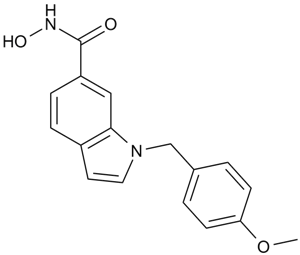
PCI-34051 is a novel, potent and specific inhibitor of histone deacetylase 8 (HDAC8) with potential anticancer activity. It exhibits >200-fold selectivity for HDAC8 over HDAC1 and 6, and 1000-fold higher selectivity over HDAC2/3/10. In a cell-free assay, it inhibits HDAC8 with an IC50 of 10 nM.
Physicochemical Properties
| Molecular Formula | C17H16N2O3 | |
| Molecular Weight | 296.32 | |
| Exact Mass | 296.116 | |
| Elemental Analysis | C, 68.91; H, 5.44; N, 9.45; O, 16.20 | |
| CAS # | 950762-95-5 | |
| Related CAS # |
|
|
| PubChem CID | 24753719 | |
| Appearance | White to gray solid powder | |
| Density | 1.3±0.1 g/cm3 | |
| Index of Refraction | 1.621 | |
| LogP | 2.2 | |
| Hydrogen Bond Donor Count | 2 | |
| Hydrogen Bond Acceptor Count | 3 | |
| Rotatable Bond Count | 4 | |
| Heavy Atom Count | 22 | |
| Complexity | 382 | |
| Defined Atom Stereocenter Count | 0 | |
| SMILES | O=C(C1C=C2C(C=CN2CC2C=CC(OC)=CC=2)=CC=1)NO |
|
| InChi Key | AJRGHIGYPXNABY-UHFFFAOYSA-N | |
| InChi Code | InChI=1S/C17H16N2O3/c1-22-15-6-2-12(3-7-15)11-19-9-8-13-4-5-14(10-16(13)19)17(20)18-21/h2-10,21H,11H2,1H3,(H,18,20) | |
| Chemical Name | N-hydroxy-1-[(4-methoxyphenyl)methyl]indole-6-carboxamide | |
| Synonyms | PCI-34051; PCI 34051; PCI34051 | |
| HS Tariff Code | 2934.99.9001 | |
| Storage |
Powder-20°C 3 years 4°C 2 years In solvent -80°C 6 months -20°C 1 month |
|
| Shipping Condition | Room temperature (This product is stable at ambient temperature for a few days during ordinary shipping and time spent in Customs) |
Biological Activity
| Targets | HDAC8 ( IC50 = 10 nM ); HDAC6 ( IC50 = 2.9 μM ); HDAC1 ( IC50 = 4 μM ); HDAC10 ( IC50 = 13 μM ) | |
| ln Vitro |
|
|
| ln Vivo |
|
|
| Enzyme Assay | Measurements are conducted in a reaction volume of 100 μL using 96-well assay plates in a fluorescence plate reader for PCI-34051 characterization. for every isozyme. The HDAC protein is combined with PCI-34051 at different concentrations and incubated for 15 minutes in reaction buffer (50 mM HEPES, 100 mM KCl, 0.001% Tween-20, 5% dimethyl sulfoxide, pH7.4) supplemented with bovine serum albumin at concentrations of 0-0.05%. The reaction is started by adding acetyl-gly-Ala-(N-acetyl-Lys)-amino-4-methylcoumarin at a final concentration of 25–100 μM and trysin at a final concentration of 50 nM. The fluorescence is measured over a 30-minute period with an excitation wavelength of 335 nm and a detection wavelength of 460 nm, following a 30-minute lag time. The reaction rate is determined by measuring the increase in fluorescence with time. | |
| Cell Assay | Human umbilical vein endothelial cells and tumor cell lines are cultured for at least two doubling times, and growth is assessed using an Alamar Blue fluorometric cell proliferation assay, per the manufacturer's recommendation, at the conclusion of PCI-34051 exposure. In 96-well plates, PCI-34051 is tested in triplicate wells. A logistic equation with four parameters is used to estimate the concentration needed to inhibit cell growth by 50% (GI50) and the 95% confidence intervals from nonlinear regression. | |
| Animal Protocol |
|
|
| References |
[1]. A novel histone deacetylase 8 (HDAC8)-specific inhibitor PCI-34051 induces apoptosis in T-cell lymphomas. Leukemia. 2008 May;22(5):1026-34. [2]. Therapeutic effects of histone deacetylase inhibitors in a murine asthma model. Inflamm Res. 2016 Dec;65(12):995-1008. |
|
| Additional Infomation | N-hydroxy-1-[(4-methoxyphenyl)methyl]-6-indolecarboxamide is an indolecarboxamide. |
Solubility Data
| Solubility (In Vitro) |
|
|||
| Solubility (In Vivo) |
Solubility in Formulation 1: ≥ 2.5 mg/mL (8.44 mM) (saturation unknown) in 10% DMSO + 40% PEG300 + 5% Tween80 + 45% Saline (add these co-solvents sequentially from left to right, and one by one), clear solution. For example, if 1 mL of working solution is to be prepared, you can add 100 μL of 25.0 mg/mL clear DMSO stock solution to 400 μL PEG300 and mix evenly; then add 50 μL Tween-80 to the above solution and mix evenly; then add 450 μL normal saline to adjust the volume to 1 mL. Preparation of saline: Dissolve 0.9 g of sodium chloride in 100 mL ddH₂ O to obtain a clear solution. Solubility in Formulation 2: ≥ 2.5 mg/mL (8.44 mM) (saturation unknown) in 10% DMSO + 90% (20% SBE-β-CD in Saline) (add these co-solvents sequentially from left to right, and one by one), clear solution. For example, if 1 mL of working solution is to be prepared, you can add 100 μL of 25.0 mg/mL clear DMSO stock solution to 900 μL of 20% SBE-β-CD physiological saline solution and mix evenly. Preparation of 20% SBE-β-CD in Saline (4°C,1 week): Dissolve 2 g SBE-β-CD in 10 mL saline to obtain a clear solution. Solubility in Formulation 3: ≥ 2.5 mg/mL (8.44 mM) (saturation unknown) in 10% DMSO + 90% Corn Oil (add these co-solvents sequentially from left to right, and one by one), clear solution. For example, if 1 mL of working solution is to be prepared, you can add 100 μL of 25.0 mg/mL clear DMSO stock solution to 900 μL of corn oil and mix evenly. Solubility in Formulation 4: 30% PEG400+0.5% Tween80+5% propylene glycol: 30mg/mL (Please use freshly prepared in vivo formulations for optimal results.) |
| Preparing Stock Solutions | 1 mg | 5 mg | 10 mg | |
| 1 mM | 3.3747 mL | 16.8737 mL | 33.7473 mL | |
| 5 mM | 0.6749 mL | 3.3747 mL | 6.7495 mL | |
| 10 mM | 0.3375 mL | 1.6874 mL | 3.3747 mL |