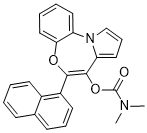
Physicochemical Properties
| Molecular Formula | C25H20N2O3 |
| Molecular Weight | 396.437906265259 |
| Exact Mass | 396.147 |
| CAS # | 290814-68-5 |
| PubChem CID | 9865511 |
| Appearance | White to off-white solid powder |
| Density | 1.2±0.1 g/cm3 |
| Boiling Point | 580.6±50.0 °C at 760 mmHg |
| Flash Point | 305.0±30.1 °C |
| Vapour Pressure | 0.0±1.6 mmHg at 25°C |
| Index of Refraction | 1.640 |
| LogP | 5.69 |
| Hydrogen Bond Donor Count | 0 |
| Hydrogen Bond Acceptor Count | 3 |
| Rotatable Bond Count | 3 |
| Heavy Atom Count | 30 |
| Complexity | 675 |
| Defined Atom Stereocenter Count | 0 |
| InChi Key | SOIZAFVNIXAZFQ-UHFFFAOYSA-N |
| InChi Code | InChI=1S/C25H20N2O3/c1-26(2)25(28)30-24-21-14-8-16-27(21)20-13-5-6-15-22(20)29-23(24)19-12-7-10-17-9-3-4-11-18(17)19/h3-16H,1-2H3 |
| Chemical Name | (6-naphthalen-1-ylpyrrolo[2,1-d][1,5]benzoxazepin-7-yl) N,N-dimethylcarbamate |
| HS Tariff Code | 2934.99.9001 |
| Storage |
Powder-20°C 3 years 4°C 2 years In solvent -80°C 6 months -20°C 1 month |
| Shipping Condition | Room temperature (This product is stable at ambient temperature for a few days during ordinary shipping and time spent in Customs) |
Biological Activity
| ln Vitro | While PBOX 6 is a strong apoptotic PBOX, in the rat R2C Leydig cell line it has no general harmful effects. PBOX 6 (0-25 μM, 16 h) induces apoptosis in HL-60 cells in a dose- and time-dependent manner. At 10 μM, it also fragments DNA. PBOX 6 (10 μM) activates caspase 3-like protease in HL-60 cells, causing them to undergo apoptosis. PBOX 6 (10 μM) causes apoptosis and cytochrome accumulation in the cytoplasm; however, oxidative stress is not responsible for this impact, nor is it dependent on NF-κB or peripheral benzodiazepine receptors (PBR)[1]. By activating caspase-7, PBOX 6 (25 μM) causes MCF-7 cells to undergo apoptosis[2]. In K562 cells, PBOX 6 (10 μM) causes cypA to be redistributed from the nucleus to the cytoplasm. Trypsin-like serine proteases must be activated upstream in order for PBOX 6 (10 μM) to cause the nucleocytoplasmic translocation of cypA and pin1 in a JNK-dependent manner. This result is linked to G2/M phase arrest in K562 cells [3]. |
| References |
[1]. Pyrrolo-1,5-benzoxazepines induce apoptosis in HL-60, Jurkat, and Hut-78 cells: a new class of apoptotic agents. J Pharmacol Exp Ther. 2000 Apr;293(1):48-59. [2]. Caspase-3 is not essential for DNA fragmentation in MCF-7 cells during apoptosis induced by the pyrrolo-1,5-benzoxazepine, PBOX-6. FEBS Lett. 2002 Mar 27;515(1-3):66-70. [3]. The microtubule-targeting agents, PBOX-6 [pyrrolobenzoxazepine 7-[(dimethylcarbamoyl)oxy]-6-(2-naphthyl)pyrrolo-[2,1-d] (1,5)-benzoxazepine] and paclitaxel, induce nucleocytoplasmic redistribution of the peptidyl-prolyl isomerases, cycloph. |
Solubility Data
| Solubility (In Vitro) | DMSO : ~33.33 mg/mL (~84.07 mM) |
| Solubility (In Vivo) |
Solubility in Formulation 1: ≥ 2.5 mg/mL (6.31 mM) (saturation unknown) in 10% DMSO + 90% Corn Oil (add these co-solvents sequentially from left to right, and one by one), clear solution. For example, if 1 mL of working solution is to be prepared, you can add 100 μL of 25.0 mg/mL clear DMSO stock solution to 900 μL of corn oil and mix evenly. (Please use freshly prepared in vivo formulations for optimal results.) |
| Preparing Stock Solutions | 1 mg | 5 mg | 10 mg | |
| 1 mM | 2.5224 mL | 12.6122 mL | 25.2245 mL | |
| 5 mM | 0.5045 mL | 2.5224 mL | 5.0449 mL | |
| 10 mM | 0.2522 mL | 1.2612 mL | 2.5224 mL |