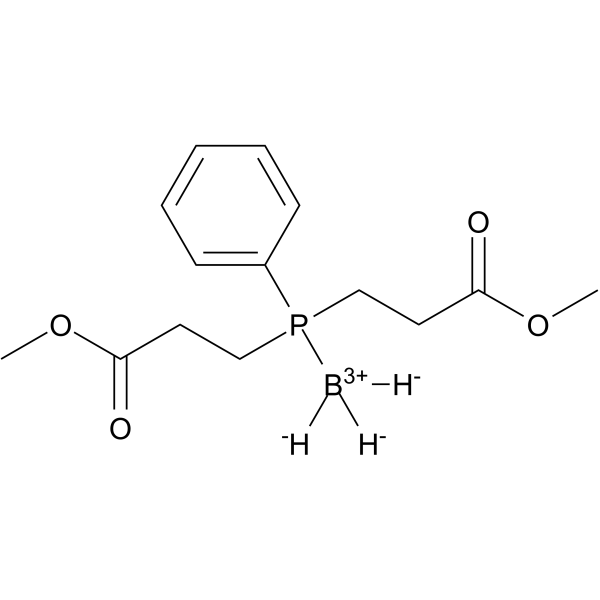
Physicochemical Properties
| Molecular Formula | C14H22BO4P |
| Molecular Weight | 296.11 |
| CAS # | 188714-28-5 |
| Appearance | Colorless to light yellow liquid |
| HS Tariff Code | 2934.99.9001 |
| Storage |
Powder-20°C 3 years 4°C 2 years In solvent -80°C 6 months -20°C 1 month Note: Please store this product in a sealed and protected environment (e.g. under nitrogen), avoid exposure to moisture. |
| Shipping Condition | Room temperature (This product is stable at ambient temperature for a few days during ordinary shipping and time spent in Customs) |
Biological Activity
| Targets | TCEP[1][2] |
| ln Vitro | Strong activation of the BDNF effector ERK1/2 is produced by PB1. RGC survival is enhanced by PB1[1]. |
| ln Vivo | In experimental glaucoma, PB1 (150 μM; intraocular injection; 1 week) attenuates the loss of both RGC (retinal ganglion cells) soma and axons[1]. In experimental glaucoma, PB1 shields the RGC soma. The biological activity in vivo is limited by a single dose of PB1. In experimental glaucoma, PB1 attenuates the loss of RGC axons as well as soma. It takes 72 hours for PB1 (0.001~100 μM) to start saving acutely axotomized retinal ganglion cells[1][2]. |
| Animal Protocol |
Animal/Disease Models: SD (Sprague-Dawley) rats (180~ 200 g)[1] Doses: 150 μM Route of Administration: Intraocular injection Experimental Results: PB1-treated eyes, 66% of RGCs survived at 1 week after axotomy. |
| References |
[1]. Almasieh M, et al. A cell-permeable phosphine-borane complex delays retinal ganglion cell death after axonal injury through activation of the pro-survival extracellular signal-regulated kinases 1/2 pathway. J Neurochem. 2011;118(6):1075-1086. [2]. Schlieve CR, et al. Synthesis and characterization of a novel class of reducing agents that are highly neuroprotective for retinal ganglion cells. Exp Eye Res. 2006;83(5):1252-1259. [3]. Niemuth NJ, et al. Intracellular disulfide reduction by phosphine-borane complexes: Mechanism of action for neuroprotection. Neurochem Int. 2016;99:24-32. |
Solubility Data
| Solubility (In Vitro) | DMSO: 100 mg/mL (337.71 mM) |
| Solubility (In Vivo) |
Solubility in Formulation 1: ≥ 2.5 mg/mL (8.44 mM) (saturation unknown) in 10% DMSO + 40% PEG300 + 5% Tween80 + 45% Saline (add these co-solvents sequentially from left to right, and one by one), clear solution. For example, if 1 mL of working solution is to be prepared, you can add 100 μL of 25.0 mg/mL clear DMSO stock solution to 400 μL PEG300 and mix evenly; then add 50 μL Tween-80 to the above solution and mix evenly; then add 450 μL normal saline to adjust the volume to 1 mL. Preparation of saline: Dissolve 0.9 g of sodium chloride in 100 mL ddH₂ O to obtain a clear solution. Solubility in Formulation 2: ≥ 2.5 mg/mL (8.44 mM) (saturation unknown) in 10% DMSO + 90% (20% SBE-β-CD in Saline) (add these co-solvents sequentially from left to right, and one by one), clear solution. For example, if 1 mL of working solution is to be prepared, you can add 100 μL of 25.0 mg/mL clear DMSO stock solution to 900 μL of 20% SBE-β-CD physiological saline solution and mix evenly. Preparation of 20% SBE-β-CD in Saline (4°C,1 week): Dissolve 2 g SBE-β-CD in 10 mL saline to obtain a clear solution. Solubility in Formulation 3: ≥ 2.5 mg/mL (8.44 mM) (saturation unknown) in 10% DMSO + 90% Corn Oil (add these co-solvents sequentially from left to right, and one by one), clear solution. For example, if 1 mL of working solution is to be prepared, you can add 100 μL of 25.0 mg/mL clear DMSO stock solution to 900 μL of corn oil and mix evenly. (Please use freshly prepared in vivo formulations for optimal results.) |
| Preparing Stock Solutions | 1 mg | 5 mg | 10 mg | |
| 1 mM | 3.3771 mL | 16.8856 mL | 33.7712 mL | |
| 5 mM | 0.6754 mL | 3.3771 mL | 6.7542 mL | |
| 10 mM | 0.3377 mL | 1.6886 mL | 3.3771 mL |