|
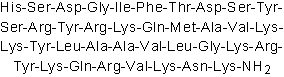
PACAP 1-38 is a highly potent agonist of the PACAP (Pituitary adenylate cyclase-activating polypeptide) receptor with Kd of 100 pM. The ADCYAP1 gene in humans encodes the protein PACAP. PACAP and vasoactive intestinal peptide are comparable. It stimulates cells that resemble enterochromaffin, among other things. It binds to both the PACAP receptor and the vasoactive intestinal peptide receptor. The small peptide PACAP 1-38 promotes phagocytosis and adenylate cyclase (AC). Strong, long-lasting, and effective stimulatory effects on sympathetic neuronal NPY and catecholamine production are exhibited by PACAP 1-38. By inhibiting p38 MAPK and NFκB translocation via both PAC1 and VPAC1 receptors, PACAP 1-38 significantly prevents damage to cultured renal proximal tubule cells caused by myeloma light chains. This is achieved through suppression of pro-inflammatory cytokine production.
|
Physicochemical Properties
| Molecular Formula |
C203H331N63O53S
|
| Molecular Weight |
4534.25553999996
|
| CAS # |
137061-48-4
|
| Related CAS # |
PACAP (1-38), human, ovine, rat TFA; PACAP (1-38) free acid TFA; PACAP (1-38) free acid; 129405-61-4
|
| Appearance |
White to off-white solid powder
|
| SMILES |
[H]/N=C(/NCCC[C@@H](C(N[C@H](C(N[C@H](C(N[C@H](C(N[C@H](C(N[C@H](C(N[C@H](C(N[C@H](C(N[C@H](C(=O)N)CCCCN)=O)CC(=O)N)=O)CCCCN)=O)C(C)C)=O)CCCN/C(=N/[H])/N)=O)CCC(=O)N)=O)CCCCN)=O)CC1=CC=C(O)C=C1)=O)NC([C@@H](NC(CNC([C@@H](NC([C@H](C(C)C)NC([C@@H](NC([C@@H](NC([C@@H](NC([C@@H](NC([C@@H](NC([C@@H](NC([C@H](C(C)C)NC([C@@H](NC([C@@H](NC([C@@H](NC([C@@H](NC([C@@H](NC([C@@H](NC([C@@H](NC([C@@H](NC([C@@H](NC([C@@H](NC([C@@H](NC([C@H]([C@H](O)C)NC([C@@H](NC([C@H]([C@H](CC)C)NC(CNC([C@@H](NC([C@@H](NC([C@H](CC1N=CNC=1)N)=O)CO)=O)CC(=O)O)=O)=O)=O)CC1=CC=CC=C1)=O)=O)CC(=O)O)=O)CO)=O)CC1=CC=C(O)C=C1)=O)CO)=O)CCCN/C(=N/[H])/N)=O)CC1=CC=C(O)C=C1)=O)CCCN/C(=N/[H])/N)=O)CCCCN)=O)CCC(=O)N)=O)CCSC)=O)C)=O)=O)CCCCN)=O)CCCCN)=O)CC1=CC=C(O)C=C1)=O)CC(C)C)=O)C)=O)C)=O)=O)CC(C)C)=O)=O)CCCCN)=O)\N
|
| Synonyms |
| PACAP (1-38), human, ovine, rat; Pituitary Adenylate Cyclase Activating Polypeptide 38 |
|
| HS Tariff Code |
2934.99.9001
|
| Storage |
Powder-20°C 3 years
4°C 2 years
In solvent -80°C 6 months
-20°C 1 month Note: Please store this product in a sealed and protected environment, avoid exposure to moisture.
|
| Shipping Condition |
Room temperature (This product is stable at ambient temperature for a few days during ordinary shipping and time spent in Customs)
|
|
Biological Activity
| Targets |
PAC1 ( Ki = 1.1 nM ); PAC1s ( Ki = 1.7 nM ); PAC1vs ( Ki = 121 nM )
|
| ln Vitro |
In vitro activity: PACAP 1-38 has strong, long-lasting stimulatory effects on catecholamine synthesis and sympathetic neuronal NPY[1]. This neuropeptide is pleiotropic, displaying a range of biologic actions in immune cells, such as neurotransmitter, neuromodulator, neurotrophic factor, and immunomodulator via modulating NFκB activation and MAPK signaling. By blocking the production of proinflammatory cytokines, PACAP 1-38 significantly reduces the harm that myeloma light chains cause to cultured renal proximal tubule cells. This is achieved by blocking p38 MAPK and NFκB translocation via both PAC1 and VPAC1 receptors. In addition to directly preventing myeloma cell adhesion-induced production of the growth factor IL-6 from bone marrow stromal cells, PACAP38 may also have an indirect effect on myeloma cell growth inhibition. In a dose-dependent manner, PACAP38 inhibited the release of TNFα and IL-6[2]. |
|
| ln Vivo |
| PACAP38 is highly effective at blocking the production of cytokines triggered by light chains, thereby averting the in vivo cell damage that would otherwise occur. PACAP is thought to act as an autoregulatory factor for some tumors, promoting their growth in an autocrine manner[2]. |
|
| Cell Assay |
Human renal proximal tubule cells are cultured for 24 hours at 37°C in DRM-23E medium with 0.5% (vol/vol) FBS after being plated onto 6-well tissue culture plates. Following a prewash with serum-free medium, the cells are cultured with κ-LC (1.5 mg/ml, approximately 50 μM) for three days, both in the presence and absence of different concentrations of transcription factor and kinase inhibitors, as well as PACAP38 or dexamethasone. Trypan blue exclusion assays are used to determine the viability of cells; in all experiments, at least 85% of the cells are still viable. For cytokine assays, culture supernatants are removed and kept at -70°C after being exposed to test substances. The cells are lysed using Sigma Mammalian Cell Lysis Reagents to extract the proteins after the medium is removed, and the cells are then rinsed with ice-cold PBS. Following scraping, lysates are centrifuged at 12,000 g for 10 minutes at 4°C, and a 21-gauge needle is used to shear DNA. Substratum is subsequently collected and utilized in kinase research.
|
| Animal Protocol |
| physiologic saline; 2 nmol/10 mL; i.v. | | Male Sprague-Dawley rats | |
|
| References |
[1]. Ann N Y Acad Sci
. 1996 Dec 26:805:204-16; discussion 217-8.
[2]. Blood
. 2006 Jan 15;107(2):661-8.
[3]. J Neuroendocrinol
. 1999 Dec;11(12):941-9.
|
|
Solubility Data
| Solubility (In Vitro) |
| DMSO: N/A | | Water: ~100 mg/mL (~22.1 mM) | | Ethanol: N/A |
|
| Solubility (In Vivo) |
(Please use freshly prepared in vivo formulations for optimal results.)
|
| Preparing Stock Solutions |
|
1 mg |
5 mg |
10 mg |
| 1 mM |
0.2205 mL |
1.1027 mL |
2.2054 mL |
| 5 mM |
0.0441 mL |
0.2205 mL |
0.4411 mL |
| 10 mM |
0.0221 mL |
0.1103 mL |
0.2205 mL |
*Note: Please select an appropriate solvent for the preparation of stock solution based on your experiment needs. For most products, DMSO can be used for preparing stock solutions (e.g. 5 mM, 10 mM, or 20 mM concentration); some products with high aqueous solubility may be dissolved in water directly. Solubility information is available at the above Solubility Data section. Once the stock solution is prepared, aliquot it to routine usage volumes and store at -20°C or -80°C. Avoid repeated freeze and thaw cycles. |