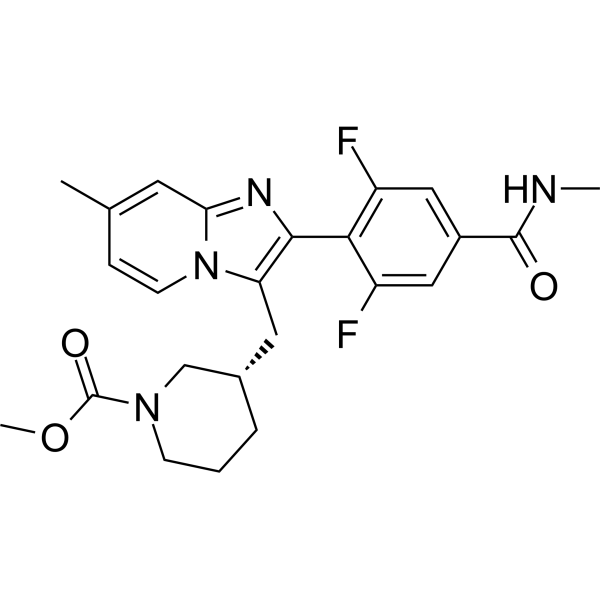
Physicochemical Properties
| Molecular Formula | C24H26F2N4O3 |
| Molecular Weight | 456.4851 |
| Exact Mass | 456.197 |
| CAS # | 2417288-67-4 |
| PubChem CID | 132129813 |
| Appearance | Off-white to light yellow solid powder |
| LogP | 4.2 |
| Hydrogen Bond Donor Count | 1 |
| Hydrogen Bond Acceptor Count | 6 |
| Rotatable Bond Count | 5 |
| Heavy Atom Count | 33 |
| Complexity | 701 |
| Defined Atom Stereocenter Count | 1 |
| SMILES | FC1C([H])=C(C(N([H])C([H])([H])[H])=O)C([H])=C(C=1C1=C(C([H])([H])[C@@]2([H])C([H])([H])N(C(=O)OC([H])([H])[H])C([H])([H])C([H])([H])C2([H])[H])N2C([H])=C([H])C(C([H])([H])[H])=C([H])C2=N1)F |
| InChi Key | HHJIZLMOCIYWJF-HNNXBMFYSA-N |
| InChi Code | InChI=1S/C24H26F2N4O3/c1-14-6-8-30-19(10-15-5-4-7-29(13-15)24(32)33-3)22(28-20(30)9-14)21-17(25)11-16(12-18(21)26)23(31)27-2/h6,8-9,11-12,15H,4-5,7,10,13H2,1-3H3,(H,27,31)/t15-/m0/s1 |
| Chemical Name | methyl (3S)-3-[[2-[2,6-difluoro-4-(methylcarbamoyl)phenyl]-7-methylimidazo[1,2-a]pyridin-3-yl]methyl]piperidine-1-carboxylate |
| Synonyms | P2X3 antagonist 34; P2X3 antagonist 34 |
| HS Tariff Code | 2934.99.9001 |
| Storage |
Powder-20°C 3 years 4°C 2 years In solvent -80°C 6 months -20°C 1 month Note: This product requires protection from light (avoid light exposure) during transportation and storage. |
| Shipping Condition | Room temperature (This product is stable at ambient temperature for a few days during ordinary shipping and time spent in Customs) |
Biological Activity
| ln Vitro | P2X3 antagonist 34 (BLU-5937; 500 nM) antagonizes P2X3 homotrimeric receptors to prevent αβ-meATP-induced sensitization of isolated primary nociceptors in the rat dorsal root ganglion (DRG). as well as the discharge process. Following washout, both the sensitizing effect of αβ-meATP and the inhibitory impact of P2X3 antagonist 34 are reversible [1]. |
| ln Vivo | The administration of P2X3 antagonist 34 (BLU-5937; 0.3-0 mg/kg, oral; male Dunkin Hartley guinea pigs) to guinea pigs resulted in a dose-dependent reduction in the number of coughs induced by citric acid, which was caused by histamine. model [1]. It has also been demonstrated that the P2X3 antagonist 34 (BLU-5937; orally administered at 3 and 30 mg/kg) significantly and dose-dependently reduces the ATP-induced potentiation of citric acid-induced cough in guinea pigs [1]. |
| Animal Protocol |
Animal/Disease Models: Male Dunkin Hartley guinea pig [1] Doses: 0.3 mg/kg, 3 mg/kg, 30 mg/kg Route of Administration: Oral Experimental Results: Significant reduction in the number of histamine-induced citric acid-induced coughs in a dose-dependent manner Way. |
| References |
[1]. BLU-5937: A selective P2X3 antagonist with potent anti-tussive effect and no taste alteration. Pulm Pharmacol Ther. 2019 Jun;56:56-62. |
Solubility Data
| Solubility (In Vitro) | DMSO : ~100 mg/mL (~219.06 mM) |
| Solubility (In Vivo) |
Solubility in Formulation 1: ≥ 2.5 mg/mL (5.48 mM) (saturation unknown) in 10% DMSO + 40% PEG300 + 5% Tween80 + 45% Saline (add these co-solvents sequentially from left to right, and one by one), clear solution. For example, if 1 mL of working solution is to be prepared, you can add 100 μL of 25.0 mg/mL clear DMSO stock solution to 400 μL PEG300 and mix evenly; then add 50 μL Tween-80 to the above solution and mix evenly; then add 450 μL normal saline to adjust the volume to 1 mL. Preparation of saline: Dissolve 0.9 g of sodium chloride in 100 mL ddH₂ O to obtain a clear solution. Solubility in Formulation 2: ≥ 2.5 mg/mL (5.48 mM) (saturation unknown) in 10% DMSO + 90% (20% SBE-β-CD in Saline) (add these co-solvents sequentially from left to right, and one by one), clear solution. For example, if 1 mL of working solution is to be prepared, you can add 100 μL of 25.0 mg/mL clear DMSO stock solution to 900 μL of 20% SBE-β-CD physiological saline solution and mix evenly. Preparation of 20% SBE-β-CD in Saline (4°C,1 week): Dissolve 2 g SBE-β-CD in 10 mL saline to obtain a clear solution. Solubility in Formulation 3: ≥ 2.5 mg/mL (5.48 mM) (saturation unknown) in 10% DMSO + 90% Corn Oil (add these co-solvents sequentially from left to right, and one by one), clear solution. For example, if 1 mL of working solution is to be prepared, you can add 100 μL of 25.0 mg/mL clear DMSO stock solution to 900 μL of corn oil and mix evenly. (Please use freshly prepared in vivo formulations for optimal results.) |
| Preparing Stock Solutions | 1 mg | 5 mg | 10 mg | |
| 1 mM | 2.1906 mL | 10.9531 mL | 21.9063 mL | |
| 5 mM | 0.4381 mL | 2.1906 mL | 4.3813 mL | |
| 10 mM | 0.2191 mL | 1.0953 mL | 2.1906 mL |