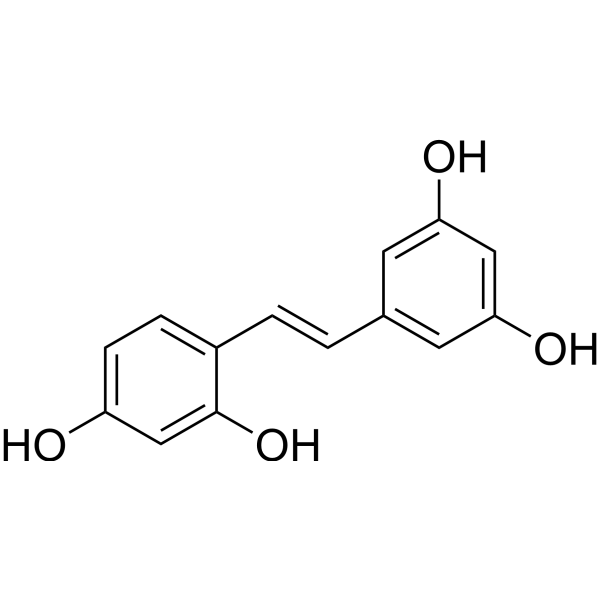
Physicochemical Properties
| Molecular Formula | C14H12O4 |
| Molecular Weight | 244.2427 |
| Exact Mass | 244.073 |
| CAS # | 29700-22-9 |
| PubChem CID | 5281717 |
| Appearance | Light yellow to khaki solid powder |
| Density | 1.5±0.1 g/cm3 |
| Boiling Point | 523.8±30.0 °C at 760 mmHg |
| Melting Point | 201ºC |
| Flash Point | 260.8±19.2 °C |
| Vapour Pressure | 0.0±1.4 mmHg at 25°C |
| Index of Refraction | 1.801 |
| LogP | 3.17 |
| Hydrogen Bond Donor Count | 4 |
| Hydrogen Bond Acceptor Count | 4 |
| Rotatable Bond Count | 2 |
| Heavy Atom Count | 18 |
| Complexity | 282 |
| Defined Atom Stereocenter Count | 0 |
| SMILES | C1=CC(=C(C=C1O)O)/C=C/C2=CC(=CC(=C2)O)O |
| InChi Key | PDHAOJSHSJQANO-OWOJBTEDSA-N |
| InChi Code | InChI=1S/C14H12O4/c15-11-4-3-10(14(18)8-11)2-1-9-5-12(16)7-13(17)6-9/h1-8,15-18H/b2-1+ |
| Chemical Name | 4-[(E)-2-(3,5-dihydroxyphenyl)ethenyl]benzene-1,3-diol |
| Synonyms | Oxyresveratrol; 29700-22-9; Hydroxyresveratrol; Tetrahydroxystilbene; (E)-4-(3,5-Dihydroxystyryl)benzene-1,3-diol; trans-oxyresveratrol; 4-[(E)-2-(3,5-dihydroxyphenyl)ethenyl]benzene-1,3-diol; 4721-07-7; |
| HS Tariff Code | 2934.99.9001 |
| Storage |
Powder-20°C 3 years 4°C 2 years In solvent -80°C 6 months -20°C 1 month |
| Shipping Condition | Room temperature (This product is stable at ambient temperature for a few days during ordinary shipping and time spent in Customs) |
Biological Activity
| Targets |
Tyrosinase (IC50 = 1.2 µM, for mushroom tyrosinase; HSV-1; HSV-2; varicella-zoster virus Tyrosinase (IC50 = 2.1 μM) [2] |
| ln Vitro |
The inducible isoform of nitric oxide synthase (iNOS) was expressed, and cultures of the mouse microglial cell line N9 and primary mixed glial cell cultures were utilized to assess the effects of medications on NO generation. In mouse microglia, oxidized resveratrol dramatically lowers NO (nitrite) levels (IC50 of 45.31 µM) [1]. Oxidized resveratrol can inhibit dopa oxidase activity, cyclooxygenase, and rat liver mitochondrial ATPase activity [1]. At 100 µM, oxyresveratrol reduced mouse tyrosinase activity by 63.3%, with an IC50 value of 52.7 µM. Oxyresveratrol has a dose-dependent inhibitory impact on L-tyrosine oxidation by mouse tyrosinase but does not decrease the promoter activity of the enzyme gene. Oxidized resveratrol at doses of 10 µM and higher has a considerable inhibitory effect on mouse tyrosinase activity [2]. Oxyresveratrol exhibited potent antioxidant and free radical scavenging activity. It scavenged superoxide anion (O₂⁻), hydroxyl radical (·OH), and nitric oxide (NO) with IC50 values of 3.8 μM, 2.5 μM, and 4.1 μM respectively. In LPS-stimulated BV-2 microglial cells, it dose-dependently reduced ROS and NO production by 30–80% at concentrations of 1–10 μM [1] It showed competitive inhibitory activity against tyrosinase, with an IC50 of 2.1 μM. In B16 murine melanoma cells, 10 μM Oxyresveratrol reduced melanin synthesis by 62% and tyrosinase activity by 58% compared to the control [2] In PC12 cells subjected to oxygen-glucose deprivation (OGD), Oxyresveratrol (5–20 μM) dose-dependently improved cell viability by 35–50% and reduced caspase-3 activation by 40–65%, inhibiting apoptotic cell death [3] It exhibited anti-HSV-1 activity in Vero cells, inhibiting viral replication with an IC50 of 4.2 μM. At 10 μM, it reduced HSV-1 plaque formation by 70% and viral DNA synthesis by 68% [4] |
| ln Vivo |
In MCAO rats, oxidized resveratrol treatment (2–30 mg/kg; intraperitoneally; twice) decreased the amount of the cerebral infarct. When oxidized resveratrol is administered, the ischemic brain of MCAO rats exhibits less caspase-3 activation, less cytochrome C release, and fewer apoptotic nuclei [3]. Anti-herpes simplex virus (HSV) activities of oxyresveratrol in vitro and topical administration in cutaneous HSV-1 infection in mice were examined. The inhibitory concentrations for 50% plaque formation (IC(50)) of oxyresveratrol against HSV-1 clinical isolates and HSV-2 clinical isolates were 20.9-29.5 and 22.2-27.5 μg/ml, respectively. In topical administration in cutaneous HSV-1 infection in mice, 2.5%, 5%, 10% and 20% oxyresveratrol in cream vehicle applied three times daily for 7 days after infection were evaluated and 10% and 20% oxyresveratrol cream were significantly effective in delaying the development of skin lesions and protection from death (P < 0.01). The concentration of 10% oxyresveratrol in cream was significantly more effective than that of 30% oxyresveratrol in vaseline applied three times daily (P < 0.01). Oxyresveratrol cream at 20% was as effective as 5% ACV cream applied three times daily (P < 0.01). Both 10% and 20% oxyresveratrol cream were as effective as that of 5% ACV cream applied two times daily (P > 0.05). Therapeutic efficacy of oxyresveratrol in cream vehicle was dose-dependent and the maximum efficacy observed on day 6 after infection was shown at 10% oxyresveratrol in cream applied three times daily. The frequency of application of 10% oxyresveratrol cream at three, four and five times daily was as effective as that of 5% ACV cream applied five times daily (P > 0.05). These results demonstrated that topical administration of oxyresveratrol in novel cream vehicle reduced the concentration of oxyresveratrol to 10% and was suitable for cutaneous HSV infection.[4] In a mouse model of transient cerebral ischemia (middle cerebral artery occlusion, MCAO), intraperitoneal injection of Oxyresveratrol (10 mg/kg) immediately after reperfusion reduced cerebral infarct volume by 40% compared to the vehicle control. Histological analysis showed a 55% increase in surviving neurons in the ischemic penumbra and reduced apoptotic cells (detected by TUNEL staining) [3] In a mouse model of cutaneous HSV-1 infection, topical application of cream containing 1% or 3% Oxyresveratrol (twice daily for 7 days) reduced viral load in skin lesions by 45% (1% concentration) and 65% (3% concentration) compared to the vehicle control. The 3% concentration also shortened ulcer healing time by 3 days and alleviated skin inflammation [4] |
| Enzyme Assay |
Tyrosinase is responsible for the molting process in insects, undesirable browning of fruits and vegetables, and coloring of skin, hair, and eyes in animals. To clarify the mechanism of the depigmenting property of hydroxystilbene compounds, inhibitory actions of oxyresveratrol and its analogs on tyrosinases from mushroom and murine melanoma B-16 have been elucidated in this study. Oxyresveratrol showed potent inhibitory effect with an IC(50) value of 1.2 microm on mushroom tyrosinase activity, which was 32-fold stronger inhibition than kojic acid, a depigmenting agent used as the cosmetic material with skin-whitening effect and the medical agent for hyperpigmentation disorders. Hydroxystilbene compounds of resveratrol, 3,5-dihydroxy-4'-methoxystilbene, and rhapontigenin also showed more than 50% inhibition at 100 microm on mushroom tyrosinase activity, but other methylated or glycosylated hydroxystilbenes of 3,4'-dimethoxy-5-hydroxystilbene, trimethylresveratrol, piceid, and rhaponticin did not inhibit significantly. None of the hydroxystilbene compounds except oxyresveratrol exhibited more than 50% inhibition at 100 microm on l-tyrosine oxidation by murine tyrosinase activity; oxyresveratrol showed an IC(50) value of 52.7 microm on the enzyme activity. The kinetics and mechanism for inhibition of mushroom tyrosinase exhibited the reversibility of oxyresveratrol as a noncompetitive inhibitor with l-tyrosine as the substrate. The interaction between oxyresveratrol and tyrosinase exhibited a high affinity reflected in a K(i) value of 3.2-4.2 x 10(-7) m. Oxyresveratrol did not affect the promoter activity of the tyrosinase gene in murine melanoma B-16 at 10 and 100 microm. Therefore, the depigmenting effect of oxyresveratrol works through reversible inhibition of tyrosinase activity rather than suppression of the expression and synthesis of the enzyme. The number and position of hydroxy substituents seem to play an important role in the inhibitory effects of hydroxystilbene compounds on tyrosinase activity.[2] For tyrosinase activity assay, recombinant tyrosinase was incubated with serial concentrations of Oxyresveratrol (0.1–10 μM) in assay buffer at 37°C for 15 minutes. L-DOPA substrate was added to initiate the reaction, and absorbance at 475 nm was measured after 30 minutes. Inhibition rate was calculated, and IC50 was determined by nonlinear regression. Kinetic analysis confirmed competitive inhibition by measuring enzyme activity at different substrate concentrations [2] |
| Cell Assay |
Hydroxystilbenes are naturally occurring polyphenols with protective effects against reactive oxygen and nitrogen species (ROS/RNS). Here, we investigated oxyresveratrol (OXY), which is contained in high amounts in mulberry wood, in comparison to the antioxidant resveratrol (RES). We found that OXY is a more effective scavenger for 2,2-diphenyl-1-picryl-hydrazyl (DPPH, 100 microM) used as a general free radical model, compared to RES or trans-4-hydroxystilbene (IC(50)=28.9, 38.5, and 39.6 microM, respectively). When primary glial cell cultures were loaded with the ROS/RNS-sensitive fluorochrome 2,7-dichlorodihydrofluorescein, the lowest rise in the fluorescence signal after H(2)O(2) exposure was seen when the cells were pretreated with OXY. Using 4,5-diaminofluorescein (DAF-2) to monitor free nitric oxide levels (7.7 microM NO) in a spectrofluorimetric cell-free assay, we found again that OXY (at 5 microM) is a more effective scavenger. Accordingly, cultures of the murine microglial cell line N9 and primary mixed glial cultures were used to test the drug effects of NO production upon expression of the inducible isoform of nitric oxide synthase (iNOS). We found that both compounds considerably diminished NO (nitrite) levels, RES more effectively than OXY (IC(50)=22.36 and 45.31 microM). RES but not OXY down-regulated the expression of iNOS protein, but both did not alter iNOS activity. Furthermore, OXY displayed a generally lower cytotoxicity than RES. The radical and ROS scavenging properties, as well as the lower cytotoxicity towards microglia and the known good water solubility suggest OXY as a potential protectant against ROS/RNS.[1] BV-2 microglial cells were seeded and incubated until 70% confluence. Cells were pre-treated with Oxyresveratrol (1, 5, 10 μM) for 1 hour, then stimulated with LPS for 24 hours. Intracellular ROS was detected using a fluorescent probe, and NO production was measured by Griess reagent [1] B16 melanoma cells were cultured to 80% confluence and treated with Oxyresveratrol (2.5, 5, 10 μM) for 72 hours. Tyrosinase activity was assayed using L-DOPA as substrate, and melanin content was quantified by dissolving cells in NaOH and measuring absorbance at 405 nm [2] PC12 cells were subjected to OGD for 4 hours, then reoxygenated and treated with Oxyresveratrol (5, 10, 20 μM) for 24 hours. Cell viability was assessed by MTT assay, and caspase-3 activity was measured using a fluorescent assay kit [3] Vero cells were seeded in 6-well plates and infected with HSV-1 (MOI = 0.1) for 1 hour. After removing unbound virus, Oxyresveratrol (1–20 μM) was added, and cells were incubated for 48 hours. Viral plaques were stained and counted, and viral DNA was extracted for quantitative analysis [4] |
| Animal Protocol |
Animal/Disease Models: Adult male Wistar rat (300-350 g), middle cerebral artery occlusion (MCAO) [3] Doses: 2 mg/kg, 10 mg/kg, 20 mg/kg and 30 mg/kg Route of Administration: intraperitoneal (ip) injection; intraperitoneal (ip) injection. Two times (during occlusion and during reperfusion) Experimental Results: diminished cerebral infarct volume in MCAO rats. Oxidative stress is one of the major pathological factors in the cascade that leads to cell death in cerebral ischemia. Here, we investigated the neuroprotective effect of a naturally occurring antioxidant, oxyresveratrol, to reduce brain injury after cerebral stroke. We used the transient rat middle cerebral artery occlusion (MCAO) model of brain ischemia to induce a defined brain infarction. Oxyresveratrol was given twice intraperitoneally: immediately after occlusion and at the time of reperfusion. Oxyresveratrol (10 or 20 mg/kg) significantly reduced the brain infarct volume by approximately 54% and 63%, respectively, when compared to vehicle-treated MCAO rats. Also, the neurological deficits as assessed by different scoring methods improved in oxyresveratrol-treated MCAO rats. Histological analysis of apoptotic markers in the ischemic brain area revealed that oxyresveratrol treatment diminished cytochrome c release and decreased caspase-3 activation in MCAO rats. Also, staining for apoptotic DNA showed that the number of apoptotic nuclei in ischemic brain was reduced after oxyresveratrol treatment as compared to the vehicle-treated MCAO rats. This dose-dependent neuroprotective effect of oxyresveratrol in an in vivo stroke model demonstrates that this drug may prove to be beneficial for a therapeutic strategy to limit brain injury in acute brain ischemia.[3] For transient cerebral ischemia model, male C57BL/6 mice (8–10 weeks old) were anesthetized, and MCAO was induced by intraluminal suture occlusion for 2 hours. After reperfusion, mice were randomly divided into two groups (n=10 per group): vehicle control and Oxyresveratrol-treated (10 mg/kg, intraperitoneal injection). Twenty-four hours later, mice were sacrificed, brains were sectioned, and infarct volume was measured by TTC staining. Apoptotic cells were detected by TUNEL assay [3] For cutaneous HSV-1 infection model, female BALB/c mice (6–8 weeks old) were anesthetized, and the dorsal skin was scratched (5 mm × 5 mm). HSV-1 suspension was applied to the scratched area. Twenty-four hours post-infection, mice were randomly divided into three groups (n=8 per group): vehicle cream, 1% Oxyresveratrol cream, and 3% Oxyresveratrol cream. Creams were applied topically twice daily for 7 days. Skin lesions were photographed daily, and viral load was quantified by plaque assay of skin homogenates [4] |
| References |
[1]. Oxyresveratrol and resveratrol are potent antioxidants and free radical scavengers: Effect on nitrosative and oxidative stress derived from microglial cells. Nitric Oxide 9(2) 64-76 (2003). [2]. Oxyresveratrol and hydroxystilbene compounds. Inhbitory effect on tyrosinase and mechanism of action. J Biol Chem277(18) 16340-16344 (2002). [3]. Oxyresveratrol (trans-2,3′,4,5′-tetrahydroxystilbene) is neuroprotective and inhibits the apoptotic cell death in transient cerebral ischemia. Brain Res, 2004 Aug 13, 1017(1-2):98-107. [4]. Topical cream-based oxyresveratrol in the treatment of cutaneous HSV-1 infection in mice. Antiviral Res. 2011 Aug;91(2):154-60. |
| Additional Infomation |
Oxyresveratrol is a stilbenoid. Oxyresveratrol has been reported in Maclura pomifera, Gnetum montanum, and other organisms with data available. Oxyresveratrol is a natural polyphenolic compound found in plants such as Polygonum cuspidatum and Morus alba [1][2][3][4] Its antioxidant mechanism involves direct scavenging of reactive oxygen/nitrogen species and enhancing the activity of endogenous antioxidant enzymes [1] As a competitive tyrosinase inhibitor, it blocks melanin biosynthesis by binding to the enzyme's active site [2] Its neuroprotective effect is associated with inhibiting apoptotic signaling pathways (e.g., caspase-3 activation) in ischemic neurons [3] Its anti-HSV-1 activity may involve blocking viral entry or replication cycle, without affecting host cell viability at effective concentrations [4] |
Solubility Data
| Solubility (In Vitro) | DMSO : ~50 mg/mL (~204.72 mM) |
| Solubility (In Vivo) |
Solubility in Formulation 1: ≥ 2.5 mg/mL (10.24 mM) (saturation unknown) in 10% DMSO + 40% PEG300 + 5% Tween80 + 45% Saline (add these co-solvents sequentially from left to right, and one by one), clear solution. For example, if 1 mL of working solution is to be prepared, you can add 100 μL of 25.0 mg/mL clear DMSO stock solution to 400 μL PEG300 and mix evenly; then add 50 μL Tween-80 to the above solution and mix evenly; then add 450 μL normal saline to adjust the volume to 1 mL. Preparation of saline: Dissolve 0.9 g of sodium chloride in 100 mL ddH₂ O to obtain a clear solution. Solubility in Formulation 2: ≥ 2.5 mg/mL (10.24 mM) (saturation unknown) in 10% DMSO + 90% (20% SBE-β-CD in Saline) (add these co-solvents sequentially from left to right, and one by one), clear solution. For example, if 1 mL of working solution is to be prepared, you can add 100 μL of 25.0 mg/mL clear DMSO stock solution to 900 μL of 20% SBE-β-CD physiological saline solution and mix evenly. Preparation of 20% SBE-β-CD in Saline (4°C,1 week): Dissolve 2 g SBE-β-CD in 10 mL saline to obtain a clear solution. Solubility in Formulation 3: ≥ 2.5 mg/mL (10.24 mM) (saturation unknown) in 10% DMSO + 90% Corn Oil (add these co-solvents sequentially from left to right, and one by one), clear solution. For example, if 1 mL of working solution is to be prepared, you can add 100 μL of 25.0 mg/mL clear DMSO stock solution to 900 μL of corn oil and mix evenly. (Please use freshly prepared in vivo formulations for optimal results.) |
| Preparing Stock Solutions | 1 mg | 5 mg | 10 mg | |
| 1 mM | 4.0943 mL | 20.4717 mL | 40.9433 mL | |
| 5 mM | 0.8189 mL | 4.0943 mL | 8.1887 mL | |
| 10 mM | 0.4094 mL | 2.0472 mL | 4.0943 mL |