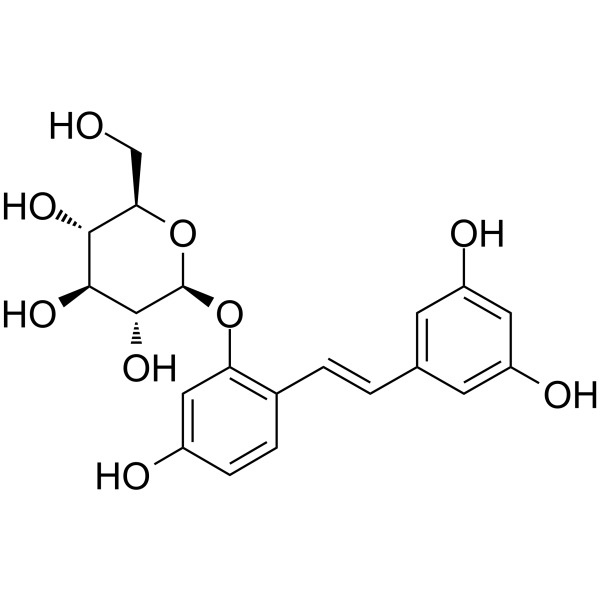
Physicochemical Properties
| Molecular Formula | C₂₀H₂₂O₉ |
| Molecular Weight | 406.38 |
| Exact Mass | 406.126 |
| CAS # | 392274-22-5 |
| PubChem CID | 11058597 |
| Appearance | White to off-white solid powder |
| Density | 1.6±0.1 g/cm3 |
| Boiling Point | 738.9±60.0 °C at 760 mmHg |
| Flash Point | 400.7±32.9 °C |
| Vapour Pressure | 0.0±2.6 mmHg at 25°C |
| Index of Refraction | 1.761 |
| LogP | 0.43 |
| Hydrogen Bond Donor Count | 7 |
| Hydrogen Bond Acceptor Count | 9 |
| Rotatable Bond Count | 5 |
| Heavy Atom Count | 29 |
| Complexity | 534 |
| Defined Atom Stereocenter Count | 5 |
| SMILES | C1=CC(=C(C=C1O)O[C@H]2[C@@H]([C@H]([C@@H]([C@H](O2)CO)O)O)O)/C=C/C3=CC(=CC(=C3)O)O |
| InChi Key | UPUMEBJDZQEUFC-CUYWLFDKSA-N |
| InChi Code | InChI=1S/C20H22O9/c21-9-16-17(25)18(26)19(27)20(29-16)28-15-8-12(22)4-3-11(15)2-1-10-5-13(23)7-14(24)6-10/h1-8,16-27H,9H2/b2-1+/t16-,17-,18+,19-,20-/m1/s1 |
| Chemical Name | (2S,3R,4S,5S,6R)-2-[2-[(E)-2-(3,5-dihydroxyphenyl)ethenyl]-5-hydroxyphenoxy]-6-(hydroxymethyl)oxane-3,4,5-triol |
| Synonyms | Oxyresveratrol 2OβDglucopyranoside; Oxyresveratrol 2-O-beta-D-glucopyranoside; 392274-22-5; (2S,3R,4S,5S,6R)-2-[2-[(E)-2-(3,5-dihydroxyphenyl)ethenyl]-5-hydroxyphenoxy]-6-(hydroxymethyl)oxane-3,4,5-triol; Oxyresveratrol 2-O-; A-D-glucopyranoside; (2S,3R,4S,5S,6R)-2-(2-((E)-2-(3,5-dihydroxyphenyl)ethenyl)-5-hydroxyphenoxy)-6-(hydroxymethyl)oxane-3,4,5-triol; Oxyresveratrol 2 O β D glucopyranoside |
| HS Tariff Code | 2934.99.9001 |
| Storage |
Powder-20°C 3 years 4°C 2 years In solvent -80°C 6 months -20°C 1 month Note: This product requires protection from light (avoid light exposure) during transportation and storage. |
| Shipping Condition | Room temperature (This product is stable at ambient temperature for a few days during ordinary shipping and time spent in Customs) |
Biological Activity
| Targets | Tyrosinase (IC50 = 29.75 μM) |
| ln Vitro | The phytochemical profiles of Morus nigra roots and twigs were compared by HPLC with those of the old and young twigs of Morus alba which are known to contain oxyresveratrol and mulberroside A as major components. It was found that M. nigra root extract contains some unknown natural products with potential tyrosinase inhibitory activity. The extract (95% ethanol) of the roots of M. nigra was further investigated in this study. One new compound, 5'-geranyl-5,7,2',4'-tetrahydroxyflavone, and twenty-eight known phenolic compounds were isolated. Their structures were identified by mass spectrometry and NMR spectroscopy. Nine compounds, 5'-geranyl-5,7,2',4'-tetrahydroxyflavone, steppogenin-7-O-beta-D-glucoside, 2,4,2',4'-tetrahydroxychalcone, moracin N, kuwanon H, mulberrofuran G, morachalcone A, oxyresveratrol-3'-O-beta-D-glucopyranoside and oxyresveratrol-2-O-beta-D-glucopyranoside, showed better tyrosinase inhibitory activities than kojic acid. It was noteworthy that the IC(50) values of 2,4,2',4'-tetrahydroxychalcone and morachalcone A were 757-fold and 328-fold lower than that of kojic acid, respectively, suggesting a great potential for their development as effective natural tyrosinase inhibitors.[1] |
| References |
[1]. Tyrosinase inhibitory constituents from the roots of Morus nigra: a structure-activity relationship study. J Agric Food Chem. 2010;58(9):5368-5373. |
| Additional Infomation | Oxyresveratrol 2-O-beta-D-glucopyranoside has been reported in Morus alba, Morus nigra, and Schoenocaulon officinale with data available. |
Solubility Data
| Solubility (In Vitro) | DMSO : ~100 mg/mL (~246.08 mM) |
| Solubility (In Vivo) |
Solubility in Formulation 1: ≥ 2.5 mg/mL (6.15 mM) (saturation unknown) in 10% DMSO + 40% PEG300 + 5% Tween80 + 45% Saline (add these co-solvents sequentially from left to right, and one by one), clear solution. For example, if 1 mL of working solution is to be prepared, you can add 100 μL of 25.0 mg/mL clear DMSO stock solution to 400 μL PEG300 and mix evenly; then add 50 μL Tween-80 to the above solution and mix evenly; then add 450 μL normal saline to adjust the volume to 1 mL. Preparation of saline: Dissolve 0.9 g of sodium chloride in 100 mL ddH₂ O to obtain a clear solution. Solubility in Formulation 2: ≥ 2.5 mg/mL (6.15 mM) (saturation unknown) in 10% DMSO + 90% (20% SBE-β-CD in Saline) (add these co-solvents sequentially from left to right, and one by one), clear solution. For example, if 1 mL of working solution is to be prepared, you can add 100 μL of 25.0 mg/mL clear DMSO stock solution to 900 μL of 20% SBE-β-CD physiological saline solution and mix evenly. Preparation of 20% SBE-β-CD in Saline (4°C,1 week): Dissolve 2 g SBE-β-CD in 10 mL saline to obtain a clear solution. Solubility in Formulation 3: ≥ 2.5 mg/mL (6.15 mM) (saturation unknown) in 10% DMSO + 90% Corn Oil (add these co-solvents sequentially from left to right, and one by one), clear solution. For example, if 1 mL of working solution is to be prepared, you can add 100 μL of 25.0 mg/mL clear DMSO stock solution to 900 μL of corn oil and mix evenly. (Please use freshly prepared in vivo formulations for optimal results.) |
| Preparing Stock Solutions | 1 mg | 5 mg | 10 mg | |
| 1 mM | 2.4608 mL | 12.3038 mL | 24.6075 mL | |
| 5 mM | 0.4922 mL | 2.4608 mL | 4.9215 mL | |
| 10 mM | 0.2461 mL | 1.2304 mL | 2.4608 mL |