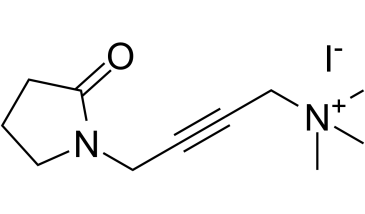
Oxotremorine M iodide is a novel, potent and selective muscarinic acetylcholine receptor (mAChR) agonist. Oxotremorine M iodide increases the potency of NMDA receptors through both independent and dependent muscarinic receptor mechanisms.
Physicochemical Properties
| Molecular Formula | C₁₁H₁₉IN₂O |
| Molecular Weight | 303.0345 |
| Exact Mass | 322.054 |
| Elemental Analysis | C, 41.01; H, 5.94; I, 39.39; N, 8.69; O, 4.97 |
| CAS # | 3854-04-4 |
| PubChem CID | 3027782 |
| Appearance | Light yellow to yellow solid powder |
| Hydrogen Bond Donor Count | 0 |
| Hydrogen Bond Acceptor Count | 2 |
| Rotatable Bond Count | 2 |
| Heavy Atom Count | 15 |
| Complexity | 277 |
| Defined Atom Stereocenter Count | 0 |
| SMILES | C[N+](C)(C)CC#CCN1CCCC1=O.[I-] |
| InChi Key | VVLMSCJCXMBGDI-UHFFFAOYSA-M |
| InChi Code | InChI=1S/C11H19N2O.HI/c1-13(2,3)10-5-4-8-12-9-6-7-11(12)14;/h6-10H2,1-3H3;1H/q+1;/p-1 |
| Chemical Name | trimethyl-[4-(2-oxopyrrolidin-1-yl)but-2-ynyl]azanium;iodide |
| Synonyms | Oxotremorine M |
| HS Tariff Code | 2934.99.9001 |
| Storage |
Powder-20°C 3 years 4°C 2 years In solvent -80°C 6 months -20°C 1 month Note: Please store this product in a sealed and protected environment, avoid exposure to moisture. |
| Shipping Condition | Room temperature (This product is stable at ambient temperature for a few days during ordinary shipping and time spent in Customs) |
Biological Activity
| ln Vitro |
Oxotremorine M iodide (0.1, 0.3, 1, 3, 10, 30 μM) reduces the concentration-dependent KCNQ2/3 currents[2]. Oxotremorine M iodide Phosphoinositide response to iodide is strong and has an EC50 of 0.22 μM. In mice lacking M2, M3, and M2/M3 genes, oxotremorine M iodide EC50 values are 0.36, 0.52, 1.62, and 1.48 μM, respectively[3]. |
| ln Vivo | Oxotremorine M iodide (0.5 mg/kg; s.c.) increases dopamine (DA) release in the medial prefrontal cortex (mPFC) but has no effect in the nucleus accumbens (NAC) in male Sprague-Dawley albino rats weighing 250-350 g[4]. |
| References |
[1]. Oxotremorine-M potentiates NMDA receptors by muscarinic receptor dependent and independentmechanisms. Biochem Biophys Res Commun. 2018 Jan 1;495(1):481-486. [2]. A novel muscarinic receptor-independent mechanism of KCNQ2/3 potassium channel blockadeby Oxotremorine-M. Eur J Pharmacol. 2016 Nov 15;791:221-228. [3]. Differential coupling of muscarinic M1, M2, and M3 receptors to phosphoinositide hydrolysis in urinary bladder and longitudinal muscle of the ileum of the mouse. J Pharmacol Exp Ther. 2006 Aug;318(2):649-56. Epub 2006 May 4. [4]. Cholinergic modulation of basal and amphetamine-induced dopamine release in rat medial prefrontal cortex and nucleus accumbens. Brain Res. 2002 Dec 20;958(1):176-84. |
Solubility Data
| Solubility (In Vitro) |
DMSO: ~125 mg/mL (~388.0 mM) H2O: ~8.3 mg/mL (~25.9 mM) |
| Solubility (In Vivo) |
Solubility in Formulation 1: ≥ 2.08 mg/mL (6.46 mM) (saturation unknown) in 10% DMSO + 40% PEG300 + 5% Tween80 + 45% Saline (add these co-solvents sequentially from left to right, and one by one), clear solution. For example, if 1 mL of working solution is to be prepared, you can add 100 μL of 20.8 mg/mL clear DMSO stock solution to 400 μL PEG300 and mix evenly; then add 50 μL Tween-80 to the above solution and mix evenly; then add 450 μL normal saline to adjust the volume to 1 mL. Preparation of saline: Dissolve 0.9 g of sodium chloride in 100 mL ddH₂ O to obtain a clear solution. Solubility in Formulation 2: ≥ 2.08 mg/mL (6.46 mM) (saturation unknown) in 10% DMSO + 90% (20% SBE-β-CD in Saline) (add these co-solvents sequentially from left to right, and one by one), clear solution. For example, if 1 mL of working solution is to be prepared, you can add 100 μL of 20.8 mg/mL clear DMSO stock solution to 900 μL of 20% SBE-β-CD physiological saline solution and mix evenly. Preparation of 20% SBE-β-CD in Saline (4°C,1 week): Dissolve 2 g SBE-β-CD in 10 mL saline to obtain a clear solution. Solubility in Formulation 3: ≥ 2.08 mg/mL (6.46 mM) (saturation unknown) in 10% DMSO + 90% Corn Oil (add these co-solvents sequentially from left to right, and one by one), clear solution. For example, if 1 mL of working solution is to be prepared, you can add 100 μL of 20.8 mg/mL clear DMSO stock solution to 900 μL of corn oil and mix evenly. Solubility in Formulation 4: 7.14 mg/mL (22.16 mM) in PBS (add these co-solvents sequentially from left to right, and one by one), clear solution; with ultrasonication (<60°C). (Please use freshly prepared in vivo formulations for optimal results.) |
| Preparing Stock Solutions | 1 mg | 5 mg | 10 mg | |
| 1 mM | 3.3000 mL | 16.5000 mL | 33.0000 mL | |
| 5 mM | 0.6600 mL | 3.3000 mL | 6.6000 mL | |
| 10 mM | 0.3300 mL | 1.6500 mL | 3.3000 mL |