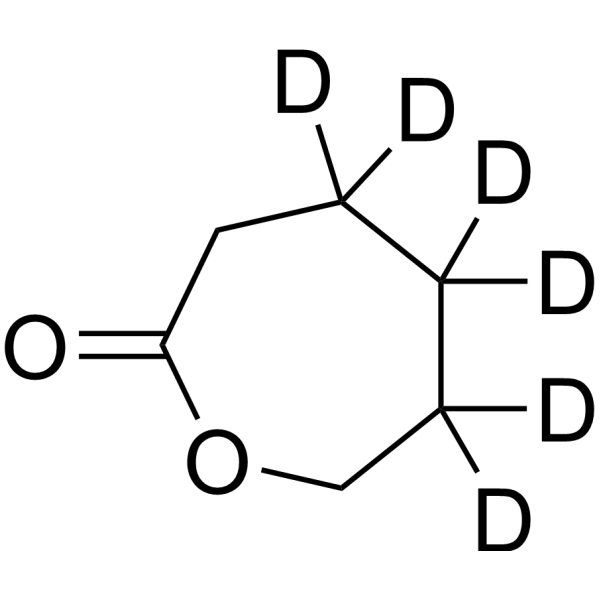
Physicochemical Properties
| Molecular Formula | C6H4D6O2 |
| Molecular Weight | 120.18 |
| Exact Mass | 120.105 |
| CAS # | 1219802-08-0 |
| Related CAS # | 24980-41-4 |
| PubChem CID | 10401 |
| Appearance | Typically exists as solid at room temperature |
| Density | 1.0±0.1 g/cm3 |
| Boiling Point | 225.4±8.0 °C at 760 mmHg |
| Melting Point | -1.5 °C |
| Flash Point | 109.4±0.0 °C |
| Vapour Pressure | 0.1±0.4 mmHg at 25°C |
| Index of Refraction | 1.439 |
| LogP | 0.36 |
| Hydrogen Bond Donor Count | 0 |
| Hydrogen Bond Acceptor Count | 2 |
| Rotatable Bond Count | 0 |
| Heavy Atom Count | 8 |
| Complexity | 88.5 |
| Defined Atom Stereocenter Count | 0 |
| SMILES | C1(OCCC([2H])([2H])C([2H])([2H])C1([2H])[2H])=O |
| InChi Key | PAPBSGBWRJIAAV-UHFFFAOYSA-N |
| InChi Code | InChI=1S/C6H10O2/c7-6-4-2-1-3-5-8-6/h1-5H2 |
| Chemical Name | oxepan-2-one |
| HS Tariff Code | 2934.99.9001 |
| Storage |
Powder-20°C 3 years 4°C 2 years In solvent -80°C 6 months -20°C 1 month |
| Shipping Condition | Room temperature (This product is stable at ambient temperature for a few days during ordinary shipping and time spent in Customs) |
Biological Activity
| ln Vitro | Drug compounds have included stable heavy isotopes of carbon, hydrogen, and other elements, mostly as quantitative tracers while the drugs were being developed. Because deuteration may have an effect on a drug's pharmacokinetics and metabolic properties, it is a cause for concern [1]. |
| References |
[1]. Impact of Deuterium Substitution on the Pharmacokinetics of Pharmaceuticals. Ann Pharmacother. 2019 Feb;53(2):211-216. |
| Additional Infomation |
Hexano-6-lactone is a epsilon-lactone that is oxepane substituted by an oxo group at position 2. See also: Poliglecaprone 25 (monomer of); Poliglecaprone 90 (monomer of); Polycaprolactone (annotation moved to). Mechanism of Action CAPROLACTONE INHIBITED PROTEOLYTIC & FIBRINOLYTIC ACTIVITIES OF HUMAN PLASMIN. IN VERY LOW CONCN, IT ALSO INHIBITED ACTIVATION OF PLASMINOGEN THROUGH PLASMIN-STREPTOKINASE ACTIVATOR & HUMAN UROKINASE. Therapeutic Uses The incorporation of estramustine into biodegradable waxy type copolyesters, prepared by direct copolycondensation of epsilon-caprolactone and delta-valerolactone in the absence of catalysts, to apply as implantable matrices for drug delivery systems, is described and the in vivo capability of the implantable device was evaluated by implanting into the back of male rats. The copolyesters are much more subject to erosion than their homopolyesters, in which the degradation is further accelerated by the action of lipase type enzyme. The drug release, although accompanying a burst phenomenon in the initial stage, was kept constant throughout an experimental period of 19 wk from the first to twentieth wk. In this case, the release pattern was parallel to the degradation pattern, in support of the release being the rate-limiting step in the degradation of the polymer. The results showed about 75% of the initial drug content was still present in the device even after 20 wk of implantation. This finding means that the biodegradable poly(epsilon-caprolactone-co-delta-valerolactone) wax is useful as an implantable matrix for a drug delivery system which controls the release over a relatively long period of time. The in vivo activity of the drug was demonstrated by observing atrophy of the seminal vesicles and ventral prostate in male rats 10 wk after implantation. The release of levonorgestrel from a poly(epsilon-caprolactone) capsule implanted subdermally in 8 women was studied over 5 menstrual cycles. All subjects except one experienced suppression of ovulation while the capsule was in place (one cycle). The capsules contained 16 mg of drug and 61 mg of ethyl oleate as a suspending vehicle. There was a wide range of serum levels of the drug. Suppression of ovulation appeared to occur at a serum level of 300 pg/ml or greater. |
Solubility Data
| Solubility (In Vivo) |
Note: Listed below are some common formulations that may be used to formulate products with low water solubility (e.g. < 1 mg/mL), you may test these formulations using a minute amount of products to avoid loss of samples. Injection Formulations (e.g. IP/IV/IM/SC) Injection Formulation 1: DMSO : Tween 80: Saline = 10 : 5 : 85 (i.e. 100 μL DMSO stock solution → 50 μL Tween 80 → 850 μL Saline) *Preparation of saline: Dissolve 0.9 g of sodium chloride in 100 mL ddH ₂ O to obtain a clear solution. Injection Formulation 2: DMSO : PEG300 :Tween 80 : Saline = 10 : 40 : 5 : 45 (i.e. 100 μL DMSO → 400 μLPEG300 → 50 μL Tween 80 → 450 μL Saline) Injection Formulation 3: DMSO : Corn oil = 10 : 90 (i.e. 100 μL DMSO → 900 μL Corn oil) Example: Take the Injection Formulation 3 (DMSO : Corn oil = 10 : 90) as an example, if 1 mL of 2.5 mg/mL working solution is to be prepared, you can take 100 μL 25 mg/mL DMSO stock solution and add to 900 μL corn oil, mix well to obtain a clear or suspension solution (2.5 mg/mL, ready for use in animals). Injection Formulation 4: DMSO : 20% SBE-β-CD in saline = 10 : 90 [i.e. 100 μL DMSO → 900 μL (20% SBE-β-CD in saline)] *Preparation of 20% SBE-β-CD in Saline (4°C,1 week): Dissolve 2 g SBE-β-CD in 10 mL saline to obtain a clear solution. Injection Formulation 5: 2-Hydroxypropyl-β-cyclodextrin : Saline = 50 : 50 (i.e. 500 μL 2-Hydroxypropyl-β-cyclodextrin → 500 μL Saline) Injection Formulation 6: DMSO : PEG300 : castor oil : Saline = 5 : 10 : 20 : 65 (i.e. 50 μL DMSO → 100 μLPEG300 → 200 μL castor oil → 650 μL Saline) Injection Formulation 7: Ethanol : Cremophor : Saline = 10: 10 : 80 (i.e. 100 μL Ethanol → 100 μL Cremophor → 800 μL Saline) Injection Formulation 8: Dissolve in Cremophor/Ethanol (50 : 50), then diluted by Saline Injection Formulation 9: EtOH : Corn oil = 10 : 90 (i.e. 100 μL EtOH → 900 μL Corn oil) Injection Formulation 10: EtOH : PEG300:Tween 80 : Saline = 10 : 40 : 5 : 45 (i.e. 100 μL EtOH → 400 μLPEG300 → 50 μL Tween 80 → 450 μL Saline) Oral Formulations Oral Formulation 1: Suspend in 0.5% CMC Na (carboxymethylcellulose sodium) Oral Formulation 2: Suspend in 0.5% Carboxymethyl cellulose Example: Take the Oral Formulation 1 (Suspend in 0.5% CMC Na) as an example, if 100 mL of 2.5 mg/mL working solution is to be prepared, you can first prepare 0.5% CMC Na solution by measuring 0.5 g CMC Na and dissolve it in 100 mL ddH2O to obtain a clear solution; then add 250 mg of the product to 100 mL 0.5% CMC Na solution, to make the suspension solution (2.5 mg/mL, ready for use in animals). Oral Formulation 3: Dissolved in PEG400 Oral Formulation 4: Suspend in 0.2% Carboxymethyl cellulose Oral Formulation 5: Dissolve in 0.25% Tween 80 and 0.5% Carboxymethyl cellulose Oral Formulation 6: Mixing with food powders Note: Please be aware that the above formulations are for reference only. InvivoChem strongly recommends customers to read literature methods/protocols carefully before determining which formulation you should use for in vivo studies, as different compounds have different solubility properties and have to be formulated differently. (Please use freshly prepared in vivo formulations for optimal results.) |
| Preparing Stock Solutions | 1 mg | 5 mg | 10 mg | |
| 1 mM | 8.3209 mL | 41.6043 mL | 83.2085 mL | |
| 5 mM | 1.6642 mL | 8.3209 mL | 16.6417 mL | |
| 10 mM | 0.8321 mL | 4.1604 mL | 8.3209 mL |