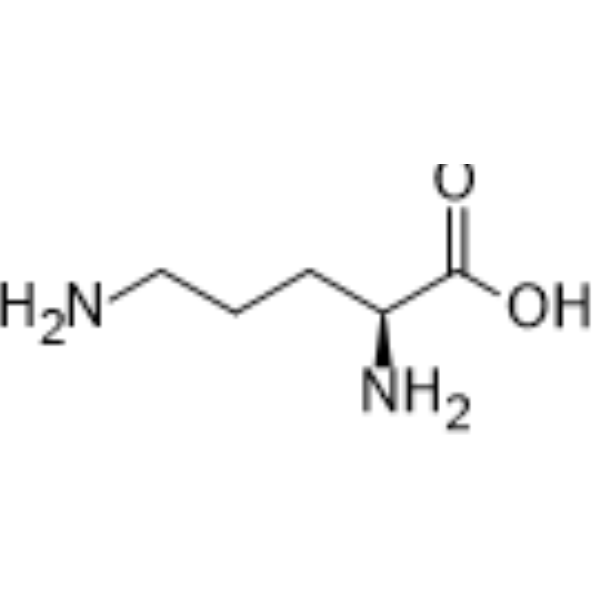
Physicochemical Properties
| Molecular Formula | C5H12N2O2 |
| Molecular Weight | 132.16098 |
| Exact Mass | 132.089 |
| CAS # | 70-26-8 |
| Related CAS # | L-Ornithine hydrochloride;3184-13-2 |
| PubChem CID | 6262 |
| Appearance | White to off-white solid powder |
| Density | 1.2±0.1 g/cm3 |
| Boiling Point | 308.7±32.0 °C at 760 mmHg |
| Melting Point | 140ºC |
| Flash Point | 140.5±25.1 °C |
| Vapour Pressure | 0.0±1.4 mmHg at 25°C |
| Index of Refraction | 1.508 |
| LogP | -0.96 |
| Hydrogen Bond Donor Count | 3 |
| Hydrogen Bond Acceptor Count | 4 |
| Rotatable Bond Count | 4 |
| Heavy Atom Count | 9 |
| Complexity | 95 |
| Defined Atom Stereocenter Count | 1 |
| SMILES | N[C@@H](CCCN)C(O)=O |
| InChi Key | AHLPHDHHMVZTML-BYPYZUCNSA-N |
| InChi Code | InChI=1S/C5H12N2O2/c6-3-1-2-4(7)5(8)9/h4H,1-3,6-7H2,(H,8,9)/t4-/m0/s1 |
| Chemical Name | (2S)-2,5-diaminopentanoic acid |
| HS Tariff Code | 2934.99.9001 |
| Storage |
Powder-20°C 3 years 4°C 2 years In solvent -80°C 6 months -20°C 1 month Note: Please store this product in a sealed and protected environment (e.g. under nitrogen), avoid exposure to moisture and light. |
| Shipping Condition | Room temperature (This product is stable at ambient temperature for a few days during ordinary shipping and time spent in Customs) |
Biological Activity
| ln Vitro | L-ornithine (0–10 mM) influences Ca2+ signaling in HK-2 cells and, in a concentration-dependent manner, activates CaSR [2]. In HK-2 cells, L-ornithine (10 mM) stimulates the Ca2+ entry pathway mediated by the TRPC channel [2]. Via the ROCE pathway, L-ornithine (100 or 300 μM; 24 hours) demonstrated a protective effect against ROS generation in HK-2 cells [2]. When H2O2 is exposed to HK-2 cells, L-ornithine (10 μM) guards against ROS and oxidative damage [2]. |
| ADME/Pharmacokinetics |
Absorption, Distribution and Excretion Absorbed from the small intestine via a sodium-dependent active transport process Metabolism / Metabolites Ornithine undergoes extensive metabolism in the liver to L-arginine, polyamines, and proline, and several other metabolites. Ornithine undergoes extensive metabolism in the liver to L-arginine, polyamines, and proline, and several other metabolites. |
| Toxicity/Toxicokinetics |
Toxicity Summary L-Ornithine is metabolised to L-arginine. L-arginine stimulates the pituitary release of growth hormone. Burns or other injuries affect the state of L-arginine in tissues throughout the body. As De novo synthesis of L-arginine during these conditions is usually not sufficient for normal immune function, nor for normal protein synthesis, L-ornithine may have immunomodulatory and wound-healing activities under these conditions (by virtue of its metabolism to L-arginine). Toxicity Data Oral, rat LD50 = 10000 mg/kg |
| References |
[1]. Effect of L-ornithine hydrochloride ingestion on intermittent maximal anaerobic cycle ergometer performance and fatigue recovery after exercise. Eur J Appl Physiol. 2011 Nov;111(11):2837-43. [2]. l-ornithine activates Ca2+ signaling to exert its protective function on human proximal tubular cells. Cell Signal. 2020 Mar;67:109484. |
| Additional Infomation |
L-ornithine is an optically active form of ornithine having L-configuration. It has a role as a hepatoprotective agent, an algal metabolite and a mouse metabolite. It is an ornithine and a non-proteinogenic L-alpha-amino acid. It is a conjugate base of a L-ornithinium(1+). It is a conjugate acid of a L-ornithinate. It is an enantiomer of a D-ornithine. Produced during the urea cycle, ornithine is an amino acid produced from the splitting off of urea from arginine. L-Ornithine allows for the disposal of excess nitrogen and acts as a precursor of citrulline and arginine. Ornithine is a metabolite found in or produced by Escherichia coli (strain K12, MG1655). L-Ornithine is a metabolite found in or produced by Escherichia coli (strain K12, MG1655). L-ornithine has been reported in Euphorbia prostrata, Glycine max, and other organisms with data available. Ornithine is a naturally occurring amino acid found in meat, fish, dairy and eggs. Ornithine is one of the key reactants in the urea cycle that is responsible for 80% of the nitrogen excretion in the body. Ornithine enhances liver function and helps detoxify harmful substances. Ornithine is an amino acid produced in the urea cycle by the splitting off of urea from arginine. It is a central part of the urea cycle, which allows for the disposal of excess nitrogen. L-Ornithine is also a precursor of citrulline and arginine. In order for ornithine produced in the cytosol to be converted to citrulline, it must first cross the inner mitochondrial membrane into the mitochondrial matrix where it is carbamylated by ornithine transcarbamylase. This transfer is mediated by the mitochondrial ornithine transporter (SLC25A15; AF112968; ORNT1). Mutations in the mitochondrial ornithine transporter result in hyperammonemia, hyperornithinemia, homocitrullinuria (HHH) syndrome, a disorder of the urea cycle. The pathophysiology of thef the disease may involve diminished ornithine transport into mitochondria, resulting in ornithine accumulation in the cytoplasm and reduced ability to clear carbamoyl phosphate and ammonia loads. (OMIM 838970). (A3420). An amino acid produced in the urea cycle by the splitting off of urea from arginine. See also: Lysine (annotation moved to). Drug Indication Used for nutritional supplementation, also for treating dietary shortage or imbalance. It has been claimed that ornithine improves athletic performance, has anabolic effects, has wound-healing effects, and is immuno-enhancing. Mechanism of Action L-Ornithine is metabolised to L-arginine. L-arginine stimulates the pituitary release of growth hormone. Burns or other injuries affect the state of L-arginine in tissues throughout the body. As De novo synthesis of L-arginine during these conditions is usually not sufficient for normal immune function, nor for normal protein synthesis, L-ornithine may have immunomodulatory and wound-healing activities under these conditions (by virtue of its metabolism to L-arginine). Pharmacodynamics A non-essential and nonprotein amino acid, ornithine is critical for the production of the body's proteins, enzymes and muscle tissue. Ornithine plays a central role in the urea cycle and is important for the disposal of excess nitrogen (ammonia). Ornithine is the starting point for the synthesis of many polyamines such as putrescine and spermine. Ornithine supplements are claimed to enhance the release of growth hormone and to burn excess body fat. Ornithine is necessary for proper immune function and good liver function. |
Solubility Data
| Solubility (In Vitro) |
H2O : ~50 mg/mL (~378.33 mM) DMSO : ~1.3 mg/mL (~9.84 mM) |
| Solubility (In Vivo) |
Note: Listed below are some common formulations that may be used to formulate products with low water solubility (e.g. < 1 mg/mL), you may test these formulations using a minute amount of products to avoid loss of samples. Injection Formulations (e.g. IP/IV/IM/SC) Injection Formulation 1: DMSO : Tween 80: Saline = 10 : 5 : 85 (i.e. 100 μL DMSO stock solution → 50 μL Tween 80 → 850 μL Saline) *Preparation of saline: Dissolve 0.9 g of sodium chloride in 100 mL ddH ₂ O to obtain a clear solution. Injection Formulation 2: DMSO : PEG300 :Tween 80 : Saline = 10 : 40 : 5 : 45 (i.e. 100 μL DMSO → 400 μLPEG300 → 50 μL Tween 80 → 450 μL Saline) Injection Formulation 3: DMSO : Corn oil = 10 : 90 (i.e. 100 μL DMSO → 900 μL Corn oil) Example: Take the Injection Formulation 3 (DMSO : Corn oil = 10 : 90) as an example, if 1 mL of 2.5 mg/mL working solution is to be prepared, you can take 100 μL 25 mg/mL DMSO stock solution and add to 900 μL corn oil, mix well to obtain a clear or suspension solution (2.5 mg/mL, ready for use in animals). Injection Formulation 4: DMSO : 20% SBE-β-CD in saline = 10 : 90 [i.e. 100 μL DMSO → 900 μL (20% SBE-β-CD in saline)] *Preparation of 20% SBE-β-CD in Saline (4°C,1 week): Dissolve 2 g SBE-β-CD in 10 mL saline to obtain a clear solution. Injection Formulation 5: 2-Hydroxypropyl-β-cyclodextrin : Saline = 50 : 50 (i.e. 500 μL 2-Hydroxypropyl-β-cyclodextrin → 500 μL Saline) Injection Formulation 6: DMSO : PEG300 : castor oil : Saline = 5 : 10 : 20 : 65 (i.e. 50 μL DMSO → 100 μLPEG300 → 200 μL castor oil → 650 μL Saline) Injection Formulation 7: Ethanol : Cremophor : Saline = 10: 10 : 80 (i.e. 100 μL Ethanol → 100 μL Cremophor → 800 μL Saline) Injection Formulation 8: Dissolve in Cremophor/Ethanol (50 : 50), then diluted by Saline Injection Formulation 9: EtOH : Corn oil = 10 : 90 (i.e. 100 μL EtOH → 900 μL Corn oil) Injection Formulation 10: EtOH : PEG300:Tween 80 : Saline = 10 : 40 : 5 : 45 (i.e. 100 μL EtOH → 400 μLPEG300 → 50 μL Tween 80 → 450 μL Saline) Oral Formulations Oral Formulation 1: Suspend in 0.5% CMC Na (carboxymethylcellulose sodium) Oral Formulation 2: Suspend in 0.5% Carboxymethyl cellulose Example: Take the Oral Formulation 1 (Suspend in 0.5% CMC Na) as an example, if 100 mL of 2.5 mg/mL working solution is to be prepared, you can first prepare 0.5% CMC Na solution by measuring 0.5 g CMC Na and dissolve it in 100 mL ddH2O to obtain a clear solution; then add 250 mg of the product to 100 mL 0.5% CMC Na solution, to make the suspension solution (2.5 mg/mL, ready for use in animals). Oral Formulation 3: Dissolved in PEG400 Oral Formulation 4: Suspend in 0.2% Carboxymethyl cellulose Oral Formulation 5: Dissolve in 0.25% Tween 80 and 0.5% Carboxymethyl cellulose Oral Formulation 6: Mixing with food powders Note: Please be aware that the above formulations are for reference only. InvivoChem strongly recommends customers to read literature methods/protocols carefully before determining which formulation you should use for in vivo studies, as different compounds have different solubility properties and have to be formulated differently. (Please use freshly prepared in vivo formulations for optimal results.) |
| Preparing Stock Solutions | 1 mg | 5 mg | 10 mg | |
| 1 mM | 7.5666 mL | 37.8329 mL | 75.6659 mL | |
| 5 mM | 1.5133 mL | 7.5666 mL | 15.1332 mL | |
| 10 mM | 0.7567 mL | 3.7833 mL | 7.5666 mL |