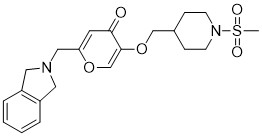
Physicochemical Properties
| Molecular Formula | C21H26N2O5S |
| Molecular Weight | 418.51 |
| Exact Mass | 418.16 |
| Elemental Analysis | C, 60.27; H, 6.26; N, 6.69; O, 19.11; S, 7.66 |
| CAS # | 2231294-96-3 |
| PubChem CID | 135151902 |
| Appearance | Off-white to light yellow solid powder |
| LogP | 1.3 |
| Hydrogen Bond Donor Count | 0 |
| Hydrogen Bond Acceptor Count | 7 |
| Rotatable Bond Count | 6 |
| Heavy Atom Count | 29 |
| Complexity | 763 |
| Defined Atom Stereocenter Count | 0 |
| SMILES | C1(CN2CC3=C(C2)C=CC=C3)OC=C(OCC2CCN(S(C)(=O)=O)CC2)C(=O)C=1 |
| InChi Key | LHVKCOBGLZGRQZ-UHFFFAOYSA-N |
| InChi Code | InChI=1S/C21H26N2O5S/c1-29(25,26)23-8-6-16(7-9-23)14-28-21-15-27-19(10-20(21)24)13-22-11-17-4-2-3-5-18(17)12-22/h2-5,10,15-16H,6-9,11-14H2,1H3 |
| Chemical Name | 2-[(1,3-dihydro-2H-isoindol-2-yl)methyl]-5-{[1-(methanesulfonyl)piperidin-4-yl]methoxy}-4H-pyran-4-one |
| Synonyms | Opevesostat |
| HS Tariff Code | 2934.99.9001 |
| Storage |
Powder-20°C 3 years 4°C 2 years In solvent -80°C 6 months -20°C 1 month |
| Shipping Condition | Room temperature (This product is stable at ambient temperature for a few days during ordinary shipping and time spent in Customs) |
Biological Activity
| References |
[1]. Method for treating prostate cancer in patient using CYP11A1 inhibitor as active ingredient. World Intellectual Property Organization, WO2023052682 A1. 2023-04-06. |
| Additional Infomation | Opevesostat is an orally bioavailable, non-steroidal, selective inhibitor of the enzyme cytochrome 450 side-chain cleavage (scc) (CYP11A1), with potential antineoplastic activity. Upon oral administration, opevesostat targets, binds to and inhibits the activity of CYP11A1. This prevents the synthesis of all steroid hormones and their precursors. This may inhibit proliferation of hormone-positive tumor cells. CYP11A1, a mitochondrial enzyme, catalyzes the conversion of cholesterol to pregnenolone (Preg), which is the first rate-liming step in steroid hormone biosynthesis. |
Solubility Data
| Solubility (In Vitro) | DMSO : ~50 mg/mL (~119.47 mM) |
| Solubility (In Vivo) |
Solubility in Formulation 1: ≥ 1.25 mg/mL (2.99 mM) (saturation unknown) in 10% DMSO + 40% PEG300 + 5% Tween80 + 45% Saline (add these co-solvents sequentially from left to right, and one by one), clear solution. For example, if 1 mL of working solution is to be prepared, you can add 100 μL of 12.5 mg/mL clear DMSO stock solution to 400 μL PEG300 and mix evenly; then add 50 μL Tween-80 to the above solution and mix evenly; then add 450 μL normal saline to adjust the volume to 1 mL. Preparation of saline: Dissolve 0.9 g of sodium chloride in 100 mL ddH₂ O to obtain a clear solution. Solubility in Formulation 2: ≥ 1.25 mg/mL (2.99 mM) (saturation unknown) in 10% DMSO + 90% (20% SBE-β-CD in Saline) (add these co-solvents sequentially from left to right, and one by one), clear solution. For example, if 1 mL of working solution is to be prepared, you can add 100 μL of 12.5 mg/mL clear DMSO stock solution to 900 μL of 20% SBE-β-CD physiological saline solution and mix evenly. Preparation of 20% SBE-β-CD in Saline (4°C,1 week): Dissolve 2 g SBE-β-CD in 10 mL saline to obtain a clear solution. (Please use freshly prepared in vivo formulations for optimal results.) |
| Preparing Stock Solutions | 1 mg | 5 mg | 10 mg | |
| 1 mM | 2.3894 mL | 11.9471 mL | 23.8943 mL | |
| 5 mM | 0.4779 mL | 2.3894 mL | 4.7789 mL | |
| 10 mM | 0.2389 mL | 1.1947 mL | 2.3894 mL |