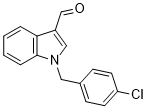
Oncrasin-1 is a novel and potent antitumor agent that kills various human lung cancer cells with K-Ras mutations at low or submicromolar concentrations; it also led to abnormal aggregation of PKCι in nucleus of sensitive cells but not in resistant cells. It acts by inducing abnormal nuclear aggregation of PKC1 and suppressing RNA transcription.
Physicochemical Properties
| Molecular Formula | C16H12CLNO |
| Molecular Weight | 269.7256 |
| Exact Mass | 269.061 |
| CAS # | 75629-57-1 |
| PubChem CID | 872445 |
| Appearance | Light yellow to khaki solid powder |
| Density | 1.21g/cm3 |
| Boiling Point | 465.5ºC at 760 mmHg |
| Melting Point | 117 °C |
| Flash Point | 235.3ºC |
| Index of Refraction | 1.62 |
| LogP | 4.155 |
| Hydrogen Bond Donor Count | 0 |
| Hydrogen Bond Acceptor Count | 1 |
| Rotatable Bond Count | 3 |
| Heavy Atom Count | 19 |
| Complexity | 314 |
| Defined Atom Stereocenter Count | 0 |
| InChi Key | ZDRQMXCSSAPUMM-UHFFFAOYSA-N |
| InChi Code | InChI=1S/C16H12ClNO/c17-14-7-5-12(6-8-14)9-18-10-13(11-19)15-3-1-2-4-16(15)18/h1-8,10-11H,9H2 |
| Chemical Name | 1-(4-Chlorobenzyl)-1H-indole-3-carbaldehyde |
| Synonyms | Oncrasin-1; Oncrasin 1; Oncrasin1 |
| HS Tariff Code | 2934.99.9001 |
| Storage |
Powder-20°C 3 years 4°C 2 years In solvent -80°C 6 months -20°C 1 month |
| Shipping Condition | Room temperature (This product is stable at ambient temperature for a few days during ordinary shipping and time spent in Customs) |
Biological Activity
| ln Vitro | Oncrasin-1 can selectively kill K-Ras mutant cancer cells and induce abnormal nuclear aggregation of PKCiota in sensitive cells but not in resistant cells. Oncrasin-1 treatment led to coaggregation of PKCiota and splicing factors into megaspliceosomes but had no obvious effects on the DNA repair molecule Rad51. Moreover, oncrasin-1 treatment suppressed the phosphorylation of the largest subunit of RNA polymerase II and the expression of intronless reporter genes in sensitive cells but not in resistant cells, suggesting that suppression of RNA transcription is a major effect of oncrasin-1 treatment. Studies with cultured cells or with recombinant proteins showed that oncrasin-1 can disrupt the interaction of PKCiota and cyclin-dependent protein kinase 9/cyclin T1 complex, which is known to phosphorylate the largest subunit of RNA polymerase II and is required for RNA transcription. Together, our results suggest that oncrasin-1 suppresses the function of RNA processing machinery and that PKCiota might be involved in the biological function of RNA processing complexes |
| Enzyme Assay | The kinase reactions (20 µL) were performed at 30°C for 15 min. The solution contained 1X reaction buffer, 5 mM MgCl2, 50 µM cold ATP, 1 µL γ[P32]-ATP (3000 Ci/mmol), 50 ng individual kinase, and their corresponding substrates. 500mM CDK7/9 tide was used as the substrate for CDK9/cyclin T1, CDK7/cyclin H/MAT1, while 0.1mg/ml Histone H1 was used for CDK2/cyclinA, CDK6/cyclinD3 kinase assay. The mix was incubated with different doses of oncrasin-1. Free γ[P32]-ATP was washed away through P81 phosphocellulose filters. The samples were read under a scintillation counter. |
| Cell Assay |
Cells (3×10⁴/well) were seeded in 24-well plates overnight. They were then grown in serum-free medium for 12 h, followed by transfection with 250 ng of different luciferase reporter plasmids. FuGENE 6 was used for plasmid transfection. The cells were kept in normal medium for another 24 h and then treated with 1 µM oncrasin-1 for different time periods. Cells were harvested for the luciferase activity assay, which was performed using the luciferase assay system (Promega Life Science) as instructed by the manufacturer. Cells transfected with pCDNA3.1 were used as the control.[1] |
| References | Mol Cancer Ther. 2009 Feb;8(2):441-8. |
| Additional Infomation | Oncrasin-1 is a member of the class of indoles that is 1H-indole substituted by 4-chlorobenzyl and formyl groups at positions 1 and 3, respectively. It is an anti-cancer agent that is active against lung cancer cells with K-Ras mutations. It has a role as an apoptosis inducer and an antineoplastic agent. It is a member of indoles, a member of monochlorobenzenes and an arenecarbaldehyde. |
Solubility Data
| Solubility (In Vitro) | DMSO : ~100 mg/mL (~370.74 mM) |
| Solubility (In Vivo) |
Solubility in Formulation 1: 2.5 mg/mL (9.27 mM) in 10% DMSO + 40% PEG300 + 5% Tween80 + 45% Saline (add these co-solvents sequentially from left to right, and one by one), suspension solution; with sonication. For example, if 1 mL of working solution is to be prepared, you can add 100 μL of 25.0 mg/mL clear DMSO stock solution to 400 μL PEG300 and mix evenly; then add 50 μL Tween-80 to the above solution and mix evenly; then add 450 μL normal saline to adjust the volume to 1 mL. Preparation of saline: Dissolve 0.9 g of sodium chloride in 100 mL ddH₂ O to obtain a clear solution. Solubility in Formulation 2: 2.5 mg/mL (9.27 mM) in 10% DMSO + 90% (20% SBE-β-CD in Saline) (add these co-solvents sequentially from left to right, and one by one), suspension solution; with ultrasonication. For example, if 1 mL of working solution is to be prepared, you can add 100 μL of 25.0 mg/mL clear DMSO stock solution to 900 μL of 20% SBE-β-CD physiological saline solution and mix evenly. Preparation of 20% SBE-β-CD in Saline (4°C,1 week): Dissolve 2 g SBE-β-CD in 10 mL saline to obtain a clear solution. Solubility in Formulation 3: 2.5 mg/mL (9.27 mM) in 10% DMSO + 90% Corn Oil (add these co-solvents sequentially from left to right, and one by one), clear solution; with ultrasonication. For example, if 1 mL of working solution is to be prepared, you can add 100 μL of 25.0 mg/mL clear DMSO stock solution to 900 μL of corn oil and mix evenly. (Please use freshly prepared in vivo formulations for optimal results.) |
| Preparing Stock Solutions | 1 mg | 5 mg | 10 mg | |
| 1 mM | 3.7074 mL | 18.5371 mL | 37.0741 mL | |
| 5 mM | 0.7415 mL | 3.7074 mL | 7.4148 mL | |
| 10 mM | 0.3707 mL | 1.8537 mL | 3.7074 mL |