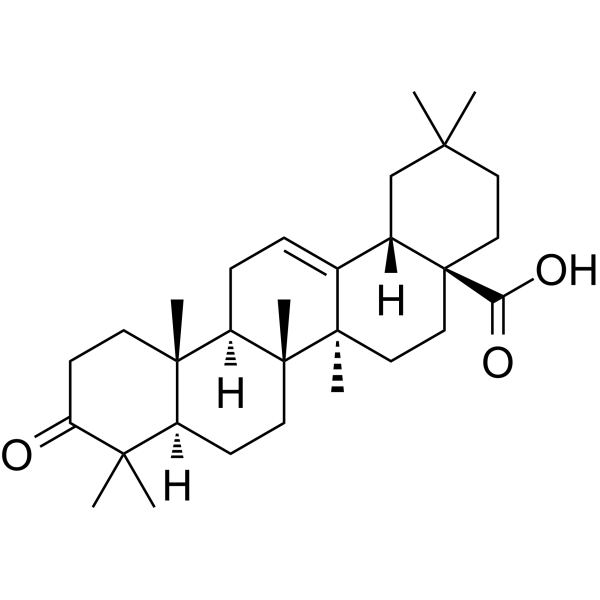
Physicochemical Properties
| Molecular Formula | C30H46O3 |
| Molecular Weight | 454.6844 |
| Exact Mass | 454.344 |
| CAS # | 17990-42-0 |
| PubChem CID | 12313704 |
| Appearance | White to off-white solid powder |
| Density | 1.1±0.1 g/cm3 |
| Boiling Point | 551.7±50.0 °C at 760 mmHg |
| Flash Point | 301.5±26.6 °C |
| Vapour Pressure | 0.0±3.2 mmHg at 25°C |
| Index of Refraction | 1.552 |
| LogP | 8.48 |
| Hydrogen Bond Donor Count | 1 |
| Hydrogen Bond Acceptor Count | 3 |
| Rotatable Bond Count | 1 |
| Heavy Atom Count | 33 |
| Complexity | 927 |
| Defined Atom Stereocenter Count | 7 |
| SMILES | C[C@]12CCC(=O)C([C@@H]1CC[C@@]3([C@@H]2CC=C4[C@]3(CC[C@@]5([C@H]4CC(CC5)(C)C)C(=O)O)C)C)(C)C |
| InChi Key | FMIMFCRXYXVFTA-FUAOEXFOSA-N |
| InChi Code | InChI=1S/C30H46O3/c1-25(2)14-16-30(24(32)33)17-15-28(6)19(20(30)18-25)8-9-22-27(5)12-11-23(31)26(3,4)21(27)10-13-29(22,28)7/h8,20-22H,9-18H2,1-7H3,(H,32,33)/t20-,21-,22+,27-,28+,29+,30-/m0/s1 |
| Chemical Name | (4aS,6aR,6aS,6bR,8aR,12aR,14bS)-2,2,6a,6b,9,9,12a-heptamethyl-10-oxo-3,4,5,6,6a,7,8,8a,11,12,13,14b-dodecahydro-1H-picene-4a-carboxylic acid |
| HS Tariff Code | 2934.99.9001 |
| Storage |
Powder-20°C 3 years 4°C 2 years In solvent -80°C 6 months -20°C 1 month |
| Shipping Condition | Room temperature (This product is stable at ambient temperature for a few days during ordinary shipping and time spent in Customs) |
Biological Activity
| ln Vitro |
Oleanonic acid dose-dependently inhibited leukotriene B4 production from rat peritoneal polymorphonuclear leukocytes stimulated by calcium ionophore A23187, with an IC50 value of 17 µM. [1] At a dose of 100 µM, oleanonic acid reduced the production of 12-hydroxyheptadecatrienoic acid (12-HHTrE), a product of COX-1 activity in human platelets, by 78%. [1] Oleanonic acid was considered non-cytotoxic in an MTT assay using rat polymorphonuclear leukocytes, showing cell viability higher than 95% after exposure. [1] |
| ln Vivo |
Oleanonic acid (0.5 mg/ear), applied topically simultaneously with the irritant, significantly reduced mouse ear edema induced by 12-deoxyphorbol-13-phenylacetate (DPP) by 40%. [1] In a mouse model of chronic skin inflammation induced by multiple topical applications of TPA, oleanonic acid (0.3 mg/ear, applied twice daily) significantly inhibited ear swelling by 45% and reduced neutrophil infiltration (measured as myeloperoxidase activity) by 84%. Histological examination showed it reduced the intensity and extent of TPA-induced damage, converting the lesion to a milder chronic form with fibrosis and lymphocyte infiltration, and produced an antiproliferative effect on the epithelial layer. [1] Oleanonic acid (30 mg/kg, i.p.) significantly reduced mouse paw edema induced by bradykinin (61% inhibition). [1] Oleanonic acid (30 mg/kg, i.p.) significantly inhibited mouse paw edema induced by phospholipase A2 from Naja mossambica venom, showing maximum inhibition (84%) at 60 minutes and maintaining activity at 90 minutes after challenge. [1] Oleanonic acid (1 mg/ear, applied 16h prior) showed no activity on mouse ear edema induced by ethyl phenylpropiolate. [1] Oleanonic acid (0.5 mg/ear, applied simultaneously) showed a non-significant 28% inhibition of mouse ear edema induced by a single application of TPA. [1] Oleanonic acid (0.5 mg/ear, applied repeatedly after challenge) was ineffective in a mouse delayed-type hypersensitivity model induced by dinitrofluorobenzene. [1] |
| Enzyme Assay |
The assay for leukotriene B4 production inhibition involved glycogen-elicited rat peritoneal polymorphonuclear leukocytes. The cells were stimulated with 1.8 mM Ca²⁺ and 1.9 µM calcium ionophore A23187 to induce LTB4 formation from endogenous arachidonic acid. The cells were incubated in the presence of different concentrations of the test compounds. After incubation, the products of the 5-lipoxygenase pathway were separated by high-performance liquid chromatography (HPLC) using a reverse-phase column eluted with a mixture of methanol and water containing trifluoroacetic acid. Detection was performed with a diode array detector. The results, based on peak areas, were normalized to a prostaglandin B2 internal standard and expressed as a percentage of LTB4 production. The IC50 was calculated by linear regression from inhibition percentages at four concentrations between 12.5 and 100 µM. [1] The assay for cyclooxygenase-1 (COX-1) activity used human blood platelets obtained from healthy donors. Platelets were separated by sequential centrifugations and stimulated with 2.5 mM Ca²⁺ and 1.9 µM calcium ionophore A23187. The platelets were incubated in the presence of the test compound (100 µM). The activity of COX-1 was measured by the production of 12-hydroxyheptadecatrienoic acid (12-HHTrE). Separation of 12-HHTrE was achieved by HPLC using a reverse-phase column eluted with a methanol/water mixture containing trifluoroacetic acid, followed by diode array detection. Results from peak areas were normalized to a prostaglandin B2 internal standard and expressed as a percentage of 12-HHTrE |
| Cell Assay |
Cytotoxicity was assessed using a modified MTT colorimetric assay. Rat polymorphonuclear leukocytes were exposed to the test compounds in a microplate for 30 minutes. Following this, MTT reagent was added and incubated. The resulting colored formazan metabolite was dissolved in dimethyl sulfoxide using an ultrasonic bath. The absorbance was measured at 490 nm using a plate reader. A decrease in absorbance indicated a reduction in cell viability. Results were expressed in absolute absorbance readings. [1] |
| Animal Protocol |
For the DPP-induced mouse ear edema model, inflammation was induced by topical application of 4 µg of DPP dissolved in 20 µl acetone to the right ear. Oleanonic acid (0.5 mg) was dissolved in acetone and applied topically to the ear simultaneously with DPP. Ear thickness was measured 30 minutes after challenge. [1] For the TPA-induced chronic skin inflammation model, inflammation was induced by topical application of 2 µg of TPA in 20 µl acetone to both sides of the ear on alternate days for a total of 4 applications. Oleanonic acid (0.3 mg/ear in acetone) was applied topically twice daily for 4 days, starting immediately after the first TPA application. Mice were euthanized, and ear punches were taken for weighing, myeloperoxidase assay, and histology. [1] For the bradykinin-induced mouse paw edema model, 25 µl of a solution containing 3 µg bradykinin in saline was injected subcutaneously into the right hind paw. Oleanonic acid (30 mg/kg) was dissolved in a vehicle of ethanol/Tween 80/water (1:1:10) and administered intraperitoneally 60 minutes before the irritant injection. Paw volume was measured using a plethysmometer at various time points. [1] For the phospholipase A2-induced mouse paw edema model, phospholipase A2 (1.18 units in 25 µl saline) was injected subcutaneously into the right hind paw. Oleanonic acid (30 mg/kg) was dissolved in a vehicle of Tween 80/ethanol/water (2:2:20) and administered intraperitoneally 30 minutes before the phospholipase A2 injection. Paw volume was measured using a plethysmometer at 30, 60, and 90 minutes after challenge. [1] For the ethyl phenylpropiolate-induced ear edema model, edema was induced by topical application of 1 mg of ethyl phenylpropiolate in 20 µl acetone. Oleanonic acid (1 mg/ear) was dissolved in acetone and applied topically 16 hours before the inducer. Edema was measured 1 hour after challenge. [1] For the single-application TPA ear edema model, edema was induced by topical application of 2.5 µg of TPA in 20 µl acetone. Oleanonic acid (0.5 mg/ear in acetone) was applied simultaneously with TPA. Ear thickness was measured 4 hours after application. [1] For the delayed-type hypersensitivity model, mice were sensitized by topical application of dinitrofluorobenzene on the shaved abdomen on days 0 and 1. They were challenged on the ear on day 5. Oleanonic acid (0.5 mg/ear in acetone) was applied topically to the ear at 2, 24, 48, and 72 hours after challenge. Ear thickness was measured 24 and 96 hours after challenge. [1] |
| Toxicity/Toxicokinetics |
In an in vitro MTT assay using rat polymorphonuclear leukocytes, oleanonic acid showed no significant cytotoxicity, maintaining cell viability above 95%. [1] |
| References |
[1]. Oleanonic acid, a 3-oxotriterpene from Pistacia, inhibits leukotriene synthesis and has anti-inflammatory activity.Eur J Pharmacol.Sep 28;428(1):137-43.doi:10.1016/S0014-2999(01)01290-0(2001). [2]. Fabio Mengoni.Anti-HIV Activity of Oleanolic Acid on Infected Human Mononuclear Cells.Planta Med 68(2): 111-114.DOI: 10.1055/s-2002-20256(2002). |
| Additional Infomation |
Oleanonic acid has been reported in Gibbaria ilicifolia, Uncaria sinensis, and other organisms with data available. Oleanonic acid (3-oxo-olean-12-en-28-oic acid) is a 3-oxo derivative of oleanolic acid, a naturally occurring triterpenoid. It was isolated from the galls of Pistacia terebinthus in this study. [1] The presence of a ketone group at the C-3 position appears to enhance anti-inflammatory activity in models related to 5-lipoxygenase activity (e.g., LTB4 inhibition, chronic TPA inflammation) compared to its 3-hydroxy analogue, oleanolic acid. [1] The anti-inflammatory mechanism of oleanonic acid may involve inhibition of leukotriene synthesis (via 5-lipoxygenase pathway) and prostaglandin synthesis (via cyclooxygenase-1), as well as possible effects on mast cell degranulation and neutrophil infiltration. [1] It showed no activity in models where glucocorticoids are typically effective (ethyl phenylpropiolate edema, delayed-type hypersensitivity), suggesting a different mechanism of action. [1] |
Solubility Data
| Solubility (In Vitro) |
DMSO : ~50 mg/mL (~109.97 mM) H2O : ≥ mg/mL |
| Solubility (In Vivo) |
Solubility in Formulation 1: ≥ 2.5 mg/mL (5.50 mM) (saturation unknown) in 10% DMSO + 40% PEG300 + 5% Tween80 + 45% Saline (add these co-solvents sequentially from left to right, and one by one), clear solution. For example, if 1 mL of working solution is to be prepared, you can add 100 μL of 25.0 mg/mL clear DMSO stock solution to 400 μL PEG300 and mix evenly; then add 50 μL Tween-80 to the above solution and mix evenly; then add 450 μL normal saline to adjust the volume to 1 mL. Preparation of saline: Dissolve 0.9 g of sodium chloride in 100 mL ddH₂ O to obtain a clear solution. Solubility in Formulation 2: 2.5 mg/mL (5.50 mM) in 10% DMSO + 90% (20% SBE-β-CD in Saline) (add these co-solvents sequentially from left to right, and one by one), suspension solution; with ultrasonication. For example, if 1 mL of working solution is to be prepared, you can add 100 μL of 25.0 mg/mL clear DMSO stock solution to 900 μL of 20% SBE-β-CD physiological saline solution and mix evenly. Preparation of 20% SBE-β-CD in Saline (4°C,1 week): Dissolve 2 g SBE-β-CD in 10 mL saline to obtain a clear solution. Solubility in Formulation 3: ≥ 2.5 mg/mL (5.50 mM) (saturation unknown) in 10% DMSO + 90% Corn Oil (add these co-solvents sequentially from left to right, and one by one), clear solution. For example, if 1 mL of working solution is to be prepared, you can add 100 μL of 25.0 mg/mL clear DMSO stock solution to 900 μL of corn oil and mix evenly. (Please use freshly prepared in vivo formulations for optimal results.) |
| Preparing Stock Solutions | 1 mg | 5 mg | 10 mg | |
| 1 mM | 2.1993 mL | 10.9967 mL | 21.9935 mL | |
| 5 mM | 0.4399 mL | 2.1993 mL | 4.3987 mL | |
| 10 mM | 0.2199 mL | 1.0997 mL | 2.1993 mL |