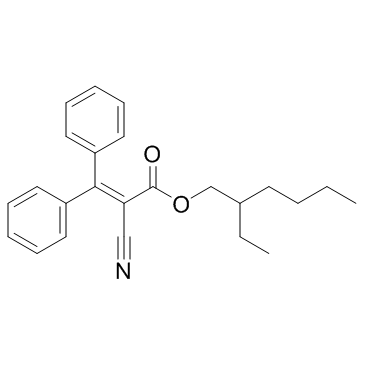
Octocrylene is an organic compound used as a UV (ultraviolet) filter in sunscreens and cosmetics to protect cosmetic formulations from UV radiation. It stabilizes the full-spectrum UVA blocker avobenzone to UV radiation, and absorbs mainly UVB radiation and short UVA wavelengths. Octocrylene or octocrilene is used in various cosmetic products to either provide an appropriate sun protection factor in sunscreen products or to protect cosmetic formulations from UV radiation.
Physicochemical Properties
| Molecular Formula | C24H27NO2 |
| Molecular Weight | 361.4767 |
| Exact Mass | 361.204 |
| CAS # | 6197-30-4 |
| PubChem CID | 22571 |
| Appearance | Light yellow to yellow ointment |
| Density | 1.1±0.1 g/cm3 |
| Boiling Point | 478.5±33.0 °C at 760 mmHg |
| Melting Point | −10 °C(lit.) |
| Flash Point | 239.5±12.1 °C |
| Vapour Pressure | 0.0±1.2 mmHg at 25°C |
| Index of Refraction | 1.546 |
| LogP | 7.53 |
| Hydrogen Bond Donor Count | 0 |
| Hydrogen Bond Acceptor Count | 3 |
| Rotatable Bond Count | 10 |
| Heavy Atom Count | 27 |
| Complexity | 510 |
| Defined Atom Stereocenter Count | 0 |
| SMILES | O(C(/C(/C#N)=C(\C1C([H])=C([H])C([H])=C([H])C=1[H])/C1C([H])=C([H])C([H])=C([H])C=1[H])=O)C([H])([H])C([H])(C([H])([H])C([H])([H])[H])C([H])([H])C([H])([H])C([H])([H])C([H])([H])[H] |
| InChi Key | FMJSMJQBSVNSBF-UHFFFAOYSA-N |
| InChi Code | InChI=1S/C24H27NO2/c1-3-5-12-19(4-2)18-27-24(26)22(17-25)23(20-13-8-6-9-14-20)21-15-10-7-11-16-21/h6-11,13-16,19H,3-5,12,18H2,1-2H3 |
| Chemical Name | 2-ethylhexyl 2-cyano-3,3-diphenylprop-2-enoate |
| HS Tariff Code | 2934.99.9001 |
| Storage |
Powder-20°C 3 years 4°C 2 years In solvent -80°C 6 months -20°C 1 month |
| Shipping Condition | Room temperature (This product is stable at ambient temperature for a few days during ordinary shipping and time spent in Customs) |
Biological Activity
| References |
[1]Int J Environ Res Public Health. 2022 May 16;19(10):6037 [2]Review of the safety of octocrylene used as an ultraviolet filter in cosmetics. J Eur Acad Dermatol Venereol. 2019 Nov;33 Suppl 7:25-33. |
| Additional Infomation |
2-ethylhexyl-2-cyano-3,3-diphenylacrylate is a yellow viscous liquid. Insoluble in water. (NTP, 1992) Octocrylene is a diarylmethane. Octocrylene is a compound often used as an additive in sun screen, and is thought to have skin moisturizing effects because of its emollient properties. What makes this chemical such a popular additive to sun block, is its ability to neutralize UV radiation dissipated by sunlight, and to minimize skin damage from prolonged sun exposure. Octocrylene is also often combined with avobenzone, another common sunscreen ingredient often appearing on ingredient labels. Because of its effectiveness, the chemical has been approved across the globe for use in cosmetics and skin care products, but the concentrations of this ingredient are usually limited to no more than 10 or 12 percent. However, the use of this chemical doesn’t just stop with sunscreen for face and arms, but can extend to a variety of other products, like hair spray, tannin oil, BB cream, conditioner, and CC cream, among others. Octocrylene may cause contact and photocontact allergy. See also: Avobenzone; ecamsule; octocrylene (component of); AVOBENZONE; Octocrylene (component of); Octisalate; octocrylene (component of) ... View More ... Drug Indication In the US, Octocrylene has been evaluated by the FDA and is considered safe for use up to 10% in the formula. Similarly, the EU allows its use up to 10% in a formula while Health Canada allows a maximum use level of 12%. Mechanism of Action Octocrylene is an effective oil soluble liquid UV‐B filter. It has excellent dissolving properties for crystalline UV filters. Due to its outstanding photostability it is used as photostabilizer. Conjugated acrylate portion absorbs UVB and short-wave UVA (ultraviolet) rays with wavelengths in the range of 280-320 nm which protects the skin from direct DNA damage. The ethylhexanol portion is a fatty alcohol, which functions as an emollient due to it's hydrophobicity. |
Solubility Data
| Solubility (In Vitro) |
DMSO : ≥ 100 mg/mL (~276.64 mM) Ethanol : ~50 mg/mL (~138.32 mM) |
| Solubility (In Vivo) |
Solubility in Formulation 1: ≥ 2.5 mg/mL (6.92 mM) (saturation unknown) in 10% DMSO + 40% PEG300 + 5% Tween80 + 45% Saline (add these co-solvents sequentially from left to right, and one by one), clear solution. For example, if 1 mL of working solution is to be prepared, you can add 100 μL of 25.0 mg/mL clear DMSO stock solution to 400 μL PEG300 and mix evenly; then add 50 μL Tween-80 to the above solution and mix evenly; then add 450 μL normal saline to adjust the volume to 1 mL. Preparation of saline: Dissolve 0.9 g of sodium chloride in 100 mL ddH₂ O to obtain a clear solution. Solubility in Formulation 2: 2.5 mg/mL (6.92 mM) in 10% DMSO + 90% (20% SBE-β-CD in Saline) (add these co-solvents sequentially from left to right, and one by one), suspension solution; with ultrasonication. For example, if 1 mL of working solution is to be prepared, you can add 100 μL of 25.0 mg/mL clear DMSO stock solution to 900 μL of 20% SBE-β-CD physiological saline solution and mix evenly. Preparation of 20% SBE-β-CD in Saline (4°C,1 week): Dissolve 2 g SBE-β-CD in 10 mL saline to obtain a clear solution. Solubility in Formulation 3: ≥ 2.5 mg/mL (6.92 mM) (saturation unknown) in 10% DMSO + 90% Corn Oil (add these co-solvents sequentially from left to right, and one by one), clear solution. For example, if 1 mL of working solution is to be prepared, you can add 100 μL of 25.0 mg/mL clear DMSO stock solution to 900 μL of corn oil and mix evenly. (Please use freshly prepared in vivo formulations for optimal results.) |
| Preparing Stock Solutions | 1 mg | 5 mg | 10 mg | |
| 1 mM | 2.7664 mL | 13.8320 mL | 27.6640 mL | |
| 5 mM | 0.5533 mL | 2.7664 mL | 5.5328 mL | |
| 10 mM | 0.2766 mL | 1.3832 mL | 2.7664 mL |