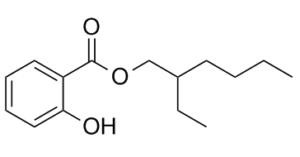
Octisalate is an organic chemical compound used in sunscreens and cosmetics to absorb the full range of UVB rays from the sun. Octisalate absorbs ultraviolet radiation in the UVB range and can protect from skin damage.
Physicochemical Properties
| Molecular Formula | C15H22O3 |
| Molecular Weight | 250.33338 |
| Exact Mass | 250.156 |
| CAS # | 118-60-5 |
| PubChem CID | 8364 |
| Appearance | Colorless to light yellow liquid |
| Density | 1.0±0.1 g/cm3 |
| Boiling Point | 331.5±15.0 °C at 760 mmHg |
| Flash Point | 127.7±13.2 °C |
| Vapour Pressure | 0.0±0.7 mmHg at 25°C |
| Index of Refraction | 1.510 |
| LogP | 5.77 |
| Hydrogen Bond Donor Count | 1 |
| Hydrogen Bond Acceptor Count | 3 |
| Rotatable Bond Count | 8 |
| Heavy Atom Count | 18 |
| Complexity | 240 |
| Defined Atom Stereocenter Count | 0 |
| SMILES | O=C(OCC(CC)CCCC)C1=CC=CC=C1O |
| InChi Key | FMRHJJZUHUTGKE-UHFFFAOYSA-N |
| InChi Code | InChI=1S/C15H22O3/c1-3-5-8-12(4-2)11-18-15(17)13-9-6-7-10-14(13)16/h6-7,9-10,12,16H,3-5,8,11H2,1-2H3 |
| Chemical Name | 2-ethylhexyl 2-hydroxybenzoate |
| Synonyms | Octyl salicylate; 2-Ethylhexyl salicylate |
| HS Tariff Code | 2934.99.9001 |
| Storage |
Powder-20°C 3 years 4°C 2 years In solvent -80°C 6 months -20°C 1 month |
| Shipping Condition | Room temperature (This product is stable at ambient temperature for a few days during ordinary shipping and time spent in Customs) |
Biological Activity
| ADME/Pharmacokinetics |
Absorption, Distribution and Excretion Intended for local use only, no systemic absorption. Intended for local use only, no systemic absorption. Intended for local use only, no systemic absorption. Intended for local use only, no systemic absorption. Metabolism / Metabolites Intended for local use only, no systemic absorption. Biological Half-Life Intended for local use only, no systemic absorption. |
| Toxicity/Toxicokinetics |
Protein Binding Intended for local use only, no systemic absorption. |
| References | N/A |
| Additional Infomation |
Ethylhexyl salicylate is a benzoate ester and a member of phenols. It is functionally related to a salicylic acid. Also known as Ethylhexyl Salicylate. Octyl salicylate is an oil soluble chemical sunscreen agent that absorbs UVB radiation. It does not protect against UVA. Octyl salicylate is used to augment the UVB protection in a sunscreen. Salicylates are weak UVB absorbers and they are generally used in combination with other UV filters. Octyl salicylate appears to have a good safety profile. It covers wavelength in the range 295-315 nm, peak at 307-310 nm. It is an ester of salicylic acid and 2-ethylhexanol. The salicylate portion of the molecule absorbs ultraviolet light to protect skin from the harmful effects of exposure to sunlight, while the ethylhexanol portion functions as an emollient. 2-Ethylhexyl salicylate has been reported in Camellia sinensis, Homo sapiens, and Lonicera japonica with data available. Drug Indication Ingredient in sunscreens for protection against damage effects of sun light, provides protection from sunburns, aging and skin cancer. Mechanism of Action Chemical sunscreen, it acts through absorption of UVB light and not UVA. |
Solubility Data
| Solubility (In Vitro) | DMSO : ~100 mg/mL (~399.47 mM) |
| Solubility (In Vivo) |
Solubility in Formulation 1: ≥ 2.5 mg/mL (9.99 mM) (saturation unknown) in 10% DMSO + 40% PEG300 + 5% Tween80 + 45% Saline (add these co-solvents sequentially from left to right, and one by one), clear solution. For example, if 1 mL of working solution is to be prepared, you can add 100 μL of 25.0 mg/mL clear DMSO stock solution to 400 μL PEG300 and mix evenly; then add 50 μL Tween-80 to the above solution and mix evenly; then add 450 μL normal saline to adjust the volume to 1 mL. Preparation of saline: Dissolve 0.9 g of sodium chloride in 100 mL ddH₂ O to obtain a clear solution. Solubility in Formulation 2: ≥ 2.5 mg/mL (9.99 mM) (saturation unknown) in 10% DMSO + 90% (20% SBE-β-CD in Saline) (add these co-solvents sequentially from left to right, and one by one), clear solution. For example, if 1 mL of working solution is to be prepared, you can add 100 μL of 25.0 mg/mL clear DMSO stock solution to 900 μL of 20% SBE-β-CD physiological saline solution and mix evenly. Preparation of 20% SBE-β-CD in Saline (4°C,1 week): Dissolve 2 g SBE-β-CD in 10 mL saline to obtain a clear solution. Solubility in Formulation 3: ≥ 2.5 mg/mL (9.99 mM) (saturation unknown) in 10% DMSO + 90% Corn Oil (add these co-solvents sequentially from left to right, and one by one), clear solution. For example, if 1 mL of working solution is to be prepared, you can add 100 μL of 25.0 mg/mL clear DMSO stock solution to 900 μL of corn oil and mix evenly. (Please use freshly prepared in vivo formulations for optimal results.) |
| Preparing Stock Solutions | 1 mg | 5 mg | 10 mg | |
| 1 mM | 3.9947 mL | 19.9736 mL | 39.9473 mL | |
| 5 mM | 0.7989 mL | 3.9947 mL | 7.9895 mL | |
| 10 mM | 0.3995 mL | 1.9974 mL | 3.9947 mL |