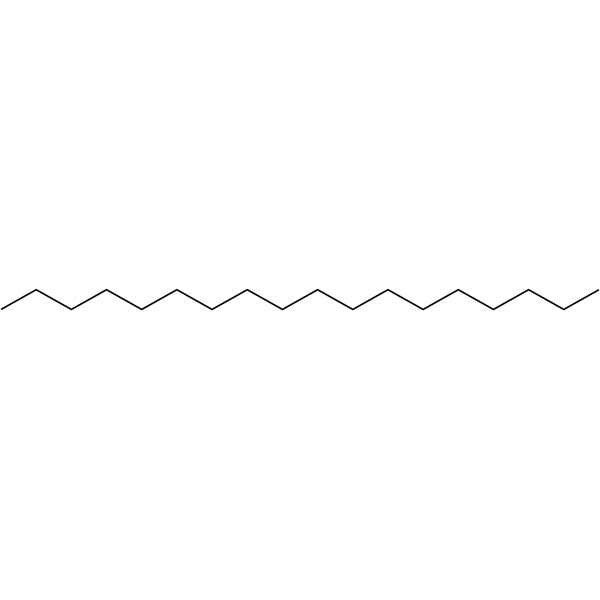
Physicochemical Properties
| Molecular Formula | C18H38 |
| Molecular Weight | 254.4943 |
| Exact Mass | 254.297 |
| CAS # | 593-45-3 |
| Related CAS # | Octadecane-d38;16416-31-2 |
| PubChem CID | 11635 |
| Appearance |
Needles from alcohol, ether-methanol Colorless liquid |
| Density | 0.8±0.1 g/cm3 |
| Boiling Point | 316.3±5.0 °C at 760 mmHg |
| Melting Point | 28 °C |
| Flash Point | 165.6±0.0 °C |
| Vapour Pressure | 0.0±0.3 mmHg at 25°C |
| Index of Refraction | 1.438 |
| LogP | 10.32 |
| Hydrogen Bond Donor Count | 0 |
| Hydrogen Bond Acceptor Count | 0 |
| Rotatable Bond Count | 15 |
| Heavy Atom Count | 18 |
| Complexity | 112 |
| Defined Atom Stereocenter Count | 0 |
| SMILES | C([H])([H])(C([H])([H])C([H])([H])C([H])([H])C([H])([H])C([H])([H])C([H])([H])C([H])([H])C([H])([H])[H])C([H])([H])C([H])([H])C([H])([H])C([H])([H])C([H])([H])C([H])([H])C([H])([H])C([H])([H])C([H])([H])[H] |
| InChi Key | RZJRJXONCZWCBN-UHFFFAOYSA-N |
| InChi Code | InChI=1S/C18H38/c1-3-5-7-9-11-13-15-17-18-16-14-12-10-8-6-4-2/h3-18H2,1-2H3 |
| Chemical Name | octadecane |
| HS Tariff Code | 2934.99.9001 |
| Storage |
Powder-20°C 3 years 4°C 2 years In solvent -80°C 6 months -20°C 1 month |
| Shipping Condition | Room temperature (This product is stable at ambient temperature for a few days during ordinary shipping and time spent in Customs) |
Biological Activity
| ADME/Pharmacokinetics |
Absorption, Distribution and Excretion Liver, heart, kidneys, muscle and adipose (perirenal and s.c.) /bovine/ tissues were collected from 6 animals for analysis of their hydrocarbon composition. Qualitative and quantitative determinations were carried out by gas chromatography and combined gas chromatography-mass spectrometry. Although differing in the proportions, a homologous series of n-alkanes ranging from n-C12-n-C31 was found in all samples. The isoprenoid hydrocarbons phytane and phytene (phyt-1-ene and phyt-2-ene) were also identified. (These findings have relevance to the health of humans consuming hydrocarbon-contaminated meats.) /n-Alkanes/ The trans-membrane transport of hydrocarbons is an important and complex aspect of the process of biodegradation of hydrocarbons by microorganisms. The mechanism of transport of (14)C n-octadecane by Pseudomonas sp. DG17, an alkane-degrading bacterium, was studied by the addition of ATP inhibitors and different substrate concentrations. When the concentration of n-octadecane was higher than 4.54 umol/L, the transport of (14)C n-octadecane was driven by a facilitated passive mechanism following the intra/extra substrate concentration gradient. However, when the cells were grown with a low concentration of the substrate, the cellular accumulation of n-octadecane, an energy-dependent process, was dramatically decreased by the presence of ATP inhibitors, and n-octadecane accumulation continually increased against its concentration gradient. Furthermore, the presence of non-labeled alkanes blocked (14)C n-octadecane transport only in the induced cells, and the trans-membrane transport of n-octadecane was specific with an apparent dissociation constant K t of 11.27 umol/L and V max of 0.96 umol/min/mg protein. The results indicated that the trans-membrane transport of n-octadecane by Pseudomonas sp. DG17 was related to the substrate concentration and ATP. |
| Toxicity/Toxicokinetics |
Toxicity Summary IDENTIFICATION AND USE: Octadecane is a solid n-alkane. Octadecane is used as a solvent, in organic synthesis, and as a calibration standard. HUMAN EXPOSURE AND TOXICITY: There are no data available. ANIMAL STUDIES: A structure activity relationship of pure n-alkanes was undertaken in a mouse ear edema model to investigate the mechanism of cumulative irritancy. Alkanes were applied twice daily over a 4-day period. Hexadecane, octadecane, and eicosane exhibited progressively decreasing activity. ECOTOXICITY STUDIES: An acute toxicity test was conducted on the marine copepod Acartia tonsa. Octadecane concentrations ranged from 9.7 to 3200 mg/L. 48-hr loading rate of test substance resulting in 50% mortality LL50 >3200 mg. Interactions The trans-membrane transport of hydrocarbons is an important and complex aspect of the process of biodegradation of hydrocarbons by microorganisms. The mechanism of transport of (14)C n-octadecane by Pseudomonas sp. DG17, an alkane-degrading bacterium, was studied by the addition of ATP inhibitors and different substrate concentrations. When the concentration of n-octadecane was higher than 4.54 umol/L, the transport of (14)C n-octadecane was driven by a facilitated passive mechanism following the intra/extra substrate concentration gradient. However, when the cells were grown with a low concentration of the substrate, the cellular accumulation of n-octadecane, an energy-dependent process, was dramatically decreased by the presence of ATP inhibitors, and n-octadecane accumulation continually increased against its concentration gradient. Furthermore, the presence of non-labeled alkanes blocked (14)C n-octadecane transport only in the induced cells, and the trans-membrane transport of n-octadecane was specific with an apparent dissociation constant K t of 11.27 umol/L and V max of 0.96 umol/min/mg protein. The results indicated that the trans-membrane transport of n-octadecane by Pseudomonas sp. DG17 was related to the substrate concentration and ATP. |
| Additional Infomation |
N-octadecane is a colorless liquid. (NTP, 1992) Octadecane is a straight-chain alkane carrying 18 carbon atoms. It has a role as a bacterial metabolite and a plant metabolite. Octadecane has been reported in Camellia sinensis, Vanilla madagascariensis, and other organisms with data available. |
Solubility Data
| Solubility (In Vitro) |
Ethanol : ~25 mg/mL (~98.24 mM) DMSO : ~5 mg/mL (~19.65 mM) |
| Solubility (In Vivo) |
Solubility in Formulation 1: ≥ 2.5 mg/mL (9.82 mM) (saturation unknown) in 10% EtOH + 40% PEG300 + 5% Tween80 + 45% Saline (add these co-solvents sequentially from left to right, and one by one), clear solution. For example, if 1 mL of working solution is to be prepared, you can add 100 μL of 25.0 mg/mL clear EtOH stock solution to 400 μL PEG300 and mix evenly; then add 50 μL Tween-80 to the above solution and mix evenly; then add 450 μL normal saline to adjust the volume to 1 mL. Preparation of saline: Dissolve 0.9 g of sodium chloride in 100 mL ddH₂ O to obtain a clear solution. Solubility in Formulation 2: ≥ 2.5 mg/mL (9.82 mM) (saturation unknown) in 10% EtOH + 90% (20% SBE-β-CD in Saline) (add these co-solvents sequentially from left to right, and one by one), clear solution. For example, if 1 mL of working solution is to be prepared, you can add 100 μL of 25.0 mg/mL clear EtOH stock solution to 900 μL of 20% SBE-β-CD physiological saline solution and mix evenly. Preparation of 20% SBE-β-CD in Saline (4°C,1 week): Dissolve 2 g SBE-β-CD in 10 mL saline to obtain a clear solution. Solubility in Formulation 3: ≥ 2.5 mg/mL (9.82 mM) (saturation unknown) in 10% EtOH + 90% Corn Oil (add these co-solvents sequentially from left to right, and one by one), clear solution. For example, if 1 mL of working solution is to be prepared, you can add 100 μL of 25.0 mg/mL clear EtOH stock solution to 900 μL of corn oil and mix evenly. Solubility in Formulation 4: ≥ 0.5 mg/mL (1.96 mM) (saturation unknown) in 10% DMSO + 40% PEG300 + 5% Tween80 + 45% Saline (add these co-solvents sequentially from left to right, and one by one), clear solution. For example, if 1 mL of working solution is to be prepared, you can add 100 μL of 5.0 mg/mL clear DMSO stock solution to 400 μL PEG300 and mix evenly; then add 50 μL Tween-80 to the above solution and mix evenly; then add 450 μL normal saline to adjust the volume to 1 mL. Preparation of saline: Dissolve 0.9 g of sodium chloride in 100 mL ddH₂ O to obtain a clear solution. Solubility in Formulation 5: ≥ 0.5 mg/mL (1.96 mM) (saturation unknown) in 10% DMSO + 90% (20% SBE-β-CD in Saline) (add these co-solvents sequentially from left to right, and one by one), clear solution. For example, if 1 mL of working solution is to be prepared, you can add 100 μL of 5.0 mg/mL clear DMSO stock solution to 900 μL of 20% SBE-β-CD physiological saline solution and mix evenly. Preparation of 20% SBE-β-CD in Saline (4°C,1 week): Dissolve 2 g SBE-β-CD in 10 mL saline to obtain a clear solution. Solubility in Formulation 6: ≥ 0.5 mg/mL (1.96 mM) (saturation unknown) in 10% DMSO + 90% Corn Oil (add these co-solvents sequentially from left to right, and one by one), clear solution. For example, if 1 mL of working solution is to be prepared, you can add 100 μL of 5.0 mg/mL clear DMSO stock solution to 900 μL of corn oil and mix evenly. (Please use freshly prepared in vivo formulations for optimal results.) |
| Preparing Stock Solutions | 1 mg | 5 mg | 10 mg | |
| 1 mM | 3.9294 mL | 19.6471 mL | 39.2943 mL | |
| 5 mM | 0.7859 mL | 3.9294 mL | 7.8589 mL | |
| 10 mM | 0.3929 mL | 1.9647 mL | 3.9294 mL |