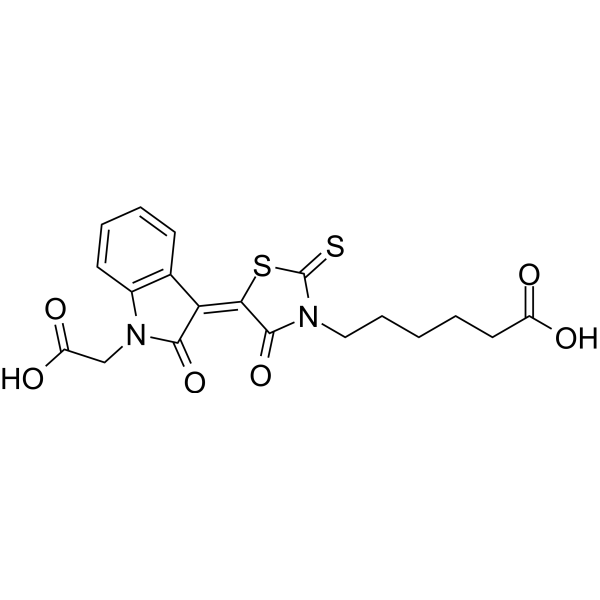
Physicochemical Properties
| Molecular Formula | C19H18N2O6S2 |
| Molecular Weight | 434.49 |
| Appearance | Solid powder |
| HS Tariff Code | 2934.99.9001 |
| Storage |
Powder-20°C 3 years 4°C 2 years In solvent -80°C 6 months -20°C 1 month Note: This product requires protection from light (avoid light exposure) during transportation and storage. |
| Shipping Condition | Room temperature (This product is stable at ambient temperature for a few days during ordinary shipping and time spent in Customs) |
Biological Activity
| ln Vitro | OTUB2-IN-1 (0-40 μM; 2 h) can reduce the level of PD-L1 in tumor cells (NCI-H358, SK-MES-1 and NCI-H226) in a dose-dependent manner, but it cannot affect the stability of OTUB2[1]. OTUB2-IN-1 (0-50 μM; 1 h) does not interfere with the protein interaction between OTUB2 and PD-L1[1]. OTUB2-IN-1 (10 μM; 0-4 d) has no significant inhibitory effect on the viability of B16-F10 tumor cells[1]. |
| ln Vivo | OTUB2-IN-1 (20 mg/kg; ip; once a day for five days) showed the potential to enhance tumor cell immune recognition and immune response in mice implanted with B16-F10 cells[1]. OTUB2-IN-1 (20 mg/kg; ip; once a day for five days) reduced the expression of YAP and phosphorylated p65 in mice implanted with LL/2 cells; reduced the expression of phosphorylated Akt in mice implanted with B16-F10 cells; and reduced the expression of phosphorylated p65 in mice implanted with KLN205 cells[1]. |
| Cell Assay |
Cell Viability Assay[1] Cell Types: B16-F10 tumor Tested Concentrations: 10 μM Incubation Duration: 0-4 d Experimental Results: OTUB2-IN-1 did not show significant inhibitory effects on the viability of B16-F10 tumor cells over a period of up to four days. Western Blot Analysis[1] Cell Types: NCI-H358,SK-MES-1, NCI-H226 Concentration: 0-40 μM Incubation Duration: Experimental Results: Reduced PD-L1 levels in a dose-dependent manner across these cell lines, indicating effective inhibition of OTUB2's functional activity regarding PD-L1 stabilization. However, it did not affect the stability of OTUB2 itself, suggesting that the inhibitor specifically disrupts the PD-L1 regulatory function of OTUB2 without altering OTUB2 protein stability. |
| Animal Protocol |
Animal/Disease Models:C57BL/6 mice implanted with B16-F10 cells or LL/2 cells [1] Doses: 20 mg/kg; daily for five days Route of Administration: i.p Experimental Results: Reduced the expression of PD-L1 on tumor cells, suggesting its potential in enhancing immune recognition and response against tumor cells. Did not significantly impact tumor cell viability directly, indicating its action might be more about modulating immune evasion mechanisms rather than cytotoxic effects. Increased the infiltration of cytotoxic T cells within the tumors, suggesting that reducing PD-L1 levels can indeed make the tumor more susceptible to immune attack.within the tumors, suggesting that reducing PD-L1 levels can indeed make the tumor more susceptible to immune attack. |
| References |
[1]. Ren W et al. Pharmaceutical targeting of OTUB2 sensitizes tumors to cytotoxic T cells via degradation of PD-L1. Nat Commun. 2024 Jan 2;15(1):9. |
Solubility Data
| Solubility (In Vitro) | DMSO : 50 mg/mL (115.08 mM; with sonication) |
| Solubility (In Vivo) |
Note: Listed below are some common formulations that may be used to formulate products with low water solubility (e.g. < 1 mg/mL), you may test these formulations using a minute amount of products to avoid loss of samples. Injection Formulations (e.g. IP/IV/IM/SC) Injection Formulation 1: DMSO : Tween 80: Saline = 10 : 5 : 85 (i.e. 100 μL DMSO stock solution → 50 μL Tween 80 → 850 μL Saline) *Preparation of saline: Dissolve 0.9 g of sodium chloride in 100 mL ddH ₂ O to obtain a clear solution. Injection Formulation 2: DMSO : PEG300 :Tween 80 : Saline = 10 : 40 : 5 : 45 (i.e. 100 μL DMSO → 400 μLPEG300 → 50 μL Tween 80 → 450 μL Saline) Injection Formulation 3: DMSO : Corn oil = 10 : 90 (i.e. 100 μL DMSO → 900 μL Corn oil) Example: Take the Injection Formulation 3 (DMSO : Corn oil = 10 : 90) as an example, if 1 mL of 2.5 mg/mL working solution is to be prepared, you can take 100 μL 25 mg/mL DMSO stock solution and add to 900 μL corn oil, mix well to obtain a clear or suspension solution (2.5 mg/mL, ready for use in animals). Injection Formulation 4: DMSO : 20% SBE-β-CD in saline = 10 : 90 [i.e. 100 μL DMSO → 900 μL (20% SBE-β-CD in saline)] *Preparation of 20% SBE-β-CD in Saline (4°C,1 week): Dissolve 2 g SBE-β-CD in 10 mL saline to obtain a clear solution. Injection Formulation 5: 2-Hydroxypropyl-β-cyclodextrin : Saline = 50 : 50 (i.e. 500 μL 2-Hydroxypropyl-β-cyclodextrin → 500 μL Saline) Injection Formulation 6: DMSO : PEG300 : castor oil : Saline = 5 : 10 : 20 : 65 (i.e. 50 μL DMSO → 100 μLPEG300 → 200 μL castor oil → 650 μL Saline) Injection Formulation 7: Ethanol : Cremophor : Saline = 10: 10 : 80 (i.e. 100 μL Ethanol → 100 μL Cremophor → 800 μL Saline) Injection Formulation 8: Dissolve in Cremophor/Ethanol (50 : 50), then diluted by Saline Injection Formulation 9: EtOH : Corn oil = 10 : 90 (i.e. 100 μL EtOH → 900 μL Corn oil) Injection Formulation 10: EtOH : PEG300:Tween 80 : Saline = 10 : 40 : 5 : 45 (i.e. 100 μL EtOH → 400 μLPEG300 → 50 μL Tween 80 → 450 μL Saline) Oral Formulations Oral Formulation 1: Suspend in 0.5% CMC Na (carboxymethylcellulose sodium) Oral Formulation 2: Suspend in 0.5% Carboxymethyl cellulose Example: Take the Oral Formulation 1 (Suspend in 0.5% CMC Na) as an example, if 100 mL of 2.5 mg/mL working solution is to be prepared, you can first prepare 0.5% CMC Na solution by measuring 0.5 g CMC Na and dissolve it in 100 mL ddH2O to obtain a clear solution; then add 250 mg of the product to 100 mL 0.5% CMC Na solution, to make the suspension solution (2.5 mg/mL, ready for use in animals). Oral Formulation 3: Dissolved in PEG400 Oral Formulation 4: Suspend in 0.2% Carboxymethyl cellulose Oral Formulation 5: Dissolve in 0.25% Tween 80 and 0.5% Carboxymethyl cellulose Oral Formulation 6: Mixing with food powders Note: Please be aware that the above formulations are for reference only. InvivoChem strongly recommends customers to read literature methods/protocols carefully before determining which formulation you should use for in vivo studies, as different compounds have different solubility properties and have to be formulated differently. (Please use freshly prepared in vivo formulations for optimal results.) |
| Preparing Stock Solutions | 1 mg | 5 mg | 10 mg | |
| 1 mM | 2.3015 mL | 11.5077 mL | 23.0155 mL | |
| 5 mM | 0.4603 mL | 2.3015 mL | 4.6031 mL | |
| 10 mM | 0.2302 mL | 1.1508 mL | 2.3015 mL |