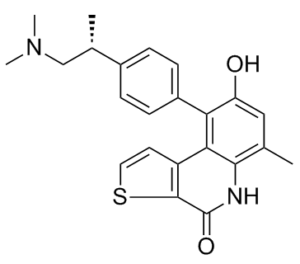
OTS964, a dimethylated derivative of OTS514, is a novel and selective TOPK ((T-lymphokine-activated killer cell-originated protein kinase) inhibitor with potential anticancer activity. The IC50 value of 28 nM indicates that it inhibits TOPK with high selectivity and affinity. An oncogene that is thought to drive tumor growth is TOPK, a protein that is present in a broad range of malignancies and tumors. Consequently, OTS964 may have anticancer properties since it inhibits TOPK. In vitro as well as in xenograft models of human lung cancer, it induces a cytokinesis defect that leads to cancer cells' apoptosis. OTS964 administration resulted in hematopoietic adverse reactions (leukocytopenia linked to thrombocytosis); however, the medication administered in a liposomal formulation successfully eradicated transplanted tumors in mice without causing any adverse reactions.
Physicochemical Properties
| Molecular Formula | C23H24N2O2S | |
| Molecular Weight | 392.5 | |
| Exact Mass | 392.155 | |
| CAS # | 1338542-14-5 | |
| Related CAS # | OTS964 hydrochloride;1338545-07-5 | |
| PubChem CID | 67448186 | |
| Appearance | Typically exists as solid at room temperature | |
| LogP | 4.7 | |
| Hydrogen Bond Donor Count | 2 | |
| Hydrogen Bond Acceptor Count | 4 | |
| Rotatable Bond Count | 4 | |
| Heavy Atom Count | 28 | |
| Complexity | 563 | |
| Defined Atom Stereocenter Count | 1 | |
| SMILES | CC1=CC(=C(C2=C1NC(=O)C3=C2C=CS3)C4=CC=C(C=C4)[C@@H](C)CN(C)C)O |
|
| InChi Key | XCFRUAOZMVFDPQ-AWEZNQCLSA-N | |
| InChi Code | InChI=1S/C23H24N2O2S/c1-13-11-18(26)19(16-7-5-15(6-8-16)14(2)12-25(3)4)20-17-9-10-28-22(17)23(27)24-21(13)20/h5-11,14,26H,12H2,1-4H3,(H,24,27)/t14-/m0/s1 | |
| Chemical Name | 9-[4-[(2R)-1-(dimethylamino)propan-2-yl]phenyl]-8-hydroxy-6-methyl-5H-thieno[2,3-c]quinolin-4-one | |
| Synonyms |
|
|
| HS Tariff Code | 2934.99.9001 | |
| Storage |
Powder-20°C 3 years 4°C 2 years In solvent -80°C 6 months -20°C 1 month |
|
| Shipping Condition | Room temperature (This product is stable at ambient temperature for a few days during ordinary shipping and time spent in Customs) |
Biological Activity
| Targets | CDK11B (Kd = 40 nM); TOPK (IC50 = 28 nM) |
| ln Vitro |
OTS964 (10 nM; 48 hours) inhibits the growth of cancer cells[1]. OTS964 (10 nM; 48 h) promotes the death of cancer cells[1]. OTS964 (0.1-2 μM; 24 and 48 hours) increases the expression of LC3-II and decreases the expression of P62 in a dose-dependent manner[3]. |
| ln Vivo |
Even after treatment, OTS964 (intravenously administered at a dose of 40 mg/kg on days 1, 4, 8, 11, 15, and 18) causes tumors to shrink, ultimately revealing complete regression[1]. OTS964 (oral; 50 or 100 mg/kg/day for two weeks) completely eradicates tumors[1]. |
| Enzyme Assay | The dimethylated derivative of OTS514, OTS964, is a strong and specific inhibitor of TOPK (T-lymphokine-activated killer cell-originated protein kinase). With an IC50 value of 28 nM, it selectively and with high affinity inhibits TOPK. It is thought that the protein TOPK, which is present in many different types of cancer and tumors, functions as an oncogene to encourage the growth of tumors. OTS964 may therefore have anticancer properties because it is a TOPK inhibitor. Both in vitro and in xenograft models of human lung cancer, it results in a cytokinesis defect and subsequent apoptosis of cancer cells. |
| Cell Assay | The following cells are plated at a specific density in 96-well plates: 100 μl, A549 cells, LU-99 cells, DU4475 cells, MDA-MB-231 cells, T47D cells, Daudi cells, UM-UC-3 cells, HCT-116 cells, MKN1 cells, MKN45 cells, HepG2 cells, MIAPaca-2 cells, 22Rv1 cells, and HT29 cells. Before the cells are exposed to compounds for 72 hours at 37°C, they are allowed to adhere for one night. Using a spectrophotometer set to 450 nm, plates are read. Every assay is run in triplicate. We compute the z scores to get P values after measuring the IC50 values. The mean and standard deviation of the log values of the IC50 for each of the 13 TOPK-positive cell lines are determined following the log transformation (base 10) of the IC50 values (nM). |
| Animal Protocol |
Nude mice bearing LU-99 lung cancer cells 40 mg/kg Intravenously; on days 1, 4, 8, 11, 15, and 18 |
| References |
[1]. TOPK inhibitor induces complete tumor regression in xenograft models of human cancerthrough inhibition of cytokinesis. Sci Transl Med. 2014 Oct 22;6(259):259ra145. [2]. Off-target toxicity is a common mechanism of action of cancer drugs undergoing clinical trials. Sci Transl Med. 2019 Sep 11;11(509). [3]. TOPK inhibits autophagy by phosphorylating ULK1 and promotes glioma resistance to TMZ. Cell Death Dis. 2019 Aug 5;10(8):583. |
Solubility Data
| Solubility (In Vitro) |
|
|||
| Solubility (In Vivo) |
Note: Listed below are some common formulations that may be used to formulate products with low water solubility (e.g. < 1 mg/mL), you may test these formulations using a minute amount of products to avoid loss of samples. Injection Formulations (e.g. IP/IV/IM/SC) Injection Formulation 1: DMSO : Tween 80: Saline = 10 : 5 : 85 (i.e. 100 μL DMSO stock solution → 50 μL Tween 80 → 850 μL Saline) *Preparation of saline: Dissolve 0.9 g of sodium chloride in 100 mL ddH ₂ O to obtain a clear solution. Injection Formulation 2: DMSO : PEG300 :Tween 80 : Saline = 10 : 40 : 5 : 45 (i.e. 100 μL DMSO → 400 μLPEG300 → 50 μL Tween 80 → 450 μL Saline) Injection Formulation 3: DMSO : Corn oil = 10 : 90 (i.e. 100 μL DMSO → 900 μL Corn oil) Example: Take the Injection Formulation 3 (DMSO : Corn oil = 10 : 90) as an example, if 1 mL of 2.5 mg/mL working solution is to be prepared, you can take 100 μL 25 mg/mL DMSO stock solution and add to 900 μL corn oil, mix well to obtain a clear or suspension solution (2.5 mg/mL, ready for use in animals). Injection Formulation 4: DMSO : 20% SBE-β-CD in saline = 10 : 90 [i.e. 100 μL DMSO → 900 μL (20% SBE-β-CD in saline)] *Preparation of 20% SBE-β-CD in Saline (4°C,1 week): Dissolve 2 g SBE-β-CD in 10 mL saline to obtain a clear solution. Injection Formulation 5: 2-Hydroxypropyl-β-cyclodextrin : Saline = 50 : 50 (i.e. 500 μL 2-Hydroxypropyl-β-cyclodextrin → 500 μL Saline) Injection Formulation 6: DMSO : PEG300 : castor oil : Saline = 5 : 10 : 20 : 65 (i.e. 50 μL DMSO → 100 μLPEG300 → 200 μL castor oil → 650 μL Saline) Injection Formulation 7: Ethanol : Cremophor : Saline = 10: 10 : 80 (i.e. 100 μL Ethanol → 100 μL Cremophor → 800 μL Saline) Injection Formulation 8: Dissolve in Cremophor/Ethanol (50 : 50), then diluted by Saline Injection Formulation 9: EtOH : Corn oil = 10 : 90 (i.e. 100 μL EtOH → 900 μL Corn oil) Injection Formulation 10: EtOH : PEG300:Tween 80 : Saline = 10 : 40 : 5 : 45 (i.e. 100 μL EtOH → 400 μLPEG300 → 50 μL Tween 80 → 450 μL Saline) Oral Formulations Oral Formulation 1: Suspend in 0.5% CMC Na (carboxymethylcellulose sodium) Oral Formulation 2: Suspend in 0.5% Carboxymethyl cellulose Example: Take the Oral Formulation 1 (Suspend in 0.5% CMC Na) as an example, if 100 mL of 2.5 mg/mL working solution is to be prepared, you can first prepare 0.5% CMC Na solution by measuring 0.5 g CMC Na and dissolve it in 100 mL ddH2O to obtain a clear solution; then add 250 mg of the product to 100 mL 0.5% CMC Na solution, to make the suspension solution (2.5 mg/mL, ready for use in animals). Oral Formulation 3: Dissolved in PEG400 Oral Formulation 4: Suspend in 0.2% Carboxymethyl cellulose Oral Formulation 5: Dissolve in 0.25% Tween 80 and 0.5% Carboxymethyl cellulose Oral Formulation 6: Mixing with food powders Note: Please be aware that the above formulations are for reference only. InvivoChem strongly recommends customers to read literature methods/protocols carefully before determining which formulation you should use for in vivo studies, as different compounds have different solubility properties and have to be formulated differently. (Please use freshly prepared in vivo formulations for optimal results.) |
| Preparing Stock Solutions | 1 mg | 5 mg | 10 mg | |
| 1 mM | 2.5478 mL | 12.7389 mL | 25.4777 mL | |
| 5 mM | 0.5096 mL | 2.5478 mL | 5.0955 mL | |
| 10 mM | 0.2548 mL | 1.2739 mL | 2.5478 mL |