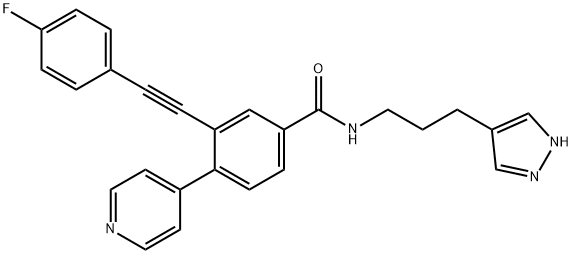
Physicochemical Properties
| Molecular Formula | C26H21FN4O |
| Molecular Weight | 424.469548940659 |
| Exact Mass | 424.169 |
| CAS # | 1800487-55-1 |
| Related CAS # | 1800487-55-1;OT-82 HCl; |
| PubChem CID | 118203189 |
| Appearance | White to light yellow solid powder |
| LogP | 4.5 |
| Hydrogen Bond Donor Count | 2 |
| Hydrogen Bond Acceptor Count | 4 |
| Rotatable Bond Count | 8 |
| Heavy Atom Count | 32 |
| Complexity | 659 |
| Defined Atom Stereocenter Count | 0 |
| SMILES | FC1C=CC(=CC=1)C#CC1C=C(C=CC=1C1C=CN=CC=1)C(NCCCC1C=NNC=1)=O |
| InChi Key | CEPAXRIKSUXHHB-UHFFFAOYSA-N |
| InChi Code | InChI=1S/C26H21FN4O/c27-24-8-4-19(5-9-24)3-6-22-16-23(7-10-25(22)21-11-14-28-15-12-21)26(32)29-13-1-2-20-17-30-31-18-20/h4-5,7-12,14-18H,1-2,13H2,(H,29,32)(H,30,31) |
| Chemical Name | 3-[2-(4-fluorophenyl)ethynyl]-N-[3-(1H-pyrazol-4-yl)propyl]-4-pyridin-4-ylbenzamide |
| Synonyms | OT82 OT 82 |
| HS Tariff Code | 2934.99.9001 |
| Storage |
Powder-20°C 3 years 4°C 2 years In solvent -80°C 6 months -20°C 1 month |
| Shipping Condition | Room temperature (This product is stable at ambient temperature for a few days during ordinary shipping and time spent in Customs) |
Biological Activity
| Targets |
|
|
| ln Vitro | For a duration of 72 hours, OT-82 (0.0001-10 μM) exhibits tissue-specific (HP versus non-HP) cytotoxicity. Its IC50 values are 2.11 nM, 2.70 nM, 1.05 nM, and 1.36 nM for HP cell lines MV4–11, U937, RS4;11, HEL92.1.7, and PER485 cell proliferation, respectively. With IC50 values of 37.92 nM, 29.52 nM, 15.67 nM, and 7.95 nM, respectively, it also inhibits the development of nonHP cell lines MCF-7, U87, HT29, and H1299[1]. OT-82 exhibits cytotoxicity that is cancer-selective (tumor vs. normal). The IC50 values for AML and ALL donors, respectively, are 31 nM and 7.10 nM, indicating that it is more sensitive to BMMNC from leukemia patients. In healthy donors, the IC50 value for BMMNC is 62.69 nM[1]. In MV4-11 cells, OT-82 (0.001-10 μM; 48 hours) generates dose-dependent decreases in cellular NAD and ATP concentrations as well as inhibits the activity of recombinant NAMPT[1]. (0.01-100 nM; 48 hours) causes the mitochondrial membrane of MV4–11 cells to depolarize, an increase in the percentage of cells with sub-G1 DNA content, and the activation of caspase-3[1]. | |
| ln Vivo | In the SC xenograft model of Burkitt's lymphoma, OT-82 (oral gavage; 20 or 40 mg/kg; 3 weeks) treatment increases survival to 100% and 56% at 40 or 20 mg/kg, respectively, after treatment discontinuation[1]. | |
| Cell Assay |
Cell Viability Assay[1] Cell Types: HP cell lines (MV4–11, U937, RS4;11, HEL92.1.7, PER485) Non-HP cell lines (MCF-7, U87, HT29, H1299) Tested Concentrations: 0.0001 μM-10 μM Incubation Duration: 72 hrs (hours) Experimental Results: Was against human cell lines derived from hematological malignancies (HP) with IC50 values ranging from 1.10 nM to 5.86 nM, and was against non-HP cancers with IC50 ranging from 1.10 nM to 37.92 nM[1]. [1] Cell Types: MV4–11 cells Tested Concentrations: 0.01-100 nM Incubation Duration: 48 hrs (hours) Experimental Results: demonstrated hallmarks of apoptotic cell death |
|
| Animal Protocol |
Animal/Disease Models: SC xenograft model of Burkitt's lymphoma in SCID (severe combined immunodeficient) mouse[1] Doses: 20 or 40 mg/kg Route of Administration: po (oral gavage); 3 weeks Experimental Results: Potently inhibited tumor growth of multiple myeloma mouse model. |
|
| References |
[1]. OT-82, a novel anticancer drug candidate that targets the strong dependence of hematological malignancies on NAD biosynthesis.Leukemia. 2020 Jan 2. |
|
| Additional Infomation | NAMPT Inhibitor OT-82 is an orally bioavailable, small molecule inhibitor of the nicotinamide adenine dinucleotide (NAD)-synthesizing enzyme nicotinamide phosphoribosyltransferase (NAMPT; NAMPRTase), with potential antineoplastic activity. Upon oral administration, NAMPT inhibitor OT-82 binds to and inhibits the activity of NAMPT. This depletes cellular NAD and inhibits NAD-dependent enzymes, both of which are needed for rapid cell proliferation; this results in cell death in NAMPT-overexpressing cancer cells. NAMPT, an enzyme that is responsible for maintaining the intracellular NAD pool, plays a key role in the regulation of cellular metabolism and has cytokine-like activities. NAMPT is overexpressed in a variety of cancers and metabolic disorders; tumor cells rely on NAMPT activity for their NAD supply. |
Solubility Data
| Solubility (In Vitro) | DMSO : ~100 mg/mL (~235.59 mM) |
| Solubility (In Vivo) |
Solubility in Formulation 1: ≥ 2.08 mg/mL (4.90 mM) (saturation unknown) in 10% DMSO + 40% PEG300 + 5% Tween80 + 45% Saline (add these co-solvents sequentially from left to right, and one by one), clear solution. For example, if 1 mL of working solution is to be prepared, you can add 100 μL of 20.8 mg/mL clear DMSO stock solution to 400 μL PEG300 and mix evenly; then add 50 μL Tween-80 to the above solution and mix evenly; then add 450 μL normal saline to adjust the volume to 1 mL. Preparation of saline: Dissolve 0.9 g of sodium chloride in 100 mL ddH₂ O to obtain a clear solution. Solubility in Formulation 2: ≥ 2.08 mg/mL (4.90 mM) (saturation unknown) in 10% DMSO + 90% (20% SBE-β-CD in Saline) (add these co-solvents sequentially from left to right, and one by one), clear solution. For example, if 1 mL of working solution is to be prepared, you can add 100 μL of 20.8 mg/mL clear DMSO stock solution to 900 μL of 20% SBE-β-CD physiological saline solution and mix evenly. Preparation of 20% SBE-β-CD in Saline (4°C,1 week): Dissolve 2 g SBE-β-CD in 10 mL saline to obtain a clear solution. Solubility in Formulation 3: ≥ 2.08 mg/mL (4.90 mM) (saturation unknown) in 10% DMSO + 90% Corn Oil (add these co-solvents sequentially from left to right, and one by one), clear solution. For example, if 1 mL of working solution is to be prepared, you can add 100 μL of 20.8 mg/mL clear DMSO stock solution to 900 μL of corn oil and mix evenly. (Please use freshly prepared in vivo formulations for optimal results.) |
| Preparing Stock Solutions | 1 mg | 5 mg | 10 mg | |
| 1 mM | 2.3559 mL | 11.7794 mL | 23.5588 mL | |
| 5 mM | 0.4712 mL | 2.3559 mL | 4.7118 mL | |
| 10 mM | 0.2356 mL | 1.1779 mL | 2.3559 mL |