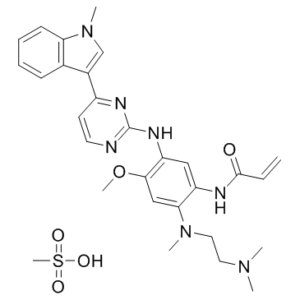
Osimertinib mesylate (formerly known as AZD9291; AZD-9291; AZD 9291; mereletinib; Tagrisso), the mesylate salt of osimertinib, is a novel, potent, oral bioavailable, irreversible, and mutant-selective, 3rd generation EGFR inhibitor approved by both FDA and the European Commission for cancer treatment. In LoVo cells, it inhibits WT EGFR, L858R/T790M EGFR, and Exon 19 deletion EGFR with IC50 values of 12.92, 11.44, and 493.8 nM, respectively.
Physicochemical Properties
| Molecular Formula | C29H37N7O5S |
| Molecular Weight | 595.72 |
| Exact Mass | 595.257 |
| Elemental Analysis | C, 58.47; H, 6.26; N, 16.46; O, 13.43; S, 5.38 |
| CAS # | 1421373-66-1 |
| Related CAS # | Osimertinib;1421373-65-0;Osimertinib-d6;1638281-44-3;Osimertinib dimesylate;2070014-82-1 |
| PubChem CID | 78357807 |
| Appearance | Light yellow solid powder |
| LogP | 5.817 |
| Hydrogen Bond Donor Count | 3 |
| Hydrogen Bond Acceptor Count | 10 |
| Rotatable Bond Count | 10 |
| Heavy Atom Count | 42 |
| Complexity | 845 |
| Defined Atom Stereocenter Count | 0 |
| SMILES | S(C([H])([H])[H])(=O)(=O)O[H].O(C([H])([H])[H])C1=C(C([H])=C(C(=C1[H])N(C([H])([H])[H])C([H])([H])C([H])([H])N(C([H])([H])[H])C([H])([H])[H])N([H])C(C([H])=C([H])[H])=O)N([H])C1=NC([H])=C([H])C(C2=C([H])N(C([H])([H])[H])C3=C([H])C([H])=C([H])C([H])=C32)=N1 |
| InChi Key | FUKSNUHSJBTCFJ-UHFFFAOYSA-N |
| InChi Code | InChI=1S/C28H33N7O2.CH4O3S/c1-7-27(36)30-22-16-23(26(37-6)17-25(22)34(4)15-14-33(2)3)32-28-29-13-12-21(31-28)20-18-35(5)24-11-9-8-10-19(20)24;1-5(2,3)4/h7-13,16-18H,1,14-15H2,2-6H3,(H,30,36)(H,29,31,32);1H3,(H,2,3,4) |
| Chemical Name | N-[2-[2-(dimethylamino)ethyl-methylamino]-4-methoxy-5-[[4-(1-methylindol-3-yl)pyrimidin-2-yl]amino]phenyl]prop-2-enamide;methanesulfonic acid |
| Synonyms | AZD-9291 mesylate; Mereletinib mesylate; AZD9291; AZD 9291; Trade name: Tagrisso |
| HS Tariff Code | 2934.99.9001 |
| Storage |
Powder-20°C 3 years 4°C 2 years In solvent -80°C 6 months -20°C 1 month Note: Please store this product in a sealed and protected environment, avoid exposure to moisture. |
| Shipping Condition | Room temperature (This product is stable at ambient temperature for a few days during ordinary shipping and time spent in Customs) |
Biological Activity
| Targets |
EGFRL858R/T790M (IC50 = 1 nM); EGFRL858R (IC50 = 12 nM) METTL7B is expressed at a higher level in lung adenocarcinoma (LUAD) cells that are resistant to osimertinib than in cells that are sensitive to the drug. LUAD cells were re-sensitized to osimertinib after METTL7B was knocked down using GNC-siRNA.[1] |
| ln Vitro |
METTL7B is expressed at a higher level in lung adenocarcinoma (LUAD) cells that are resistant to osimertinib than in cells that are sensitive to the drug. LUAD cells were re-sensitized to osimertinib after METTL7B was knocked down using GNC-siRNA.[1] Overexpression of METTL7B in LUAD cell lines (PC9 and HCC827) induced resistance to osimertinib, increasing the IC50 by 2-3 fold compared to vector control cells. Conversely, knockdown of METTL7B in osimertinib-resistant cell lines (PC9-OR, PC9-GR, H1975) re-sensitized them to osimertinib, decreasing the IC50 to 40%-80% of control levels. METTL7B-induced resistance to osimertinib was associated with enhanced glutathione metabolism, increased expression and enzymatic activity of antioxidant enzymes (GPX4, SOD1, HMOX1), and elevated m6A RNA modification. Treatment with the ROS scavenging inhibitor BSO (200 μM) or the m6A modification inhibitor 3-Deazaadenosine (3-DA, 10 μM) reversed the METTL7B-mediated resistance to osimertinib in vitro. [1] Gold nanocluster-assisted delivery of siRNA targeting METTL7B (GNC-siMETTL7B) combined with osimertinib significantly re-sensitized osimertinib-resistant PC9-OR cells, lowering the IC50 compared to treatment with siRNA control. [1] |
| ln Vivo |
METTL7B is considerably higher in osimertinib-resistant xenografts than in osimertinib-sensitive xenografts at the mRNA and protein levels. Combining GNC-siMETTL7B (6 mg siRNA per mouse equivalent) with osimertinib (30 mg/kg) treatment significantly suppresses tumor growth in the LUAD CDX mouse model. In cell-derived xenograft (CDX) mouse models, tumors formed from METTL7B-overexpressing PC9 cells showed significant resistance to treatment with osimertinib (30 mg/kg, orally, daily), as evidenced by continued tumor growth compared to vector control tumors which regressed. [1] In a doxycycline-inducible METTL7B expression CDX model, induction of METTL7B expression conferred resistance to osimertinib treatment. [1] Knockdown of METTL7B using GNC-siMETTL7B in combination with osimertinib (30 mg/kg, orally, daily) significantly suppressed tumor growth in osimertinib-resistant PC9-OR CDX models compared to osimertinib treatment alone. [1] Combination treatment with the glutathione biosynthesis inhibitor BSO (450 mg/kg, intraperitoneally, every other day) abrogated METTL7B-induced resistance to osimertinib in CDX mouse models. [1] |
| Enzyme Assay | Osimertinib, formerly known as mereletinib and AZD-9291, is a third generation EGFR inhibitor that is available orally and is irreversible. It selectively targets specific mutants of EGFR, with IC50 values of 493.8 nM for wild-type EGFR in LoVo cells, L858R/T790M EGFR, and Exon 19 deletion EGFR, respectively. It reduces the side effects associated with currently available medications by inhibiting both activating and resistant EGFR mutations while protecting the normal form of EGFR found in normal skin and gut cells. |
| Cell Assay |
In 96-well plates, cells are plated at a density of 3,000 cells per well. Addition of osimertinib to the medium results in a 72-hour treatment. Cell Counting Kit-8 is used to perform assays for cell viability. For cell viability assays, LUAD cells were plated in 96-well plates at a density of 3,000 cells per well. Osimertinib was dissolved in DMSO and diluted in culture medium. Cells were treated with a range of concentrations of osimertinib or vehicle control for 72 hours. Cell viability was assessed using a Cell Counting Kit-8 (CCK-8) according to the manufacturer's instructions. Absorbance was measured, and IC50 values were calculated and compared using GraphPad Prism software. [1] To assess oxidative stress, intracellular ROS levels were measured using a fluorescent probe (DCFH-DA). Cells were incubated with the probe for 30 minutes at 37°C, and fluorescence was measured at 488 nm excitation and 525 nm emission. RNS levels were measured using a specific fluorescent probe, incubated for 30 minutes at 37°C, with measurement at 490 nm excitation and 516 nm emission. [1] For detection of SOD enzymatic activity, cell protein extracts were incubated with a WST-8/enzyme working solution for 30 minutes at 37°C, and absorbance was measured at 450 nm. For GPX enzymatic activity, cell protein extracts were incubated with a GPX detection working solution containing NADPH for 15 minutes at 25°C. After adding peroxide, absorbance at 340 nm was continuously monitored for 5 minutes. [1] Gold nanocluster-assisted delivery of siRNA (GNC-siRNA) complexes were prepared by mixing positively charged gold nanoclusters with siRNA solution in ultrapure water and shaking to allow electrostatic binding. The formed GNC-siMETTL7B complexes were then used to transfert cells. [1] |
| Animal Protocol |
5 mg/kg; p.oEGFRm+ and EGFRm+/T790M transgenic mice
METTL7B-overexpressed LUAD cell lines, gefitinib and osimertinib-resistant Cell-Derived tumor Xenograft (CDX) and Patient-Derived tumor Xenograft (PDX) mouse models were employed to evaluate the role of METTL7B in TKIs resistance. Ultraperformance liquid chromatography-tandem mass spectrometer (UPLC-MS/MS) was used to identify the metabolites regulated by METTL7B. Methylated RNA immunoprecipitation (MeRIP)-qPCR analysis was performed to measure the N6-methyladenosine (m6A) status of mRNA of METTL7B targeted genes. Gold nanocluster-assisted delivery of siRNA targeting METTL7B (GNC-siMETTL7B) was applied to evaluate the effect of METTL7B in TKIs resistance.[1] For Cell-Derived Xenograft (CDX) models, LUAD cells (e.g., PC9, PC9-OR, PC9-GR; 1×10⁷ cells per mouse) were subcutaneously inoculated into the flanks of female BALB/c nu/nu mice (4-5 weeks old). [1] For the doxycycline-inducible METTL7B expression model, PC9 cells carrying the inducible construct were inoculated. [1] After tumors reached a stable size, mice were randomized into treatment groups. Osimertinib was administered orally (po) at a dose of 30 mg/kg body weight, once daily (qd). [1] In combination therapy studies, osimertinib (30 mg/kg, po, qd) was administered alongside either BSO (450 mg/kg, intraperitoneally, every other day) or GNC-siMETTL7B complexes (containing 6 mg siRNA equivalent per mouse, administration route inferred as intravenous or intratumoral but not explicitly stated in the provided text). [1] For the inducible model, doxycycline (1.5 mg/mL in drinking water or equivalent) was administered to induce METTL7B expression. [1] Tumor dimensions were measured regularly with calipers, and tumor volume was calculated using the formula V = L × W2 / 2. Body weights were also monitored. [1] |
| ADME/Pharmacokinetics |
Osimertinib is administered orally. The recommended clinical dose is 80 mg once daily. [2] The review mentions that osimertinib has excellent CNS penetration based on preclinical and clinical evidence. [2] |
| Toxicity/Toxicokinetics |
In the AURA3 trial, osimertinib was better tolerated than platinum-pemetrexed chemotherapy, with a lower incidence of grade ≥3 adverse effects (23% vs. 47%). [2] In the first-line FLAURA trial, osimertinib had a lower incidence of grade ≥3 adverse effects compared to first-generation EGFR-TKIs (34% vs. 45%). [2] A combination trial of osimertinib and the immune checkpoint inhibitor durvalumab was stopped due to an increased incidence of pulmonary toxicity. [2] |
| References |
[1]. Mol Cancer . 2022 Feb 10;21(1):43. [2]. Br J Cancer . 2019 Oct;121(9):725-737. |
| Additional Infomation |
Osimertinib mesylate is a methanesulfonate (mesylate) salt prepared from equimolar amounts of osimertinib and methanesulfonic acid. It is used for treatment of EGFR T790M mutation positive non-small cell lung cancer. It has a role as an antineoplastic agent and an epidermal growth factor receptor antagonist. It contains an osimertinib(1+). Osimertinib Mesylate is the mesylate salt form of osimertinib, a third-generation, orally available, irreversible, mutant-selective, epidermal growth factor receptor (EGFR) inhibitor, with potential antineoplastic activity. Upon oral administration, osimertinib covalently binds to and inhibits the activity of numerous mutant forms of EGFR, including the secondarily-acquired resistance mutation T790M, L858R, and exon 19 deletions, thereby preventing EGFR-mediated signaling. This may both induce cell death and inhibit tumor growth in EGFR-overexpressing tumor cells. EGFR, a receptor tyrosine kinase mutated in many tumor cell types, plays a key role in tumor cell proliferation and tumor vascularization. As this agent is selective towards mutant forms of EGFR, its toxicity profile may be reduced when compared to non-selective EGFR inhibitors which also inhibit wild-type EGFR. See also: Osimertinib (has active moiety). Osimertinib is a third-generation Epidermal Growth Factor Receptor Tyrosine Kinase Inhibitor (EGFR-TKI) used in the treatment of EGFR-mutant non-small cell lung cancer (NSCLC), specifically lung adenocarcinoma (LUAD). [1] This study investigates resistance mechanisms to EGFR-TKIs, including osimertinib. It identifies methyltransferase-like 7B (METTL7B) as a key contributor to osimertinib resistance in LUAD, independent of secondary EGFR mutations. METTL7B promotes resistance by enhancing cellular antioxidant defense through upregulation of GPX4, SOD1, and HMOX1 via m6A RNA modification, thereby scavenging reactive oxygen species (ROS) whose accumulation can contribute to TKI efficacy. [1] Targeting METTL7B (e.g., via siRNA knockdown) is proposed as a potential strategy to reverse osimertinib resistance. [1] |
Solubility Data
| Solubility (In Vitro) |
|
|||
| Solubility (In Vivo) |
Solubility in Formulation 1: ≥ 1.39 mg/mL (2.33 mM) (saturation unknown) in 10% DMSO + 40% PEG300 + 5% Tween80 + 45% Saline (add these co-solvents sequentially from left to right, and one by one), clear solution. For example, if 1 mL of working solution is to be prepared, you can add 100 μL of 13.9 mg/mL clear DMSO stock solution to 400 μL PEG300 and mix evenly; then add 50 μL Tween-80 to the above solution and mix evenly; then add 450 μL normal saline to adjust the volume to 1 mL. Preparation of saline: Dissolve 0.9 g of sodium chloride in 100 mL ddH₂ O to obtain a clear solution. Solubility in Formulation 2: ≥ 1.39 mg/mL (2.33 mM) (saturation unknown) in 10% DMSO + 90% (20% SBE-β-CD in Saline) (add these co-solvents sequentially from left to right, and one by one), clear solution. For example, if 1 mL of working solution is to be prepared, you can add 100 μL of 13.9 mg/mL clear DMSO stock solution to 900 μL of 20% SBE-β-CD physiological saline solution and mix evenly. Preparation of 20% SBE-β-CD in Saline (4°C,1 week): Dissolve 2 g SBE-β-CD in 10 mL saline to obtain a clear solution. Solubility in Formulation 3: ≥ 1.39 mg/mL (2.33 mM) (saturation unknown) in 10% DMSO + 90% Corn Oil (add these co-solvents sequentially from left to right, and one by one), clear solution. For example, if 1 mL of working solution is to be prepared, you can add 100 μL of 13.9 mg/mL clear DMSO stock solution to 900 μL of corn oil and mix evenly. Solubility in Formulation 4: 1% DMSO+30% PEG 300+dd H2O: 30mg/mL (Please use freshly prepared in vivo formulations for optimal results.) |
| Preparing Stock Solutions | 1 mg | 5 mg | 10 mg | |
| 1 mM | 1.6786 mL | 8.3932 mL | 16.7864 mL | |
| 5 mM | 0.3357 mL | 1.6786 mL | 3.3573 mL | |
| 10 mM | 0.1679 mL | 0.8393 mL | 1.6786 mL |