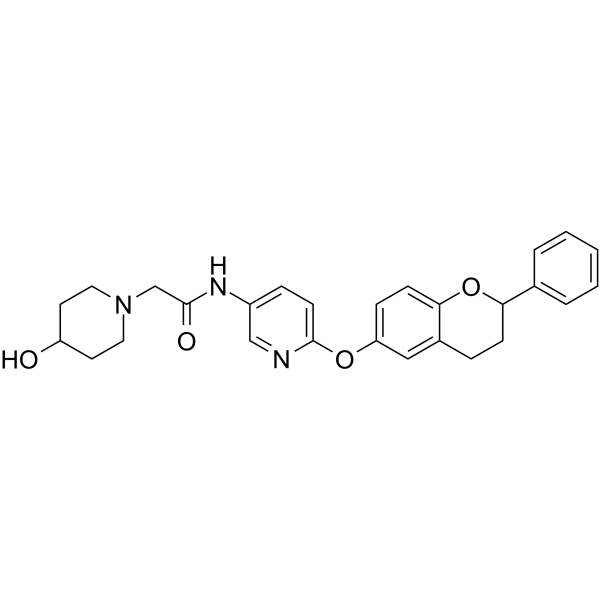
Physicochemical Properties
| Molecular Formula | C27H29N3O4 |
| Molecular Weight | 459.5369 |
| Exact Mass | 459.215 |
| CAS # | 763926-98-3 |
| PubChem CID | 69016811 |
| Appearance | Light yellow to yellow solid powder |
| LogP | 3.7 |
| Hydrogen Bond Donor Count | 2 |
| Hydrogen Bond Acceptor Count | 6 |
| Rotatable Bond Count | 6 |
| Heavy Atom Count | 34 |
| Complexity | 650 |
| Defined Atom Stereocenter Count | 0 |
| SMILES | O([H])C1([H])C([H])([H])C([H])([H])N(C([H])([H])C(N([H])C2=C([H])N=C(C([H])=C2[H])OC2C([H])=C([H])C3=C(C=2[H])C([H])([H])C([H])([H])C([H])(C2C([H])=C([H])C([H])=C([H])C=2[H])O3)=O)C([H])([H])C1([H])[H] |
| InChi Key | UPGUBLDTYLMRHO-UHFFFAOYSA-N |
| InChi Code | InChI=1S/C27H29N3O4/c31-22-12-14-30(15-13-22)18-26(32)29-21-7-11-27(28-17-21)33-23-8-10-25-20(16-23)6-9-24(34-25)19-4-2-1-3-5-19/h1-5,7-8,10-11,16-17,22,24,31H,6,9,12-15,18H2,(H,29,32) |
| Chemical Name | 2-(4-hydroxypiperidin-1-yl)-N-[6-[(2-phenyl-3,4-dihydro-2H-chromen-6-yl)oxy]pyridin-3-yl]acetamide |
| HS Tariff Code | 2934.99.9001 |
| Storage |
Powder-20°C 3 years 4°C 2 years In solvent -80°C 6 months -20°C 1 month |
| Shipping Condition | Room temperature (This product is stable at ambient temperature for a few days during ordinary shipping and time spent in Customs) |
Biological Activity
| ln Vitro | In dog ventricular myocytes, concentration-dependent reduction of NCX currents is observed with ORM-10962 (10 nM, 100 nM, and 1 μM), with estimated IC50 values of 55 and 67 nM mV at -80 and 20 mV, respectively [1]. |
| ln Vivo | In anesthetized guinea pigs, the administration of ORM-10962 (0.3 mg/kg, IV, once) markedly postpones the onset of anesthesia and premature ventricular contractions (about 50%) or ventricular tachycardia (about 30%) [1]. |
| Animal Protocol |
Animal/Disease Models: Male guinea pigs (250-300 g) [1] Doses: 0.3 mg/kg Route of Administration: intravenous (iv) (iv)injection, 10 minutes before starting ouabain infusion Experimental Results: Significant delay in the development of premature ventricular contractions (from 24 in the control group ±1.7 minutes to 36.6±2.7 minutes in the presence of drug) or ventricular tachycardia (from 31.8±1.8 minutes in the control group to 40.8±2.1 minutes in the presence of drug). |
| References |
[1]. The Effect of a Novel Highly Selective Inhibitor of the Sodium/Calcium Exchanger (NCX) on Cardiac Arrhythmias in In Vitro and In Vivo Experiments. PLoS One. 2016 Nov 10;11(11):e0166041. [2]. Inotropic effect of NCX inhibition depends on the relative activity of the reverse NCX assessed by a novel inhibitor ORM-10962 on canine ventricular myocytes. Eur J Pharmacol. 2018 Jan 5;818:278-286. [3]. Novel Na+/Ca2+ Exchanger Inhibitor ORM-10962 Supports Coupled Function of Funny-Current and Na+/Ca2+ Exchanger in Pacemaking of Rabbit Sinus Node Tissue. Front Pharmacol. 2020 Jan 29;10:1632. |
Solubility Data
| Solubility (In Vitro) | DMSO : ~250 mg/mL (~544.02 mM) |
| Solubility (In Vivo) |
Solubility in Formulation 1: ≥ 2.08 mg/mL (4.53 mM) (saturation unknown) in 10% DMSO + 40% PEG300 + 5% Tween80 + 45% Saline (add these co-solvents sequentially from left to right, and one by one), clear solution. For example, if 1 mL of working solution is to be prepared, you can add 100 μL of 20.8 mg/mL clear DMSO stock solution to 400 μL PEG300 and mix evenly; then add 50 μL Tween-80 to the above solution and mix evenly; then add 450 μL normal saline to adjust the volume to 1 mL. Preparation of saline: Dissolve 0.9 g of sodium chloride in 100 mL ddH₂ O to obtain a clear solution. Solubility in Formulation 2: ≥ 2.08 mg/mL (4.53 mM) (saturation unknown) in 10% DMSO + 90% (20% SBE-β-CD in Saline) (add these co-solvents sequentially from left to right, and one by one), clear solution. For example, if 1 mL of working solution is to be prepared, you can add 100 μL of 20.8 mg/mL clear DMSO stock solution to 900 μL of 20% SBE-β-CD physiological saline solution and mix evenly. Preparation of 20% SBE-β-CD in Saline (4°C,1 week): Dissolve 2 g SBE-β-CD in 10 mL saline to obtain a clear solution. Solubility in Formulation 3: ≥ 2.08 mg/mL (4.53 mM) (saturation unknown) in 10% DMSO + 90% Corn Oil (add these co-solvents sequentially from left to right, and one by one), clear solution. For example, if 1 mL of working solution is to be prepared, you can add 100 μL of 20.8 mg/mL clear DMSO stock solution to 900 μL of corn oil and mix evenly. (Please use freshly prepared in vivo formulations for optimal results.) |
| Preparing Stock Solutions | 1 mg | 5 mg | 10 mg | |
| 1 mM | 2.1761 mL | 10.8804 mL | 21.7609 mL | |
| 5 mM | 0.4352 mL | 2.1761 mL | 4.3522 mL | |
| 10 mM | 0.2176 mL | 1.0880 mL | 2.1761 mL |