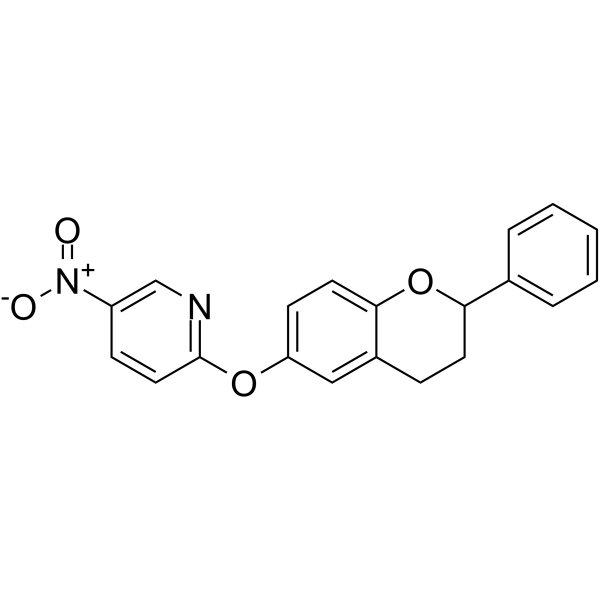
Physicochemical Properties
| Molecular Formula | C20H16N2O4 |
| Molecular Weight | 348.352 |
| Exact Mass | 348.111 |
| CAS # | 488847-28-5 |
| PubChem CID | 17978512 |
| Appearance | White to off-white solid powder |
| LogP | 5.371 |
| Hydrogen Bond Donor Count | 0 |
| Hydrogen Bond Acceptor Count | 5 |
| Rotatable Bond Count | 3 |
| Heavy Atom Count | 26 |
| Complexity | 477 |
| Defined Atom Stereocenter Count | 0 |
| InChi Key | GZONLGPIHCCJOI-UHFFFAOYSA-N |
| InChi Code | InChI=1S/C20H16N2O4/c23-22(24)16-7-11-20(21-13-16)25-17-8-10-19-15(12-17)6-9-18(26-19)14-4-2-1-3-5-14/h1-5,7-8,10-13,18H,6,9H2 |
| Chemical Name | 5-nitro-2-[(2-phenyl-3,4-dihydro-2H-chromen-6-yl)oxy]pyridine |
| HS Tariff Code | 2934.99.9001 |
| Storage |
Powder-20°C 3 years 4°C 2 years In solvent -80°C 6 months -20°C 1 month |
| Shipping Condition | Room temperature (This product is stable at ambient temperature for a few days during ordinary shipping and time spent in Customs) |
Biological Activity
| Targets |
- ORM-10103 specifically targets the cardiac sodium/calcium exchanger (NCX), primarily inhibiting the reverse mode of NCX (NCXrev, mediating Ca²⁺ influx). It exhibits an IC₅₀ of ~0.3 μM against canine cardiac NCXrev [1] - ORM-10103 shows high selectivity for cardiac NCX (NCX1 subtype) with an IC₅₀ of ~0.25 μM against rat cardiac NCXrev; it does not inhibit other cardiac ion channels (e.g., L-type Ca²⁺ channel, Na⁺ channel, Kv11.1 channel) even at concentrations up to 10 μM [2] |
| ln Vitro |
- Canine cardiac cell experiments (Reference [1]): In isolated canine right ventricular myocytes, ORM-10103 (0.1–1 μM) dose-dependently reduced ouabain-induced early afterdepolarizations (EADs) and delayed afterdepolarizations (DADs). At 1 μM, the incidence of EADs decreased from 80% to 20%, and the amplitude of DADs reduced from 50±5 μV to 15±3 μV. Patch-clamp recordings showed ORM-10103 inhibited NCXrev current (INCX(rev)) with an IC₅₀ of ~0.3 μM, without altering L-type Ca²⁺ current (ICa,L) or Na⁺ current (INa) [1] - Rat ischemic heart experiments (Reference [2]): In isolated rat hearts subjected to ischemia-reperfusion (I/R), ORM-10103 (0.25–1 μM) added to the perfusion buffer reduced the incidence of ventricular premature beats (VPBs) from 65% to 20% (0.5 μM) and shortened the duration of ventricular tachycardia (VT) from 120±15 s to 30±5 s (0.5 μM). It did not significantly change heart rate (HR) or coronary blood flow (CBF) [2] |
| ln Vivo |
- Canine I/R arrhythmia model (Reference [1]): Male beagle dogs (10–12 kg) underwent left anterior descending coronary artery (LAD) ligation (30 min ischemia, 120 min reperfusion). ORM-10103 (0.1–1 mg/kg) was administered intravenously at the start of reperfusion. At 0.3 mg/kg, the incidence of VT decreased from 75% to 25%, and VT duration reduced from 45±8 s to 10±2 s. The drug reached peak plasma concentration at 10 min post-administration, with a pharmacodynamic duration of ~60 min [1] - Rat ouabain-induced arrhythmia model (Reference [2]): Male Sprague-Dawley rats (250–300 g) received ouabain (10 μg/kg/min, iv) to induce arrhythmias. Pretreatment with ORM-10103 (0.1–0.5 mg/kg, iv) 10 min before ouabain infusion dose-dependently reduced arrhythmia scores (from 4.0±0.5 to 1.0±0.3 at 0.5 mg/kg) and delayed the onset of the first arrhythmia (from 2.5±0.3 min to 5.8±0.6 min at 0.5 mg/kg). No significant bradycardia or hypotension was observed (HR and mean arterial pressure (MAP) changes <10%) [2] |
| Enzyme Assay |
- Radioactive Ca²⁺ uptake assay (Reference [1]): Canine cardiac membrane vesicles were prepared and incubated in a reaction buffer containing 50 mM Tris-HCl (pH 7.4), 100 mM NaCl, 5 μM ⁴⁵CaCl₂, and ORM-10103 (0.01–10 μM) at 37°C for 30 min. The reaction was terminated by filtration, and the radioactivity of the retained vesicles was measured to quantify NCXrev-mediated ⁴⁵Ca²⁺ uptake. ORM-10103 inhibited ⁴⁵Ca²⁺ uptake with an IC₅₀ of ~0.3 μM [1] - Patch-clamp assay for INCX(rev) (Reference [2]): Whole-cell patch-clamp recordings were performed on primary rat ventricular myocytes. The extracellular solution contained 140 mM NaCl, 5 mM KCl, and 1.8 mM CaCl₂; the pipette solution contained 130 mM CsCl, 10 mM EGTA, and 5 mM MgATP. ORM-10103 (0.05–1 μM) was added to the extracellular solution, and INCX(rev) was recorded at voltage steps from -100 mV to +60 mV. Current amplitudes were normalized to cell capacitance, and the IC₅₀ for INCX(rev) inhibition was ~0.25 μM [2] |
| Cell Assay |
- Canine myocyte action potential recording (Reference [1]): Primary canine ventricular myocytes were cultured on microelectrode arrays. After 30 min incubation with ORM-10103 (0.1–1 μM), ouabain (1 μM) was added to induce EADs/DADs. Action potential duration at 90% repolarization (APD₉₉₀) and EAD/DAD incidence were recorded. At 1 μM, ORM-10103 shortened APD₉₉₀ by 15±3% (avoiding arrhythmogenic APD prolongation) and reduced EAD incidence from 80% to 20% [1] - Rat myocyte Ca²⁺ transient assay (Reference [2]): Rat ventricular myocytes were loaded with Fura-2 AM (a Ca²⁺ fluorescent probe). ORM-10103 (0.25–1 μM) was added, and Ca²⁺ transient amplitude and spontaneous Ca²⁺ release (a trigger for DADs) were measured by fluorescence microscopy. At 0.5 μM, Ca²⁺ transient amplitude decreased by 20±4%, and spontaneous Ca²⁺ release incidence dropped from 70% to 15% [2] |
| Animal Protocol |
- Canine I/R model (Reference [1]): 1. Model establishment: Male beagles (10–12 kg) were anesthetized, and the LAD was ligated for 30 min (ischemia) followed by 120 min reperfusion. 2. Drug preparation: ORM-10103 was dissolved in physiological saline containing 5% DMSO. 3. Administration: Intravenous injection of ORM-10103 (0.1, 0.3, 1 mg/kg) at reperfusion onset; the vehicle group received 5% DMSO in saline. 4. Monitoring: Continuous ECG recording (to assess arrhythmias), HR and MAP measurement; post-experiment myocardial tissue collection for NCX expression detection [1] - Rat ouabain model (Reference [2]): 1. Model establishment: Male SD rats (250–300 g) were anesthetized, and ouabain (10 μg/kg/min) was infused intravenously to induce arrhythmias. 2. Drug preparation: ORM-10103 was dissolved in physiological saline containing 2% Tween 80. 3. Administration: Intravenous pretreatment with ORM-10103 (0.1, 0.3, 0.5 mg/kg) 10 min before ouabain infusion; the vehicle group received 2% Tween 80 in saline. 4. Monitoring: ECG recording (arrhythmia scoring by Lambeth criteria), blood sample collection post-experiment for liver/kidney function tests [2] |
| Toxicity/Toxicokinetics |
- In vivo safety (Reference [1]): In dogs, intravenous ORM-10103 (0.1–1 mg/kg) caused no significant changes in HR (variation <15%) or MAP (variation <15%), and no atrioventricular block or bradycardia. Myocardial histopathology showed no necrosis or inflammation [1] - Toxicity and protein binding (Reference [2]): In rats, ORM-10103 (0.1–0.5 mg/kg, iv) had no significant effects on serum ALT, AST, creatinine, or urea nitrogen (P>0.05 vs. control). Plasma protein binding was 75±5% (measured by ultrafiltration). Acute toxicity tests showed no mortality at doses up to 10 mg/kg (LD₅₀ >10 mg/kg) [2] |
| References |
[1]. ORM-10103, a novel specific inhibitor of the Na+/Ca2+ exchanger, decreases early and delayed afterdepolarizations in the canine heart. Br J Pharmacol. 2013 Oct;170(4):768-78. [2]. The Effect of a Novel Highly Selective Inhibitor of the Sodium/Calcium Exchanger (NCX) on Cardiac Arrhythmias in In Vitro and In Vivo Experiments. PLoS One. 2016 Nov 10;11(11):e0166041. |
| Additional Infomation |
- ORM-10103 is a novel, highly selective NCX inhibitor designed to treat cardiac arrhythmias, with a unique mechanism of targeting NCXrev to reduce intracellular Ca²⁺ overload (a key trigger for EADs/DADs) [1, 2] - Unlike traditional antiarrhythmic drugs (e.g., class III agents), ORM-10103 does not prolong APD excessively or block other ion channels, minimizing the risk of proarrhythmia [1] - ORM-10103 is in preclinical development for ischemic and non-ischemic ventricular arrhythmias, with promising efficacy in canine and rat arrhythmia models [2] |
Solubility Data
| Solubility (In Vitro) | DMSO : ~250 mg/mL (~717.67 mM) |
| Solubility (In Vivo) |
Solubility in Formulation 1: ≥ 2.08 mg/mL (5.97 mM) (saturation unknown) in 10% DMSO + 40% PEG300 + 5% Tween80 + 45% Saline (add these co-solvents sequentially from left to right, and one by one), clear solution. For example, if 1 mL of working solution is to be prepared, you can add 100 μL of 20.8 mg/mL clear DMSO stock solution to 400 μL PEG300 and mix evenly; then add 50 μL Tween-80 to the above solution and mix evenly; then add 450 μL normal saline to adjust the volume to 1 mL. Preparation of saline: Dissolve 0.9 g of sodium chloride in 100 mL ddH₂ O to obtain a clear solution. Solubility in Formulation 2: ≥ 2.08 mg/mL (5.97 mM) (saturation unknown) in 10% DMSO + 90% Corn Oil (add these co-solvents sequentially from left to right, and one by one), clear solution. For example, if 1 mL of working solution is to be prepared, you can add 100 μL of 20.8 mg/mL clear DMSO stock solution to 900 μL of corn oil and mix evenly. (Please use freshly prepared in vivo formulations for optimal results.) |
| Preparing Stock Solutions | 1 mg | 5 mg | 10 mg | |
| 1 mM | 2.8707 mL | 14.3534 mL | 28.7068 mL | |
| 5 mM | 0.5741 mL | 2.8707 mL | 5.7414 mL | |
| 10 mM | 0.2871 mL | 1.4353 mL | 2.8707 mL |