Physicochemical Properties
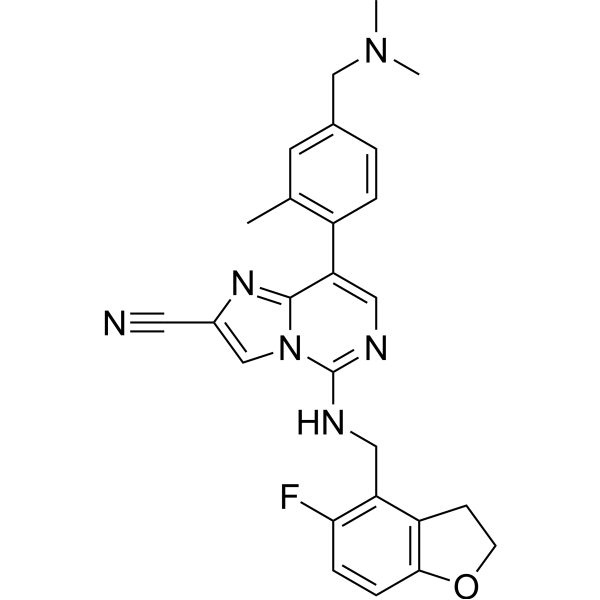
| Molecular Formula | C26H25FN6O |
| Molecular Weight | 456.51 |
| CAS # | 2369769-29-7 |
| Related CAS # | ORIC-944 TFA |
| Appearance | White to off-white solid powder |
| SMILES | C1(NCC2=C3C(=CC=C2F)OCC3)=NC=C(C2=CC=C(CN(C)C)C=C2C)C2=NC(C#N)=CN12 |
| HS Tariff Code | 2934.99.9001 |
| Storage |
Powder-20°C 3 years 4°C 2 years In solvent -80°C 6 months -20°C 1 month |
| Shipping Condition | Room temperature (This product is stable at ambient temperature for a few days during ordinary shipping and time spent in Customs) |
Biological Activity
| Targets | polycomb repressive complex 2; PRC2[1] |
| ln Vivo | ORIC-944 (30, 100, 200 mg/kg; oral; once daily for 50 days) induced significant tumor regression at all dose levels[3]. ORIC-944 (30 mg/kg; oral; once daily for 30 days) has potent single-agent activity against enzalutamide in a prostate cancer xenograft model [3]. |
| Animal Protocol |
Animal/Disease Models: KARPAS-422 DLBCL xenograft model[1] Doses: 30, 100, 200 mg/kg Route of Administration: Oral gavage (p.o.) Experimental Results: Had well tolerated at all dose levels assessed compared to tazemetostat at a clinically relevant dose. Animal/Disease Models: 22Rv1 model Doses: 30 mg/kg Route of Administration: Oral gavage (p.o.) Experimental Results: Made average tumor volume ± SEM, with n=8-10/group. Had a significant difference in ORIC-944 treatment group vs vehicle. |
| References |
[1]. ORIC-944, a potent and selective allosteric PRC2 inhibitor with best-in-class properties, demonstrates combination synergy with AR pathway inhibitors in prostate cancer modelsJ. Cancer Research, 2024, 84(6_Supplement): 6586-6586. [2]. ORIC Pharmaceuticals Provides Initial Phase 1b Data for ORIC-944, Operational Highlights for 2023, and Anticipated Upcoming Milestoneshttps://investors.oricpharma.com/news-releases/news-release-details/oric-pharmaceuticals-provides-initial-phase-1b-data-oric-944/. |
Solubility Data
| Solubility (In Vitro) | DMSO : ~100 mg/mL (~219.05 mM; with ultrasonication) |
| Solubility (In Vivo) |
Solubility in Formulation 1: ≥ 2.5 mg/mL (5.48 mM)(saturation unknown) in 10% DMSO 40% PEG300 5% Tween-80 45% Saline (add these co-solvents sequentially from left to right, and one by one),clear solution. For example, if 1 mL of working solution is to be prepared, you can add 100 μL of 25.0 mg/mL clear DMSO stock solution and add it to 400 μL PEG300, mix well; then add 50 μL Tween-80 to the above system, mix well; then continue to add 450 μL of normal saline to make up to 1 mL. Preparation of normal saline: Dissolve 0.9 g of sodium chloride in ddH₂O and make up to 100 mL to obtain a clear and transparent normal saline solution. Solubility in Formulation 2: ≥ 2.5 mg/mL (5.48 mM)(saturation unknown) in 10% DMSO 90% Corn Oil (add these co-solvents sequentially from left to right, and one by one),clear solution. For example, if 1 mL of working solution is to be prepared, you can add 100 μL of 25.0 mg/mL clear DMSO stock solution and add it to 900 μL corn oil and mix well. (Please use freshly prepared in vivo formulations for optimal results.) |
| Preparing Stock Solutions | 1 mg | 5 mg | 10 mg | |
| 1 mM | 2.1905 mL | 10.9527 mL | 21.9053 mL | |
| 5 mM | 0.4381 mL | 2.1905 mL | 4.3811 mL | |
| 10 mM | 0.2191 mL | 1.0953 mL | 2.1905 mL |