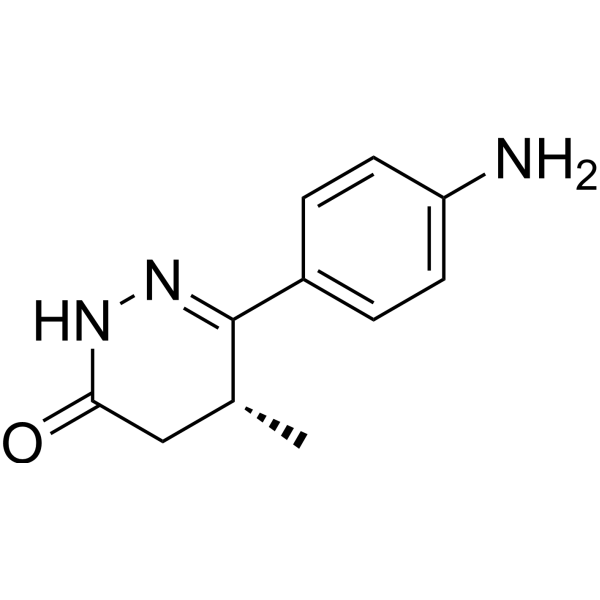
Physicochemical Properties
| Molecular Formula | C₁₁H₁₃N₃O |
| Molecular Weight | 203.24 |
| Exact Mass | 203.105 |
| CAS # | 101328-85-2 |
| PubChem CID | 10465484 |
| Appearance | Off-white to light brown solid powder |
| Density | 1.3±0.1 g/cm3 |
| Melting Point | 206-208ºC |
| Index of Refraction | 1.653 |
| LogP | -0.75 |
| Hydrogen Bond Donor Count | 2 |
| Hydrogen Bond Acceptor Count | 3 |
| Rotatable Bond Count | 1 |
| Heavy Atom Count | 15 |
| Complexity | 280 |
| Defined Atom Stereocenter Count | 1 |
| SMILES | C[C@@H]1CC(=O)NN=C1C2=CC=C(C=C2)N |
| InChi Key | GDMRFHZLKNYRRO-SSDOTTSWSA-N |
| InChi Code | InChI=1S/C11H13N3O/c1-7-6-10(15)13-14-11(7)8-2-4-9(12)5-3-8/h2-5,7H,6,12H2,1H3,(H,13,15)/t7-/m1/s1 |
| Chemical Name | (4R)-3-(4-aminophenyl)-4-methyl-4,5-dihydro-1H-pyridazin-6-one |
| Synonyms | OR1855; 101328-85-2; (R)-6-(4-Aminophenyl)-5-methyl-4,5-dihydropyridazin-3(2H)-one; (r)-6-(4-aminophenyl)-4,5-dihydro-5-methyl-3(2h)-pyridazinone; OR-1855; (4R)-3-(4-Aminophenyl)-4-methyl-4,5-dihydro-1H-pyridazin-6-one; 3(2H)-Pyridazinone, 6-(4-aminophenyl)-4,5-dihydro-5-methyl-, (5R)-; 3(2H)-Pyridazinone, 6-(4-aminophenyl)-4,5-dihydro-5-methyl-, (R)-; MFCD09032921; OR 1855 |
| HS Tariff Code | 2934.99.9001 |
| Storage |
Powder-20°C 3 years 4°C 2 years In solvent -80°C 6 months -20°C 1 month Note: This product requires protection from light (avoid light exposure) during transportation and storage. |
| Shipping Condition | Room temperature (This product is stable at ambient temperature for a few days during ordinary shipping and time spent in Customs) |
Biological Activity
| Targets | PDE; active metabolite of Levosimendan |
| ln Vivo |
Levosimendan enhances cardiac contractility via Ca(2+) sensitization and induces vasodilation through the activation of ATP-dependent K(+) and large-conductance Ca(2+)-dependent K(+) channels. However, the hemodynamic effects of levosimendan, as well as its metabolites, OR-1896 and OR-1855, relative to plasma concentrations achieved, are not well defined. Thus levosimendan, OR-1896, OR-1855, or vehicle was infused at 0.01, 0.03, 0.1, and 0.3 mumol.kg(-1).30 min(-1), targeting therapeutic to supratherapeutic concentrations of total levosimendan (62.6 ng/ml). Results were compared with those of the beta(1)-agonist dobutamine and the phosphodiesterase 3 inhibitor milrinone. Peak concentrations of levosimendan, OR-1896, and OR-1855 were 455 +/- 21, 126 +/- 6, and 136 +/- 6 ng/ml, respectively. Levosimendan and OR-1896 produced dose-dependent reductions in mean arterial pressure (-31 +/- 2 and -42 +/- 3 mmHg, respectively) and systemic resistance without affecting pulse pressure, effects paralleled by increases in heart rate; OR-1855 produced no effect at any dose tested. Dobutamine, but not milrinone, increased mean arterial pressure and pulse pressure (17 +/- 2 and 23 +/- 2 mmHg, respectively). Regarding potency to elicit reductions in time to peak pressure and time to systolic pressure recovery: OR-1896 > levosimendan > milrinone > dobutamine. Levosimendan and OR-1896 elicited dose-dependent increases in change in pressure over time (118 +/- 10 and 133 +/- 13%, respectively), concomitant with reductions in left ventricular end-diastolic pressure and ejection time. However, neither levosimendan nor OR-1896 produced increases in myocardial oxygen consumption at inotropic and vasodilatory concentrations, whereas dobutamine increased myocardial oxygen consumption (79% above baseline). Effects of the levosimendan and OR-1896 were limited to the systemic circulation; neither compound produced changes in pulmonary pressure, whereas dobutamine produced profound increases (74 +/- 13%). Thus levosimendan and OR-1896 are hemodynamically active in the anesthetized dog at concentrations observed clinically and elicit cardiovascular effects consistent with activation of both K(+) channels and Ca(2+) sensitization, whereas OR-1855 is inactive on endpoints measured in this study.[1] The intravenous formulation of levosimendan has been studied in several randomized, comparative studies in patients with decompensated heart failure and efficacy, and tolerability has been demonstrated in heart failure patients of both ischemic and nonischemic etiology. Plasma concentrations associated with levosimendan efficacy were assessed in an open-label, nonrandomized phase II study in patients diagnosed with heart failure, whereby a 24-h continuous infusion of levosimendan produced peak plasma concentrations of 62.6 ng/ml; in the same patients, peak concentrations of OR-1896 and OR-1855, the two primary circulating metabolites of levosimendan, reached 5.5 and 6.8 ng/ml, respectively. Due to the reduction of levosimendan to OR-1855 in humans and subsequent acetylation to OR-1896, the contribution of the parent vs. each metabolite to the hemodynamic and cardiovascular effects observed in patients cannot be definitively described. However, in the dog, neither levosimendan nor OR-1855 is metabolized to OR-1896. Moreover, a comprehensive assessment of the effects of levosimendan and its metabolites (in relation to plasma concentrations achieved) on cardiovascular function has not been fully described in dog. Thus the present study sought to characterize the effects of levosimendan, OR-1896, and OR-1855 on myocardial and hemodynamic function in the comprehensively instrumented dog at plasma concentrations deemed therapeutic to supratherapeutic. Results were compared with two other agents routinely prescribed in the treatment of heart failure: the β1-agonist dobutamine and the PDE3 inhibitor milrinone [1]. OR-1855 exerted an inhibitory effect on both spontaneous and agonist induced myometrial contractions, compared to control strips. The mean maximal inhibition (MMI) values were as follows: 27.85% ± 9.38 for spontaneous contractions (n=5; P< 0.05) and 31.41 ± 4.57 agonist induced contractions (n=6; P<0.05). No significant difference was found between control 1 and control 2 for both spontaneous and oxytocin induced contractions. Conclusion: The calcium sensitizer, and active levosimendan metabolite, OR-1855 exerted a relaxant effect on uterine contractions in vitro. The results from this study, coupled with the effects of Levosimendan on uterine contractility, raise the possibility of calcium sensitizers holding tocolytic properties and further studies are required to investigate the potential benefits of this novel class of drugs [2]. |
| Animal Protocol |
Animals were randomly divided into one of six treatment or vehicle (5% dextrose in water) groups. Following the completion of the surgical protocol, animals were allowed to stabilize for 1 h, and baseline data were collected at 5-min intervals 30 min before treatment. Each dose of active drug was administered as a 30-min infusion (0.02 ml·kg−1·min−1) as a series of four escalating doses dissolved in a 5% dextrose in water vehicle; following termination of the high-dose infusion, animals were observed for 30 min. Levosimendan, OR-1896, and OR-1855 were infused at 0.01, 0.03, 0.10, and 0.33 μmol·kg−1·30 min−1; blood samples were withdrawn at 15-min intervals for determination of plasma concentrations of levosimendan and each metabolite by HPLC-mass spectrometry. Dobutamine and milrinone were infused at 1-log unit higher doses to achieve similar reductions in systemic resistance as that produced by levosimendan and OR-1896 (Fig. 1). For additional depth and perspective, results from the present study were also compared with those of three K+ channel openers (KCOs) previously profiled in the anesthetized dog cardiovascular model, A-278637, ZD-6169, WAY-133537, A-325100, and the dihydropyridine Ca2+ channel blocker nifedipine [1].
Biopsies of human myometrium were obtained at elective caesarean section (n=12). Dissected myometrial strips suspended under isometric conditions, undergoing spontaneous and oxytocin-induced contractions, were exposed to cumulative additions of OR-1855 in the concentration range of 1 nmol/L to 100 mmol/L. Two sets of control experiments were performed simultaneously as follows: 1. Strips exposed to either physiological salt solution (PSS) only, for spontaneous contractions, or 0.5 nmol/L oxytocin; 2. Strips exposed to PSS/oxytocin and vehicle for OR-1855.[2] |
| References |
[1]. Comparative effects of levosimendan, OR-1896, OR-1855, dobutamine, and milrinone on vascular resistance, indexes of cardiac function, and O2 consumption in dogs. Am J Physiol Heart Circ Physiol. 2008 Jan;294(1):H238-48. [2]. 487: OR-1855, a levosimendan metabolite with an effect on human myometrial contractility.December 2009Volume 201, Issue 6, Supplement, Pages S182-S183. |
| Additional Infomation |
OR-1855 is a substituted aniline. A hydrazone and pyridazine derivative; the levo-form is a phosphodiesterase III inhibitor, calcium-sensitizing agent, and inotropic agent that is used in the treatment of HEART FAILURE. Thus levosimendan and OR-1896 produce direct inotropic effects in the heart and also direct relaxation of the systemic vasculature, resulting in dose-dependent vasodilation. Moreover, results from the present study demonstrate that both parent and the OR-1896 metabolite clearly differentiate themselves from traditional KCOs and the Ca2+ channel blocker nifedipine, with respect to potency to induce increases in left ventricular contractility vs. vasodilation alone (please see Fig. 10). Thus these results suggest that increases in contractility produced by levosimendan in patients are not wholly due to a compensatory response to the fall in blood pressure subsequent to KATP activation, but rather are mediated by a separate and distinct mechanism (Ca2+ sensitization), eliciting a response in line with that of traditional inotropic agents without increasing intracellular Ca2+. In summary, both levosimendan and OR-1896 are hemodynamically active in the dog at concentrations at and above those observed clinically, whereas OR-1855 is inactive with regards to hemodynamic function. The factors regulating contractility of uterine smooth muscle are central to the occurrence of preterm labor. Levosimendan, a calcium sensitizer, has been shown to have a relaxant effect on uterine contractility mainly through opening ATP-dependent potassium channels. OR-1855 is an active metabolite of levosimendan, which is a product of reduction of the parent drug in the intestine. OR-1855 has unknown properties in smooth muscle and the purpose of this study was to investigate its effects on human myometrial contractility.[2] |
Solubility Data
| Solubility (In Vitro) | DMSO : ~100 mg/mL (~492.03 mM) |
| Solubility (In Vivo) |
Solubility in Formulation 1: ≥ 2.5 mg/mL (12.30 mM) (saturation unknown) in 10% DMSO + 40% PEG300 + 5% Tween80 + 45% Saline (add these co-solvents sequentially from left to right, and one by one), clear solution. For example, if 1 mL of working solution is to be prepared, you can add 100 μL of 25.0 mg/mL clear DMSO stock solution to 400 μL PEG300 and mix evenly; then add 50 μL Tween-80 to the above solution and mix evenly; then add 450 μL normal saline to adjust the volume to 1 mL. Preparation of saline: Dissolve 0.9 g of sodium chloride in 100 mL ddH₂ O to obtain a clear solution. Solubility in Formulation 2: ≥ 2.5 mg/mL (12.30 mM) (saturation unknown) in 10% DMSO + 90% (20% SBE-β-CD in Saline) (add these co-solvents sequentially from left to right, and one by one), clear solution. For example, if 1 mL of working solution is to be prepared, you can add 100 μL of 25.0 mg/mL clear DMSO stock solution to 900 μL of 20% SBE-β-CD physiological saline solution and mix evenly. Preparation of 20% SBE-β-CD in Saline (4°C,1 week): Dissolve 2 g SBE-β-CD in 10 mL saline to obtain a clear solution. (Please use freshly prepared in vivo formulations for optimal results.) |
| Preparing Stock Solutions | 1 mg | 5 mg | 10 mg | |
| 1 mM | 4.9203 mL | 24.6015 mL | 49.2029 mL | |
| 5 mM | 0.9841 mL | 4.9203 mL | 9.8406 mL | |
| 10 mM | 0.4920 mL | 2.4601 mL | 4.9203 mL |