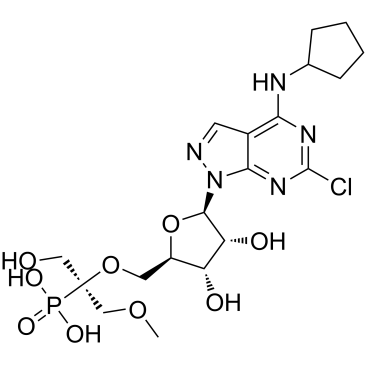
OP-5244 (OP5244) is a novel, orally bioavailable and potent CD73 inhibitor with cancer immunomodulatory effects. It inhibits CD73 with an IC50 of 0.25 nM. OP-5244 acts byreversing immunosuppressive environments via blocking of adenosine production.
Physicochemical Properties
| Molecular Formula | C19H29CLN5O9P |
| Molecular Weight | 537.8884 |
| Exact Mass | 535.159 |
| CAS # | 2381268-71-7 |
| Related CAS # | OP-5244 sodium |
| PubChem CID | 154585769 |
| Appearance | White to pink solid powder |
| LogP | -1.6 |
| Hydrogen Bond Donor Count | 6 |
| Hydrogen Bond Acceptor Count | 13 |
| Rotatable Bond Count | 10 |
| Heavy Atom Count | 35 |
| Complexity | 764 |
| Defined Atom Stereocenter Count | 5 |
| SMILES | ClC1=NC(=C2C([H])=NN(C2=N1)[C@@]1([H])[C@@]([H])([C@@]([H])([C@@]([H])(C([H])([H])O[C@@](C([H])([H])O[H])(C([H])([H])OC([H])([H])[H])P(=O)(O[H])O[H])O1)O[H])O[H])N([H])C1([H])C([H])([H])C([H])([H])C([H])([H])C1([H])[H] |
| InChi Key | MVKIUWCYHMQOCI-VVZOVNLRSA-N |
| InChi Code | InChI=1S/C20H31ClN5O8P/c1-33-10-20(9-27,35(30,31)32)7-6-13-14(28)15(29)18(34-13)26-17-12(8-22-26)16(24-19(21)25-17)23-11-4-2-3-5-11/h8,11,13-15,18,27-29H,2-7,9-10H2,1H3,(H,23,24,25)(H2,30,31,32)/t13-,14-,15-,18-,20-/m1/s1 |
| Chemical Name | ((R)-4-((2R,3S,4R,5R)-5-(6-chloro-4-(cyclopentylamino)-1H-pyrazolo[3,4-d]pyrimidin-1-yl)-3,4-dihydroxytetrahydrofuran-2-yl)-1-hydroxy-2-(methoxymethyl)butan-2-yl)phosphonic acid |
| Synonyms | OP5244 OP 5244 OP-5244 |
| HS Tariff Code | 2934.99.9001 |
| Storage |
Powder-20°C 3 years 4°C 2 years In solvent -80°C 6 months -20°C 1 month Note: Please store this product in a sealed and protected environment (e.g. under nitrogen), avoid exposure to moisture and light. |
| Shipping Condition | Room temperature (This product is stable at ambient temperature for a few days during ordinary shipping and time spent in Customs) |
Biological Activity
| ln Vitro | In H1568 (NSCLC) cells, OP-5244 suppresses the synthesis of adenosine (ADO) with an EC50 of 0.79±0.38 nM [1]. With an EC50 of 0.22 nM, OP-5244 prevents CD8+ T lymphocytes originating from peripheral blood from hydrolyzing AMP to ADO[1]. Op-5244 (4.1-1000 nM; 96 hours) restores the proliferation and cytokine production of CD8+ T cells that are suppressed by AMP [1]. ADO synthesis in human and murine cancer cell lines (H1568 and EMT6, respectively) is totally inhibited by OP-5244 (0.01 nM-10 μM) [1]. |
| ln Vivo | Tumor growth inhibition in mice indicates that OP-5244 (15 mg/kg/day; subcutaneously for 13 days) has anti-tumor effects when used alone [1]. In mice, OP-5244 (150 mg/kg; orally administered twice daily for 16 days) reverses immunosuppression and enhances CD8+ T cell infiltration [1]. OP-5244 (0.2 mg/kg; intravenous) has low steady-state volume of distribution (rat 0.22, dog 0.29, crab-eating monkey 0.10 L/kg/h) and moderate plasma clearance (rat 0.18, dog 1.22, macaque 0.05 L/kg/h)[1]. AUC (rat 1.96, dog 1.75, cynomolgus monkey 14.2 μM?h) and Cmax (rat 0.82, dog 1.25, cynomolgus monkey 1.72 μM) are seen with OP-5244 (10 mg/kg; oral) [1]. |
| Animal Protocol |
Animal/Disease Models: balb/c (Bagg ALBino) mouse with breast cancer[1] Doses: 15 mg/kg/day Route of Administration: Sc for 13 days Experimental Results: Inhibited tumor growth. demonstrated a 95% lower ADO/AMP ratio compared to that of the vehicle group. |
| References |
[1]. Orally Bioavailable Small Molecule CD73 Inhibitor (OP-5244) Reverses Immunosuppression Through Blockade of Adenosine Production. J Med Chem. 2020 Aug 31. |
Solubility Data
| Solubility (In Vitro) |
DMSO : ~250 mg/mL (~464.78 mM) H2O : ~100 mg/mL (~185.91 mM) |
| Solubility (In Vivo) |
Solubility in Formulation 1: ≥ 6.5 mg/mL (12.08 mM) (saturation unknown) in 10% DMSO + 40% PEG300 + 5% Tween80 + 45% Saline (add these co-solvents sequentially from left to right, and one by one), clear solution. For example, if 1 mL of working solution is to be prepared, you can add 100 μL of 65.0 mg/mL clear DMSO stock solution to 400 μL PEG300 and mix evenly; then add 50 μL Tween-80 to the above solution and mix evenly; then add 450 μL normal saline to adjust the volume to 1 mL. Preparation of saline: Dissolve 0.9 g of sodium chloride in 100 mL ddH₂ O to obtain a clear solution. Solubility in Formulation 2: ≥ 6.5 mg/mL (12.08 mM) (saturation unknown) in 10% DMSO + 90% (20% SBE-β-CD in Saline) (add these co-solvents sequentially from left to right, and one by one), clear solution. For example, if 1 mL of working solution is to be prepared, you can add 100 μL of 65.0 mg/mL clear DMSO stock solution to 900 μL of 20% SBE-β-CD physiological saline solution and mix evenly. Preparation of 20% SBE-β-CD in Saline (4°C,1 week): Dissolve 2 g SBE-β-CD in 10 mL saline to obtain a clear solution. Solubility in Formulation 3: ≥ 6.5 mg/mL (12.08 mM) (saturation unknown) in 10% DMSO + 90% Corn Oil (add these co-solvents sequentially from left to right, and one by one), clear solution. For example, if 1 mL of working solution is to be prepared, you can add 100 μL of 65.0 mg/mL clear DMSO stock solution to 900 μL of corn oil and mix evenly. (Please use freshly prepared in vivo formulations for optimal results.) |
| Preparing Stock Solutions | 1 mg | 5 mg | 10 mg | |
| 1 mM | 1.8591 mL | 9.2956 mL | 18.5912 mL | |
| 5 mM | 0.3718 mL | 1.8591 mL | 3.7182 mL | |
| 10 mM | 0.1859 mL | 0.9296 mL | 1.8591 mL |