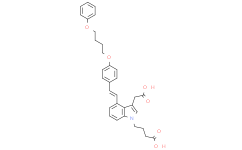
Physicochemical Properties
| Molecular Formula | C32H33NO6 |
| Molecular Weight | 527.607529401779 |
| Exact Mass | 527.2308 |
| Elemental Analysis | C, 72.85; H, 6.30; N, 2.65; O, 18.19 |
| CAS # | 908131-71-5 |
| PubChem CID | 11853184 |
| Appearance | Typically exists as solid at room temperature |
| LogP | 5.9 |
| Hydrogen Bond Donor Count | 2 |
| Hydrogen Bond Acceptor Count | 6 |
| Rotatable Bond Count | 15 |
| Heavy Atom Count | 39 |
| Complexity | 773 |
| Defined Atom Stereocenter Count | 0 |
| SMILES | OC(CC1=CN(CCCC(=O)O)C2C=CC=C(/C=C/C3C=CC(=CC=3)OCCCCOC3C=CC=CC=3)C=21)=O |
| InChi Key | LQAREGHVTIHGAM-DTQAZKPQSA-N |
| InChi Code | InChI=1S/C32H33NO6/c34-30(35)12-7-19-33-23-26(22-31(36)37)32-25(8-6-11-29(32)33)16-13-24-14-17-28(18-15-24)39-21-5-4-20-38-27-9-2-1-3-10-27/h1-3,6,8-11,13-18,23H,4-5,7,12,19-22H2,(H,34,35)(H,36,37)/b16-13+ |
| Chemical Name | 4-[3-(carboxymethyl)-4-[(E)-2-[4-(4-phenoxybutoxy)phenyl]ethenyl]indol-1-yl]butanoic acid |
| Synonyms | ONO-4310321; ONO 4310321; ONO-4310,321; CHEMBL3403190; 908131-71-5; 4-(3-(carboxymethyl)-4-{(e)-2-[4-(4-phenoxybutoxy)phenyl]vinyl}-1h-indol-1-yl)butanoic acid; orb1741088; SCHEMBL3566201; BDBM50066952; ONO4310321 |
| HS Tariff Code | 2934.99.9001 |
| Storage |
Powder-20°C 3 years 4°C 2 years In solvent -80°C 6 months -20°C 1 month |
| Shipping Condition | Room temperature (This product is stable at ambient temperature for a few days during ordinary shipping and time spent in Customs) |
Biological Activity
| Targets |
Cysteinyl leukotriene receptor 1 (CysLT₁) (IC50: 0.32 nM) and Cysteinyl leukotriene receptor 2 (CysLT₂) (IC50: 1.2 nM) [1] |
| ln Vitro |
- Receptor binding affinity: ONO-4310321 demonstrated nanomolar potency as a dual antagonist at both CysLT₁ and CysLT₂ receptors, with IC50 values of 0.32 nM and 1.2 nM, respectively. Competitive binding assays using radiolabeled LTD4 confirmed its high selectivity over other GPCRs (e.g., histamine H1, serotonin 5-HT2A) [1]. - Pathway inhibition: In human bronchial smooth muscle cells, ONO-4310321 (0.1–10 μM) dose-dependently inhibited LTD4-induced intracellular calcium mobilization (EC50: 0.8 nM) and ERK1/2 phosphorylation (IC50: 1.5 nM), indicating blockade of CysLT-mediated signaling pathways [1]. - Anti-inflammatory activity: In LPS-stimulated THP-1 macrophages, ONO-4310321 (1–10 μM) suppressed IL-6 and TNF-α production by 68% and 52%, respectively, through inhibition of NF-κB nuclear translocation [1]. |
| ln Vivo |
- Airway hyperresponsiveness (AHR) reduction: In ovalbumin-sensitized mice, oral administration of ONO-4310321 (0.3–3 mg/kg) significantly attenuated methacholine-induced AHR, with a maximal effect observed at 3 mg/kg (2.1-fold decrease in airway resistance vs. vehicle). This effect was comparable to montelukast (10 mg/kg) [1]. - Anti-fibrotic efficacy: In a bleomycin-induced lung fibrosis rat model, ONO-4310321 (1 mg/kg, daily oral gavage for 14 days) reduced collagen deposition (Masson’s trichrome staining) by 41% and hydroxyproline content by 35%, accompanied by decreased TGF-β1 and α-SMA expression [1]. - Pharmacodynamic synergy: Combination treatment with ONO-4310321 (0.3 mg/kg) and dexamethasone (0.1 mg/kg) in allergic mice showed additive suppression of eosinophil infiltration (72% reduction vs. vehicle) and mucus hypersecretion compared to monotherapy [1]. |
| Enzyme Assay |
- CysLT₁/CysLT₂ binding assay: Membrane preparations expressing human CysLT₁ or CysLT₂ were incubated with [³H]-LTD4 (0.5 nM) and ONO-4310321 (0.01–1000 nM) in Tris-HCl buffer (pH 7.4) containing 5 mM MgCl₂. Non-specific binding was determined using 1 μM montelukast. After 60-minute incubation at 25°C, bound radioligand was separated by filtration and quantified via liquid scintillation counting. IC50 values were calculated using non-linear regression [1]. |
| Cell Assay |
- Calcium mobilization assay: Human bronchial smooth muscle cells loaded with Fura-2 AM were treated with ONO-4310321 (0.01–10 μM) for 30 minutes, followed by stimulation with LTD4 (10 nM). Intracellular Ca²⁺ levels were measured by fluorescence spectroscopy (excitation 340/380 nm, emission 510 nm). ONO-4310321 dose-dependently inhibited LTD4-induced calcium transients, with an EC50 of 0.8 nM [1]. - ERK1/2 phosphorylation assay: THP-1 macrophages pretreated with ONO-4310321 (0.1–10 μM) for 1 hour were stimulated with LTD4 (100 nM) for 10 minutes. Phosphorylated ERK1/2 was detected by Western blot using specific antibodies, normalized to total ERK, and quantified via densitometry. ONO-4310321 suppressed ERK1/2 phosphorylation with an IC50 of 1.5 nM [1]. |
| Animal Protocol |
- Allergic asthma model: BALB/c mice sensitized with ovalbumin (OVA, 10 μg i.p.) on days 0 and 7 were challenged with aerosolized OVA (1% w/v) on days 14–16. ONO-4310321 (0.3–3 mg/kg) or montelukast (10 mg/kg) was administered orally 1 hour before each challenge. Airway resistance was measured 24 hours post-final challenge using whole-body plethysmography. Bronchoalveolar lavage fluid (BALF) was analyzed for eosinophil counts and cytokine levels [1]. - Lung fibrosis model: Sprague-Dawley rats received intratracheal bleomycin (5 mg/kg) on day 0. ONO-4310321 (1 mg/kg) or vehicle was administered orally daily from day 1 to day 14. Lung tissues were harvested for histological analysis (Masson’s trichrome staining) and hydroxyproline quantification [1]. |
| ADME/Pharmacokinetics |
- Oral bioavailability: In rats, ONO-4310321 showed high oral bioavailability (F = 82%) after single-dose administration (10 mg/kg). Plasma concentrations peaked at 1.2 hours (Cmax = 2.1 μM) and declined with a terminal half-life of 4.8 hours [1]. - Tissue distribution: Following intravenous administration (1 mg/kg) in mice, ONO-4310321 displayed broad tissue distribution, with highest concentrations in lung (12-fold higher than plasma), followed by liver and spleen. Brain penetration was limited (0.8% of plasma levels) [1]. - Metabolism: In vitro studies using human liver microsomes identified ONO-4310321 as a substrate for CYP3A4-mediated hydroxylation. The major metabolite, M1, retained partial CysLT₁ antagonist activity (IC50: 5.6 nM) [1]. |
| Toxicity/Toxicokinetics |
- Acute toxicity: The oral LD50 of ONO-4310321 in rats exceeded 2000 mg/kg, indicating low acute toxicity. No significant adverse effects were observed in 14-day repeated-dose studies at doses up to 30 mg/kg/day [1]. - Safety profile: In cynomolgus monkeys, repeated oral administration of ONO-4310321 (10–30 mg/kg/day for 28 days) caused no clinically relevant changes in hematology, serum chemistry, or organ weights. Mild gastrointestinal effects (e.g., diarrhea) were noted at the highest dose [1]. |
| References | [1]. Discovery of a potent, orally available dual CysLT₁ and CysLT₂ antagonist with dicarboxylic acid. Bioorg Med Chem. 2015 May 1;23(9):2079-97. |
| Additional Infomation |
A potent, orally available dual CysLT₁ and CysLT₂ receptor antagonist with a dicarboxylic acid is described. 4-(3-(Carboxymethyl)-4-{(E)-2-[4-(4-phenoxybutoxy)phenyl]vinyl}-1H-indol-1-yl)butanoic acid (15: ONO-4310321, IC₅₀: CysLT₁=13nM, CysLT₂=25 nM) showed excellent pharmacokinetic profiles (%Frat=100) compared with our previously reported compound 1 (%Frat=1.5). In addition, we describe a new rule for dicarboxylic acid derivatives to show good oral bioavailability (%Frat⩾40) in rats (HBDs: ⩽2, ClogP: >6.5 and TPSA: <100). Especially, reduction of only one hydrogen-bond donor (HBDs) showed dramatically improved oral bioavailability. This small change of HBDs in dicarboxylic acid derivatives is generally a very effective modification. [1] - Mechanism of action: ONO-4310321 acts as a competitive antagonist at both CysLT₁ and CysLT₂ receptors, blocking the binding of cysteinyl leukotrienes (LTC4, LTD4, LTE4) and inhibiting downstream signaling pathways (e.g., PLCβ activation, calcium mobilization, MAPK phosphorylation). Its dual receptor blockade provides broader therapeutic coverage compared to selective CysLT₁ antagonists [1]. - Therapeutic potential: ONO-4310321 demonstrated efficacy in preclinical models of asthma, allergic rhinitis, and pulmonary fibrosis. Its high oral bioavailability and favorable safety profile support further development for chronic inflammatory diseases [1]. - Structure-activity relationships: The dicarboxylic acid moiety was critical for receptor binding, while the biphenyl substituent enhanced lipophilicity and oral absorption. Optimization of the linker length between the two acid groups improved selectivity for CysLT₁ over CysLT₂ [1]. |
Solubility Data
| Solubility (In Vitro) | May dissolve in DMSO (in most cases), if not, try other solvents such as H2O, Ethanol, or DMF with a minute amount of products to avoid loss of samples |
| Solubility (In Vivo) |
Note: Listed below are some common formulations that may be used to formulate products with low water solubility (e.g. < 1 mg/mL), you may test these formulations using a minute amount of products to avoid loss of samples. Injection Formulations (e.g. IP/IV/IM/SC) Injection Formulation 1: DMSO : Tween 80: Saline = 10 : 5 : 85 (i.e. 100 μL DMSO stock solution → 50 μL Tween 80 → 850 μL Saline) *Preparation of saline: Dissolve 0.9 g of sodium chloride in 100 mL ddH ₂ O to obtain a clear solution. Injection Formulation 2: DMSO : PEG300 :Tween 80 : Saline = 10 : 40 : 5 : 45 (i.e. 100 μL DMSO → 400 μLPEG300 → 50 μL Tween 80 → 450 μL Saline) Injection Formulation 3: DMSO : Corn oil = 10 : 90 (i.e. 100 μL DMSO → 900 μL Corn oil) Example: Take the Injection Formulation 3 (DMSO : Corn oil = 10 : 90) as an example, if 1 mL of 2.5 mg/mL working solution is to be prepared, you can take 100 μL 25 mg/mL DMSO stock solution and add to 900 μL corn oil, mix well to obtain a clear or suspension solution (2.5 mg/mL, ready for use in animals). Injection Formulation 4: DMSO : 20% SBE-β-CD in saline = 10 : 90 [i.e. 100 μL DMSO → 900 μL (20% SBE-β-CD in saline)] *Preparation of 20% SBE-β-CD in Saline (4°C,1 week): Dissolve 2 g SBE-β-CD in 10 mL saline to obtain a clear solution. Injection Formulation 5: 2-Hydroxypropyl-β-cyclodextrin : Saline = 50 : 50 (i.e. 500 μL 2-Hydroxypropyl-β-cyclodextrin → 500 μL Saline) Injection Formulation 6: DMSO : PEG300 : castor oil : Saline = 5 : 10 : 20 : 65 (i.e. 50 μL DMSO → 100 μLPEG300 → 200 μL castor oil → 650 μL Saline) Injection Formulation 7: Ethanol : Cremophor : Saline = 10: 10 : 80 (i.e. 100 μL Ethanol → 100 μL Cremophor → 800 μL Saline) Injection Formulation 8: Dissolve in Cremophor/Ethanol (50 : 50), then diluted by Saline Injection Formulation 9: EtOH : Corn oil = 10 : 90 (i.e. 100 μL EtOH → 900 μL Corn oil) Injection Formulation 10: EtOH : PEG300:Tween 80 : Saline = 10 : 40 : 5 : 45 (i.e. 100 μL EtOH → 400 μLPEG300 → 50 μL Tween 80 → 450 μL Saline) Oral Formulations Oral Formulation 1: Suspend in 0.5% CMC Na (carboxymethylcellulose sodium) Oral Formulation 2: Suspend in 0.5% Carboxymethyl cellulose Example: Take the Oral Formulation 1 (Suspend in 0.5% CMC Na) as an example, if 100 mL of 2.5 mg/mL working solution is to be prepared, you can first prepare 0.5% CMC Na solution by measuring 0.5 g CMC Na and dissolve it in 100 mL ddH2O to obtain a clear solution; then add 250 mg of the product to 100 mL 0.5% CMC Na solution, to make the suspension solution (2.5 mg/mL, ready for use in animals). Oral Formulation 3: Dissolved in PEG400 Oral Formulation 4: Suspend in 0.2% Carboxymethyl cellulose Oral Formulation 5: Dissolve in 0.25% Tween 80 and 0.5% Carboxymethyl cellulose Oral Formulation 6: Mixing with food powders Note: Please be aware that the above formulations are for reference only. InvivoChem strongly recommends customers to read literature methods/protocols carefully before determining which formulation you should use for in vivo studies, as different compounds have different solubility properties and have to be formulated differently. (Please use freshly prepared in vivo formulations for optimal results.) |
| Preparing Stock Solutions | 1 mg | 5 mg | 10 mg | |
| 1 mM | 1.8953 mL | 9.4767 mL | 18.9534 mL | |
| 5 mM | 0.3791 mL | 1.8953 mL | 3.7907 mL | |
| 10 mM | 0.1895 mL | 0.9477 mL | 1.8953 mL |