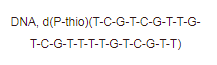
ODN-2007 (ODN2007) is a novel class B CpG ODN (oligodeoxynucleotide) acitng as a Toll-like receptor (TLR) agonit/ligand, and can be used as an immunomodulator and vaccine adjuvant to enhance immune responses in mammals, fish, and humans. Sequence: 5'-TCGTCGTTGTCGTTTTGTCGTT-3'.
Physicochemical Properties
| Molecular Formula | NA??MOLECULARWEIGHT |
| Molecular Weight | 0 |
| CAS # | 455348-63-7 |
| Appearance | White to off-white solid powder |
| HS Tariff Code | 2934.99.9001 |
| Storage |
Powder-20°C 3 years 4°C 2 years In solvent -80°C 6 months -20°C 1 month Note: Please store this product in a sealed and protected environment, avoid exposure to moisture. |
| Shipping Condition | Room temperature (This product is stable at ambient temperature for a few days during ordinary shipping and time spent in Customs) |
Biological Activity
| ln Vitro | ODN 2007 (1 or 5 μg/mL, 3–18 h) strongly increases the expression of interferon IFN-γ and IFN-β in chicken macrophages[1]. ODN 2007 (10 μg/mL, 0.5–12 h) can raise AKT and ERK2 phosphorylation levels and promote NO production[3]. |
| ln Vivo | Through controlling the expression of genes linked to the immune system in zebrafish infected with Vibrio traumaticus FJ03-X2, ODN 2007 (intraperitoneal injection, 1 μg, once) can improve the immunological response[2]. |
| Cell Assay |
RT-PCR[1] Cell Types: MQ-NCSU cells (a chicken macrophage cell line) Tested Concentrations: 1 μg/mL, 5 μg/mL Incubation Duration: 3 h, 12 h, 18 h Experimental Results: Dramatically stimulated an increase in transcriptional expression of IFN-γ after 3 hrs (hours) regardless of the dose. Increased the mRNA expression of IL-1β at 5 μg/mL high dose regardless of the time point. Western Blot Analysis[3] Cell Types: HD11, a replication-deficient avian leukemia virus MC29-transformed macrophage-like cell line Tested Concentrations: 10 μg/mL Incubation Duration: 0.5 h, 1 h, 3 h, 6 h, 12 h Experimental Results: Resulted in a significant increase in ERK2 and AKT phosphorylation levels and increased IFN-γ, IL-6 and MIP-3α mRNA levels. Stimulated an increase in the level of NO. |
| Animal Protocol |
Animal/Disease Models: Zebrafish infected with Vibrio traumaticus FJ03-X2[2] Doses: 1 μg Route of Administration: intraperitoneal (ip)injection; once Experimental Results: demonstrated a cumulative mortality rate of 15.0% in treated group while the control group reached 42.1%. demonstrated a significant decrease in the expression levels of all intestinal immune-related genes such as TNF, IFNg1-2, IL-1β, IL-10, especially IL-1β diminished by 99.88%. |
| References |
[1]. Characterization of Innate Responses Induced by PLGA Encapsulated- and Soluble TLR Ligands In Vitro and In Vivo in Chickens. PLoS One. 2017 Jan 3;12(1):e0169154. [2]. CpG-ODN 2007 protects zebrafish (Danio rerio) against Vibrio vulnificus infection. Aquac Res. 2021; 52: 897-905. [3]. Role of Hsp90 in CpG ODN mediated immunostimulation in avian macrophages. Mol Immunol. 2010 Mar;47(6):1337-46. |
Solubility Data
| Solubility (In Vitro) | H2O : ~20 mg/mL (~2.92 mM) |
| Solubility (In Vivo) |
Note: Listed below are some common formulations that may be used to formulate products with low water solubility (e.g. < 1 mg/mL), you may test these formulations using a minute amount of products to avoid loss of samples. Injection Formulations (e.g. IP/IV/IM/SC) Injection Formulation 1: DMSO : Tween 80: Saline = 10 : 5 : 85 (i.e. 100 μL DMSO stock solution → 50 μL Tween 80 → 850 μL Saline) *Preparation of saline: Dissolve 0.9 g of sodium chloride in 100 mL ddH ₂ O to obtain a clear solution. Injection Formulation 2: DMSO : PEG300 :Tween 80 : Saline = 10 : 40 : 5 : 45 (i.e. 100 μL DMSO → 400 μLPEG300 → 50 μL Tween 80 → 450 μL Saline) Injection Formulation 3: DMSO : Corn oil = 10 : 90 (i.e. 100 μL DMSO → 900 μL Corn oil) Example: Take the Injection Formulation 3 (DMSO : Corn oil = 10 : 90) as an example, if 1 mL of 2.5 mg/mL working solution is to be prepared, you can take 100 μL 25 mg/mL DMSO stock solution and add to 900 μL corn oil, mix well to obtain a clear or suspension solution (2.5 mg/mL, ready for use in animals). Injection Formulation 4: DMSO : 20% SBE-β-CD in saline = 10 : 90 [i.e. 100 μL DMSO → 900 μL (20% SBE-β-CD in saline)] *Preparation of 20% SBE-β-CD in Saline (4°C,1 week): Dissolve 2 g SBE-β-CD in 10 mL saline to obtain a clear solution. Injection Formulation 5: 2-Hydroxypropyl-β-cyclodextrin : Saline = 50 : 50 (i.e. 500 μL 2-Hydroxypropyl-β-cyclodextrin → 500 μL Saline) Injection Formulation 6: DMSO : PEG300 : castor oil : Saline = 5 : 10 : 20 : 65 (i.e. 50 μL DMSO → 100 μLPEG300 → 200 μL castor oil → 650 μL Saline) Injection Formulation 7: Ethanol : Cremophor : Saline = 10: 10 : 80 (i.e. 100 μL Ethanol → 100 μL Cremophor → 800 μL Saline) Injection Formulation 8: Dissolve in Cremophor/Ethanol (50 : 50), then diluted by Saline Injection Formulation 9: EtOH : Corn oil = 10 : 90 (i.e. 100 μL EtOH → 900 μL Corn oil) Injection Formulation 10: EtOH : PEG300:Tween 80 : Saline = 10 : 40 : 5 : 45 (i.e. 100 μL EtOH → 400 μLPEG300 → 50 μL Tween 80 → 450 μL Saline) Oral Formulations Oral Formulation 1: Suspend in 0.5% CMC Na (carboxymethylcellulose sodium) Oral Formulation 2: Suspend in 0.5% Carboxymethyl cellulose Example: Take the Oral Formulation 1 (Suspend in 0.5% CMC Na) as an example, if 100 mL of 2.5 mg/mL working solution is to be prepared, you can first prepare 0.5% CMC Na solution by measuring 0.5 g CMC Na and dissolve it in 100 mL ddH2O to obtain a clear solution; then add 250 mg of the product to 100 mL 0.5% CMC Na solution, to make the suspension solution (2.5 mg/mL, ready for use in animals). Oral Formulation 3: Dissolved in PEG400 Oral Formulation 4: Suspend in 0.2% Carboxymethyl cellulose Oral Formulation 5: Dissolve in 0.25% Tween 80 and 0.5% Carboxymethyl cellulose Oral Formulation 6: Mixing with food powders Note: Please be aware that the above formulations are for reference only. InvivoChem strongly recommends customers to read literature methods/protocols carefully before determining which formulation you should use for in vivo studies, as different compounds have different solubility properties and have to be formulated differently. (Please use freshly prepared in vivo formulations for optimal results.) |