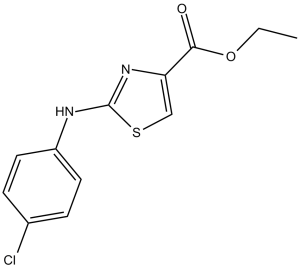
Physicochemical Properties
| Molecular Formula | C12H11CLN2O2S | |
| Molecular Weight | 282.75 | |
| Exact Mass | 282.022 | |
| CAS # | 165682-93-9 | |
| Related CAS # |
|
|
| PubChem CID | 53428670 | |
| Appearance | Light yellow to yellow solid powder | |
| Density | 1.4±0.1 g/cm3 | |
| Boiling Point | 408.1±51.0 °C at 760 mmHg | |
| Flash Point | 200.6±30.4 °C | |
| Vapour Pressure | 0.0±1.0 mmHg at 25°C | |
| Index of Refraction | 1.637 | |
| LogP | 3.83 | |
| Hydrogen Bond Donor Count | 1 | |
| Hydrogen Bond Acceptor Count | 5 | |
| Rotatable Bond Count | 5 | |
| Heavy Atom Count | 18 | |
| Complexity | 285 | |
| Defined Atom Stereocenter Count | 0 | |
| InChi Key | ULUBAPWNHROTEU-UHFFFAOYSA-N | |
| InChi Code | InChI=1S/C12H11ClN2O2S/c1-2-17-11(16)10-7-18-12(15-10)14-9-5-3-8(13)4-6-9/h3-7H,2H2,1H3,(H,14,15) | |
| Chemical Name | ethyl 2-((4-chlorophenyl)amino)thiazole-4-carboxylate | |
| Synonyms |
|
|
| HS Tariff Code | 2934.99.9001 | |
| Storage |
Powder-20°C 3 years 4°C 2 years In solvent -80°C 6 months -20°C 1 month |
|
| Shipping Condition | Room temperature (This product is stable at ambient temperature for a few days during ordinary shipping and time spent in Customs) |
Biological Activity
| Targets |
Octamer-binding transcription factor 3/4 (Oct3/4) [1] |
||
| ln Vitro |
O4I2 not only stimulates Oct3/4 expression by activating its promoter site, but also stabilizes the Oct3/4 protein in HEK293 cells[1]. O4I2 substantially activates Oct3/4 even at 5 µM after 72 hrs treatment on the translational level[1]. O4I2 (20 µM) accumulates Oct3/4 in NCCIT happened already 2 hours after incubation, but the measurable Sox2 increase emerges much later, implying compound-mediated activation of Oct3/4 might be different between embryonic kidney HEK293 cells and embryonal cancer NCCIT cells [1]. In HEK293 cells transfected with Oct3/4 promoter-driven luciferase reporter plasmid, O4I2 (1-10 μM) dose-dependently activated Oct3/4 promoter activity, with a maximal 4.2-fold increase at 5 μM compared to vehicle control. This indicated potent induction of Oct3/4 transcriptional activity[1] - In P19 embryonic carcinoma cells and mouse embryonic stem cells (mESCs), O4I2 (0.5-20 μM) upregulated Oct3/4 mRNA expression by 3.5-5.0-fold (RT-PCR) and protein levels by 2.8-3.6-fold (Western blot) at 10 μM. It also moderately increased the expression of other pluripotency-associated markers (Sox2, Nanog) by 1.5-2.0-fold[1] - In differentiated mESCs (induced by retinoic acid), O4I2 (10 μM) reversed the downregulation of Oct3/4, restoring its mRNA and protein levels to ~70% of undifferentiated mESC levels, suggesting potential pluripotency-retaining activity[1] |
||
| ln Vivo |
|
||
| Cell Assay |
Immunofluorescence[1] Cell Types: HF (human fibroblasts) cells. Tested Concentrations: 5-20 µM. Incubation Duration: 5 days. Experimental Results: Successfully detected co-expression of Oct3/4 and Sox2, as well as Nanog and Klf4. Oct3/4 promoter luciferase reporter assay: HEK293 cells were seeded in 96-well plates and co-transfected with Oct3/4 promoter-luciferase plasmid and Renilla luciferase plasmid (internal control). After 24 hours, O4I2 (0.1 μM, 1 μM, 5 μM, 10 μM, 20 μM) was added, and cells were cultured for another 48 hours. Luciferase activity was measured using a dual-luciferase assay system, with relative luciferase activity (firefly/Renilla) reflecting Oct3/4 promoter activation[1] - Pluripotency marker expression assay: P19 cells and mESCs were seeded in 6-well plates and treated with O4I2 (0.5 μM, 5 μM, 10 μM, 20 μM) for 72 hours. For RT-PCR, total RNA was extracted, reverse-transcribed to cDNA, and amplified with specific primers for Oct3/4, Sox2, and Nanog. For Western blot, cell lysates were prepared, subjected to electrophoresis, transferred to membranes, and probed with antibodies against Oct3/4, Sox2, Nanog, and β-actin (loading control)[1] - Differentiated mESC rescue assay: mESCs were induced to differentiate with retinoic acid for 4 days. O4I2 (10 μM) was added during the last 3 days of differentiation. Oct3/4 mRNA and protein levels were detected by RT-PCR and Western blot, respectively, and compared to undifferentiated and vehicle-treated differentiated mESCs[1] |
||
| Animal Protocol |
|
||
| References |
[1]. Ethyl 2-((4-Chlorophenyl)amino)thiazole-4-carboxylate and Derivatives Are Potent Inducers of Oct3/4. J Med Chem. 2015 Aug 13;58(15):5742-5750. |
||
| Additional Infomation |
O4I2 is a derivative of ethyl 2-((4-chlorophenyl)amino)thiazole-4-carboxylate, identified as a potent inducer of the pluripotency transcription factor Oct3/4[1] - Its core mechanism involves activating the Oct3/4 promoter to upregulate Oct3/4 mRNA and protein expression, which may contribute to maintaining or restoring pluripotency in stem cells[1] - It exhibits dose-dependent activity in multiple cell models (HEK293, P19, mESCs) and shows cross-regulation of other pluripotency markers (Sox2, Nanog), supporting its potential as a tool compound for stem cell biology research[1] - The thiazole scaffold of O4I2 is critical for its Oct3/4-inducing activity, providing a structural basis for the development of novel pluripotency modulators[1] |
Solubility Data
| Solubility (In Vitro) |
|
|||
| Solubility (In Vivo) |
Solubility in Formulation 1: 2.5 mg/mL (8.84 mM) in 10% DMSO + 90% (20% SBE-β-CD in Saline) (add these co-solvents sequentially from left to right, and one by one), suspension solution; with sonication. For example, if 1 mL of working solution is to be prepared, you can add 100 μL of 25.0 mg/mL clear DMSO stock solution to 900 μL of 20% SBE-β-CD physiological saline solution and mix evenly. Preparation of 20% SBE-β-CD in Saline (4°C,1 week): Dissolve 2 g SBE-β-CD in 10 mL saline to obtain a clear solution. (Please use freshly prepared in vivo formulations for optimal results.) |
| Preparing Stock Solutions | 1 mg | 5 mg | 10 mg | |
| 1 mM | 3.5367 mL | 17.6835 mL | 35.3669 mL | |
| 5 mM | 0.7073 mL | 3.5367 mL | 7.0734 mL | |
| 10 mM | 0.3537 mL | 1.7683 mL | 3.5367 mL |