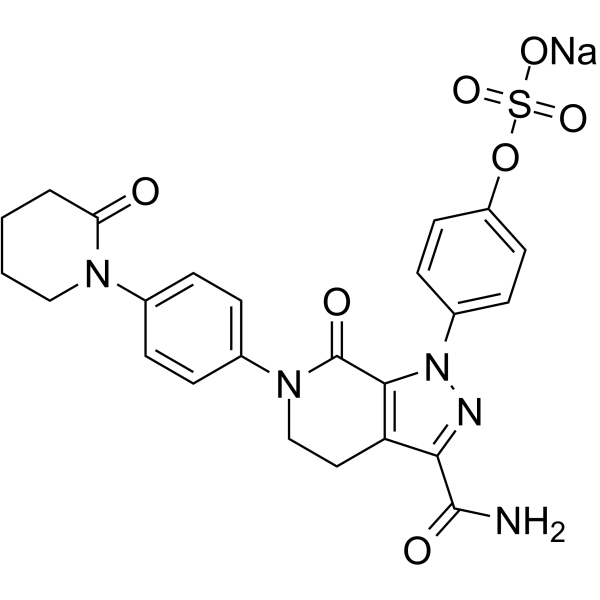
O-Desmethyl apixaban sulfate sodium is the major active metabolite, and O-demethylated/sulfated sodium salt form of Apixaban (BMS 56224701; BMS56224701; BMS-56224701; brand name: Eliquis), which is a direct inhibitor of Factor Xa used to treat and prevent the formation of blood clots.
Physicochemical Properties
| Molecular Formula | C??H??N?NAO?S |
| Molecular Weight | 547.52 |
| Exact Mass | 547.113763 |
| PubChem CID | 145925625 |
| Appearance | Typically exists as solid at room temperature |
| Hydrogen Bond Donor Count | 1 |
| Hydrogen Bond Acceptor Count | 8 |
| Rotatable Bond Count | 6 |
| Heavy Atom Count | 38 |
| Complexity | 995 |
| Defined Atom Stereocenter Count | 0 |
| SMILES | C1CCN(C(=O)C1)C2=CC=C(C=C2)N3CCC4=C(C3=O)N(N=C4C(=O)N)C5=CC=C(C=C5)OS(=O)(=O)[O-].[Na+] |
| InChi Key | IIZNDSHJOZRLJA-UHFFFAOYSA-M |
| InChi Code | InChI=1S/C24H23N5O7S.Na/c25-23(31)21-19-12-14-28(16-6-4-15(5-7-16)27-13-2-1-3-20(27)30)24(32)22(19)29(26-21)17-8-10-18(11-9-17)36-37(33,34)35;/h4-11H,1-3,12-14H2,(H2,25,31)(H,33,34,35);/q;+1/p-1 |
| Chemical Name | sodium;[4-[3-carbamoyl-7-oxo-6-[4-(2-oxopiperidin-1-yl)phenyl]-4,5-dihydropyrazolo[3,4-c]pyridin-1-yl]phenyl] sulfate |
| Synonyms | O-Desmethyl apixaban sulfate (sodium); O-Desmethyl Apixaban Sulfate Sodium Salt; O-Desmethyl apixaban sulfate sodium; 4,5,6,7-Tetrahydro-7-oxo-6-[4-(2-oxo-1-piperidinyl)phenyl]-1-[4-(sulfooxy)phenyl]-1H-Pyrazolo[3,4-c]pyridine-3-carboxamide Sodium Salt; |
| HS Tariff Code | 2934.99.9001 |
| Storage |
Powder-20°C 3 years 4°C 2 years In solvent -80°C 6 months -20°C 1 month |
| Shipping Condition | Room temperature (This product is stable at ambient temperature for a few days during ordinary shipping and time spent in Customs) |
Biological Activity
| Targets | Apixaban metabolite |
| ln Vivo | Apixaban, a potent and highly selective factor Xa inhibitor, is currently under development for treatment of arterial and venous thrombotic diseases. The O-demethyl apixaban sulfate is a major circulating metabolite in humans but circulates at lower concentrations relative to parent in animals. The aim of this study was to identify the sulfotransferases (SULTs) responsible for the sulfation reaction. Apixaban undergoes O-demethylation catalyzed by cytochrome P450 enzymes to O-demethyl apixaban, and then is conjugated by SULTs to form O-demethyl apixaban sulfate. Of the five human cDNA-expressed SULTs tested, SULT1A1 and SULT1A2 exhibited significant levels of catalytic activity for formation of O-demethyl apixaban sulfate, and SULT1A3, SULT1E1, and SULT2A1 showed much lower catalytic activities. In human liver S9, quercetin, a highly selective inhibitor of SULT1A1 and SULT1E1, inhibited O-demethyl apixaban sulfate formation by 99%; 2,6-dichloro-4-nitrophenol, another inhibitor of SULT1A1, also inhibited this reaction by >90%; estrone, a competitive inhibitor for SULT1E1, had no effect on this reaction. The comparable K(m) values for formation of O-demethyl apixaban sulfate were 41.4 microM (human liver S9), 36.8 microM (SULT1A1), and 70.8 microM (SULT1A2). Because of the high level of expression of SULT1A1 in liver and its higher level of catalytic activity for formation of O-demethyl apixaban sulfate, SULT1A1 might play a major role in humans for formation of O-demethyl apixaban sulfate. O-Demethyl apixaban was also investigated in liver S9 of mice, rats, rabbits, dogs, monkeys, and humans. The results indicated that liver S9 samples from dogs, monkeys, and humans had higher activities for formation of O-demethyl apixaban sulfate than those of mice, rats, and rabbits [2]. |
| Enzyme Assay |
Metabolite Profiling and Identification. [2] The HPLC radiochromatographic profiles of plasma samples (at 24 h) from rats and humans are shown in Fig. 2. In rat plasma profile, apixaban was the dominant component (98%), and O-demethyl apixaban sulfate was minor (1.8%); in human plasma, major circulating components were apixaban (61%) and O-demethyl apixaban sulfate (34%). O-Demethyl apixaban was a minor metabolite detected by LC/MS analysis only in plasma samples at early time points (6 h) ...[2] |
| References |
[1]. Preclinical discovery of apixaban, a direct and orally bioavailable factor Xa inhibitor. J Thromb Thrombolysis. 2011 May;31(4):478-92. [2]. Sulfation of o-demethyl apixaban: enzyme identification and species comparison. Drug Metab Dispos. 2009 Apr;37(4):802-8. |
| Additional Infomation | Apixaban (BMS-562247; 1-(4-methoxyphenyl)-7-oxo-6-(4-(2-oxopiperidin-1-yl)phenyl)-4,5,6,7-tetrahydro-1H-pyrazolo[3,4-c]pyridine-3-carboxamide), a direct inhibitor of activated factor X (FXa), is in development for the prevention and treatment of various thromboembolic diseases. With an inhibitory constant of 0.08 nM for human FXa, apixaban has greater than 30,000-fold selectivity for FXa over other human coagulation proteases. It produces a rapid onset of inhibition of FXa with association rate constant of 20 μM⁻¹/s approximately and inhibits free as well as prothrombinase- and clot-bound FXa activity in vitro. Apixaban also inhibits FXa from rabbits, rats and dogs, an activity which parallels its antithrombotic potency in these species. Although apixaban has no direct effects on platelet aggregation, it indirectly inhibits this process by reducing thrombin generation. Pre-clinical studies of apixaban in animal models have demonstrated dose-dependent antithrombotic efficacy at doses that preserved hemostasis. Apixaban improves pre-clinical antithrombotic activity, without excessive increases in bleeding times, when added on top of aspirin or aspirin plus clopidogrel at their clinically relevant doses. Apixaban has good bioavailability, low clearance and a small volume of distribution in animals and humans, and a low potential for drug-drug interactions. Elimination pathways for apixaban include renal excretion, metabolism and biliary/intestinal excretion. Although a sulfate conjugate of Ο-demethyl apixaban (O-demethyl apixaban sulfate) has been identified as the major circulating metabolite of apixaban in humans, it is inactive against human FXa. Together, these non-clinical findings have established the favorable pharmacological profile of apixaban, and support the potential use of apixaban in the clinic for the prevention and treatment of various thromboembolic diseases. [1] |
Solubility Data
| Solubility (In Vitro) | May dissolve in DMSO (in most cases), if not, try other solvents such as H2O, Ethanol, or DMF with a minute amount of products to avoid loss of samples |
| Solubility (In Vivo) |
Note: Listed below are some common formulations that may be used to formulate products with low water solubility (e.g. < 1 mg/mL), you may test these formulations using a minute amount of products to avoid loss of samples. Injection Formulations (e.g. IP/IV/IM/SC) Injection Formulation 1: DMSO : Tween 80: Saline = 10 : 5 : 85 (i.e. 100 μL DMSO stock solution → 50 μL Tween 80 → 850 μL Saline) *Preparation of saline: Dissolve 0.9 g of sodium chloride in 100 mL ddH ₂ O to obtain a clear solution. Injection Formulation 2: DMSO : PEG300 :Tween 80 : Saline = 10 : 40 : 5 : 45 (i.e. 100 μL DMSO → 400 μLPEG300 → 50 μL Tween 80 → 450 μL Saline) Injection Formulation 3: DMSO : Corn oil = 10 : 90 (i.e. 100 μL DMSO → 900 μL Corn oil) Example: Take the Injection Formulation 3 (DMSO : Corn oil = 10 : 90) as an example, if 1 mL of 2.5 mg/mL working solution is to be prepared, you can take 100 μL 25 mg/mL DMSO stock solution and add to 900 μL corn oil, mix well to obtain a clear or suspension solution (2.5 mg/mL, ready for use in animals). Injection Formulation 4: DMSO : 20% SBE-β-CD in saline = 10 : 90 [i.e. 100 μL DMSO → 900 μL (20% SBE-β-CD in saline)] *Preparation of 20% SBE-β-CD in Saline (4°C,1 week): Dissolve 2 g SBE-β-CD in 10 mL saline to obtain a clear solution. Injection Formulation 5: 2-Hydroxypropyl-β-cyclodextrin : Saline = 50 : 50 (i.e. 500 μL 2-Hydroxypropyl-β-cyclodextrin → 500 μL Saline) Injection Formulation 6: DMSO : PEG300 : castor oil : Saline = 5 : 10 : 20 : 65 (i.e. 50 μL DMSO → 100 μLPEG300 → 200 μL castor oil → 650 μL Saline) Injection Formulation 7: Ethanol : Cremophor : Saline = 10: 10 : 80 (i.e. 100 μL Ethanol → 100 μL Cremophor → 800 μL Saline) Injection Formulation 8: Dissolve in Cremophor/Ethanol (50 : 50), then diluted by Saline Injection Formulation 9: EtOH : Corn oil = 10 : 90 (i.e. 100 μL EtOH → 900 μL Corn oil) Injection Formulation 10: EtOH : PEG300:Tween 80 : Saline = 10 : 40 : 5 : 45 (i.e. 100 μL EtOH → 400 μLPEG300 → 50 μL Tween 80 → 450 μL Saline) Oral Formulations Oral Formulation 1: Suspend in 0.5% CMC Na (carboxymethylcellulose sodium) Oral Formulation 2: Suspend in 0.5% Carboxymethyl cellulose Example: Take the Oral Formulation 1 (Suspend in 0.5% CMC Na) as an example, if 100 mL of 2.5 mg/mL working solution is to be prepared, you can first prepare 0.5% CMC Na solution by measuring 0.5 g CMC Na and dissolve it in 100 mL ddH2O to obtain a clear solution; then add 250 mg of the product to 100 mL 0.5% CMC Na solution, to make the suspension solution (2.5 mg/mL, ready for use in animals). Oral Formulation 3: Dissolved in PEG400 Oral Formulation 4: Suspend in 0.2% Carboxymethyl cellulose Oral Formulation 5: Dissolve in 0.25% Tween 80 and 0.5% Carboxymethyl cellulose Oral Formulation 6: Mixing with food powders Note: Please be aware that the above formulations are for reference only. InvivoChem strongly recommends customers to read literature methods/protocols carefully before determining which formulation you should use for in vivo studies, as different compounds have different solubility properties and have to be formulated differently. (Please use freshly prepared in vivo formulations for optimal results.) |
| Preparing Stock Solutions | 1 mg | 5 mg | 10 mg | |
| 1 mM | 1.8264 mL | 9.1321 mL | 18.2642 mL | |
| 5 mM | 0.3653 mL | 1.8264 mL | 3.6528 mL | |
| 10 mM | 0.1826 mL | 0.9132 mL | 1.8264 mL |