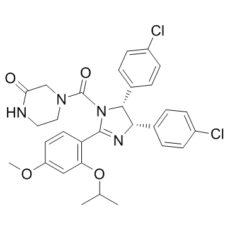
Nutlin-3a, the active enantiomer of Nutlin-3, is a novel and potent p53/MDM2 (murine double minute) protein protein interaction inhibitor with an IC50 of 90 nM in cell-free assays. Nutlin-3 works by attaching to MDM2 in the TP53-binding pocket, preventing MDM2-directed TP53 degradation, and ultimately stabilizing/activating p53. Nutlin-3a possesses anticancer properties.
Physicochemical Properties
| Molecular Formula | C30H30CL2N4O4 |
| Molecular Weight | 581.49 |
| Exact Mass | 580.164 |
| Elemental Analysis | C, 61.97; H, 5.20; Cl, 12.19; N, 9.64; O, 11.01 |
| CAS # | 675576-98-4 |
| Related CAS # | Nutlin-3b;675576-97-3;Nutlin-3;548472-68-0;(Rac)-Nutlin-3;890090-75-2 |
| Appearance | White to light yellow solid powder |
| Density | 1.4±0.1 g/cm3 |
| Index of Refraction | 1.648 |
| LogP | 2.77 |
| SMILES | ClC1C([H])=C([H])C(=C([H])C=1[H])[C@]1([H])[C@]([H])(C2C([H])=C([H])C(=C([H])C=2[H])Cl)N=C(C2C([H])=C([H])C(=C([H])C=2OC([H])(C([H])([H])[H])C([H])([H])[H])OC([H])([H])[H])N1C(N1C([H])([H])C(N([H])C([H])([H])C1([H])[H])=O)=O |
| InChi Key | BDUHCSBCVGXTJM-WUFINQPMSA-N |
| InChi Code | InChI=1S/C30H30Cl2N4O4/c1-18(2)40-25-16-23(39-3)12-13-24(25)29-34-27(19-4-8-21(31)9-5-19)28(20-6-10-22(32)11-7-20)36(29)30(38)35-15-14-33-26(37)17-35/h4-13,16,18,27-28H,14-15,17H2,1-3H3,(H,33,37)/t27-,28+/m0/s1 |
| Chemical Name | 4-[(4S,5R)-4,5-bis(4-chlorophenyl)-2-(4-methoxy-2-propan-2-yloxyphenyl)-4,5-dihydroimidazole-1-carbonyl]piperazin-2-one |
| Synonyms | Nutlin3a; Nutlin-3a; Nutlin 3a; SML 0580; SML-0580; SML0580; (-)-Nutlin-3; (-)-Nutlin 3 |
| HS Tariff Code | 2934.99.9001 |
| Storage |
Powder-20°C 3 years 4°C 2 years In solvent -80°C 6 months -20°C 1 month |
| Shipping Condition | Room temperature (This product is stable at ambient temperature for a few days during ordinary shipping and time spent in Customs) |
Biological Activity
| Targets | p53-MDM2 (IC50 = 90 nM) | ||
| ln Vitro | Nutlin-3a displaces p53 from the MDM2 binding pocket, freeing it from inhibition and proteasomal degradation. This causes the induction of p53's downstream targets, cell cycle arrest, and apoptosis. More than >90% of the growth of NIH3T3 cells was inhibited after seven days of incubation with 10 μM nutlin-3a[1]. In a dose-dependent manner, p21 expression is induced by nutlin-3a, which also stabilizes and activates p53[1]. Effectively reducing the S-phase compartment to 0.2–2% while boosting the G1- and G2/M-phase compartments is nutlin-3a[1]. After 40 hours, nutlin-3a causes apoptosis in about 60% of SJSA-1 and MHM cells, and this number rose to 85% and 65%, respectively, after 60 hours [1]. | ||
| ln Vivo | Nutlin-3a suppresses xenograft growth in a dose-dependent fashion with the highest dose (200 mg/kg) showing a substantial tumor shrinkage [1]. In vivo, nutlin-3 selectively activates the p53 pathway and is extremely effective against SJSA-1 osteosarcoma tumors[1]. Nutlin-3a therapy will work best against tumors that have wild-type p53 and mdm2 gene amplification. | ||
| Enzyme Assay | On a Biacore S51, competition assays are conducted. A PentaHis antibody is immobilized on a Series S Sensor chip CM5 in order to capture the p53 that has been His-tagged. The level of capture is ~ 200 response units or less (1 response unit corresponds to 1 pg of protein per mm 2). MDM2 protein is maintained at a constant concentration of 300 nM. Each MDM2 test sample contains a concentration series of test compounds, which are first dissolved in DMSO at a concentration of 10 mM and then further diluted. The tests are carried out at 25 °C in running buffer (10 mM Hepes, 0.15 M NaCl, 2% DMSO). Microsoft Excel is used to calculate the IC50 and the percentage of MDM2-p53 binding present versus binding absent from the inhibitor. | ||
| Cell Assay | All 15 cell lines are plated in 96-well plates at a density of 1×10³ cells per well. Incremental doses of Nutlin 3a (1 μM, 5 μM, 10 μM, 25 μM, 50 μM, and 70 μM) are administered to cells after the media has been changed and after 24 hours. WST-1 is added to each well after 72 hours of incubation, and the number of alive cells is calculated using a microplate reader set to 450 nm absorbance. To pinpoint the precise IC50 of cell lines, experiments are repeated with smaller Nutlin 3a titrations as necessary. The IC50 is established. In the same way as before, cell lines are once more plated, treated with Nutlin 3a at their respective IC50s, added WST-1, and cell viability is measured at 24, 48, and 72h. | ||
| Animal Protocol |
|
||
| References |
[1]. Proc Natl Acad Sci U S A . 2006 Feb 7;103(6):1888-93. [2]. BMC Cancer . 2011 May 30:11:211:1-11. [3]. Science . 2004 Feb 6;303(5659):844-8. |
Solubility Data
| Solubility (In Vitro) |
|
|||
| Solubility (In Vivo) |
Solubility in Formulation 1: ≥ 2.5 mg/mL (4.30 mM) (saturation unknown) in 10% DMSO + 40% PEG300 + 5% Tween80 + 45% Saline (add these co-solvents sequentially from left to right, and one by one), clear solution. For example, if 1 mL of working solution is to be prepared, you can add 100 μL of 25.0 mg/mL clear DMSO stock solution to 400 μL PEG300 and mix evenly; then add 50 μL Tween-80 to the above solution and mix evenly; then add 450 μL normal saline to adjust the volume to 1 mL. Preparation of saline: Dissolve 0.9 g of sodium chloride in 100 mL ddH₂ O to obtain a clear solution. Solubility in Formulation 2: 2.5 mg/mL (4.30 mM) in 10% DMSO + 90% (20% SBE-β-CD in Saline) (add these co-solvents sequentially from left to right, and one by one), suspension solution; with ultrasonication. For example, if 1 mL of working solution is to be prepared, you can add 100 μL of 25.0 mg/mL clear DMSO stock solution to 900 μL of 20% SBE-β-CD physiological saline solution and mix evenly. Preparation of 20% SBE-β-CD in Saline (4°C,1 week): Dissolve 2 g SBE-β-CD in 10 mL saline to obtain a clear solution. Solubility in Formulation 3: ≥ 2.5 mg/mL (4.30 mM) (saturation unknown) in 10% DMSO + 90% Corn Oil (add these co-solvents sequentially from left to right, and one by one), clear solution. For example, if 1 mL of working solution is to be prepared, you can add 100 μL of 25.0 mg/mL clear DMSO stock solution to 900 μL of corn oil and mix evenly.. Solubility in Formulation 4: 5% DMSO +55% PEG 300 +ddH2O: 8 mg/mL Solubility in Formulation 5: 8 mg/mL (13.76 mM) in 50% PEG300 50% Saline (add these co-solvents sequentially from left to right, and one by one), clear solution; with ultrasonication. Preparation of saline: Dissolve 0.9 g of sodium chloride in 100 mL ddH₂ O to obtain a clear solution. (Please use freshly prepared in vivo formulations for optimal results.) |
| Preparing Stock Solutions | 1 mg | 5 mg | 10 mg | |
| 1 mM | 1.7197 mL | 8.5986 mL | 17.1972 mL | |
| 5 mM | 0.3439 mL | 1.7197 mL | 3.4394 mL | |
| 10 mM | 0.1720 mL | 0.8599 mL | 1.7197 mL |