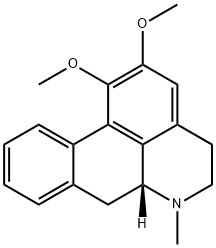
Physicochemical Properties
| Molecular Formula | C19H21NO2 |
| Molecular Weight | 295.3755 |
| Exact Mass | 295.157 |
| CAS # | 475-83-2 |
| PubChem CID | 10146 |
| Appearance | White to off-white solid powder |
| Density | 1.1±0.1 g/cm3 |
| Boiling Point | 430.7±45.0 °C at 760 mmHg |
| Melting Point | 165.5°C |
| Flash Point | 151.9±17.3 °C |
| Vapour Pressure | 0.0±1.0 mmHg at 25°C |
| Index of Refraction | 1.597 |
| LogP | 4.12 |
| Hydrogen Bond Donor Count | 0 |
| Hydrogen Bond Acceptor Count | 3 |
| Rotatable Bond Count | 2 |
| Heavy Atom Count | 22 |
| Complexity | 401 |
| Defined Atom Stereocenter Count | 1 |
| SMILES | O(C([H])([H])[H])C1=C(C([H])=C2C([H])([H])C([H])([H])N(C([H])([H])[H])[C@]3([H])C([H])([H])C4=C([H])C([H])=C([H])C([H])=C4C1=C32)OC([H])([H])[H] |
| InChi Key | ORJVQPIHKOARKV-OAHLLOKOSA-N |
| InChi Code | InChI=1S/C19H21NO2/c1-20-9-8-13-11-16(21-2)19(22-3)18-14-7-5-4-6-12(14)10-15(20)17(13)18/h4-7,11,15H,8-10H2,1-3H3/t15-/m1/s1 |
| Chemical Name | (6aR)-1,2-dimethoxy-6-methyl-5,6,6a,7-tetrahydro-4H-dibenzo[de,g]quinoline |
| HS Tariff Code | 2934.99.9001 |
| Storage |
Powder-20°C 3 years 4°C 2 years In solvent -80°C 6 months -20°C 1 month |
| Shipping Condition | Room temperature (This product is stable at ambient temperature for a few days during ordinary shipping and time spent in Customs) |
Biological Activity
| ln Vitro | Similar to aripiprazole (Emax=50% of dopamine), nuciferine is a partial agonist at the DD2 receptor with action (Emax=67% of dopamine). Nuciferine is as effective as clozapine (Nuciferine KB=62 nM; Clozapine KB=20 nM) at blocking Gi activation of dopamine inducers, which is consistent with its partial agonist action, according to Schild regression analysis [1]. Nuciferine, a naturally occurring substance, effectively inhibits the movement of insects. Schistosoma adenalis's basal motility and 5-HT-induced motility can both be successfully inhibited by nuciferine. Nuciferine inhibits Schistosoma at 0.62±0.22 μM and Sm.5HTRL at 0.24±0.04 μM, respectively [2]. |
| ln Vivo | In dental animal models related to the effects of antipsychotic drugs, nuciferine expands the apical response and prestimulatory effects of 5-HT2A agonists, replaces the precise stimulation of clozapine, enhances amphetamine-induced locomotor activity, and inhibits phencyclidine Piperidine (PCP)-induced locomotor activity and relieves PCP-induced prepulse inhibition but does not induce catalepsy. In the presence of 1 or 3 mg/kg Nuciferine, cumulative PCP dosages resulted in equivalent replacement to PCP alone. In clozapine-trained animals, a dose-dependent substitution of 1.25 mg/kg Clozapine was observed with 10 mg/kg Nuciferine (80.63% drug lever response), with an ED50 value of 5.42 mg/kg (95% CI 3.09-9.48 mg )/kg), whereas the lower doses tested (0.1 mg/kg-3 mg/kg) failed to produce discriminative cues for clozapine. In addition to eliciting a high number of responses to clozapine suitable levers, 10 mg/kg Nuciferine generated considerable gradient suppression (p<0.001) compared to vehicle control points [1]. |
| References |
[1]. Farrell MS, et al. In Vitro and In Vivo Characterization of the Alkaloid Nuciferine. PLoS One. 2016 Mar 10;11(3):e0150602. [2]. Chan JD, et al. Pharmacological profiling an abundantly expressed schistosome serotonergic GPCR identifies nuciferine as a potent antagonist. Int J Parasitol Drugs Drug Resist. 2016 Dec;6(3):364-370 |
| Additional Infomation | Nuciferine has been reported in Ziziphus jujuba, Paliurus hemsleyanus, and other organisms with data available. |
Solubility Data
| Solubility (In Vitro) | DMSO : ~5 mg/mL (~16.93 mM) |
| Solubility (In Vivo) |
Solubility in Formulation 1: ≥ 1.11 mg/mL (3.76 mM) (saturation unknown) in 10% DMSO + 40% PEG300 + 5% Tween80 + 45% Saline (add these co-solvents sequentially from left to right, and one by one), clear solution. For example, if 1 mL of working solution is to be prepared, you can add 100 μL of 11.1 mg/mL clear DMSO stock solution to 400 μL PEG300 and mix evenly; then add 50 μL Tween-80 to the above solution and mix evenly; then add 450 μL normal saline to adjust the volume to 1 mL. Preparation of saline: Dissolve 0.9 g of sodium chloride in 100 mL ddH₂ O to obtain a clear solution. Solubility in Formulation 2: ≥ 1.11 mg/mL (3.76 mM) (saturation unknown) in 10% DMSO + 90% Corn Oil (add these co-solvents sequentially from left to right, and one by one), clear solution. For example, if 1 mL of working solution is to be prepared, you can add 100 μL of 11.1 mg/mL clear DMSO stock solution to 900 μL of corn oil and mix evenly. (Please use freshly prepared in vivo formulations for optimal results.) |
| Preparing Stock Solutions | 1 mg | 5 mg | 10 mg | |
| 1 mM | 3.3855 mL | 16.9273 mL | 33.8547 mL | |
| 5 mM | 0.6771 mL | 3.3855 mL | 6.7709 mL | |
| 10 mM | 0.3385 mL | 1.6927 mL | 3.3855 mL |