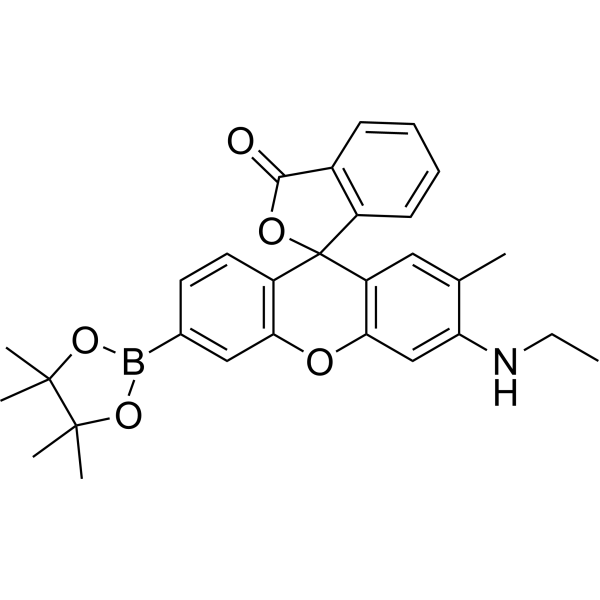
Physicochemical Properties
| Molecular Formula | C29H30BNO5 |
| Molecular Weight | 483.3632 |
| Exact Mass | 483.221 |
| CAS # | 1404091-23-1 |
| PubChem CID | 129626434 |
| Appearance | White to off-white solid powder |
| Hydrogen Bond Donor Count | 1 |
| Hydrogen Bond Acceptor Count | 6 |
| Rotatable Bond Count | 3 |
| Heavy Atom Count | 36 |
| Complexity | 849 |
| Defined Atom Stereocenter Count | 0 |
| SMILES | O1B(C2C([H])=C([H])C3=C(C=2[H])OC2C([H])=C(C(C([H])([H])[H])=C([H])C=2C23C3=C([H])C([H])=C([H])C([H])=C3C(=O)O2)N([H])C([H])([H])C([H])([H])[H])OC(C([H])([H])[H])(C([H])([H])[H])C1(C([H])([H])[H])C([H])([H])[H] |
| InChi Key | GHPDUBPWQBBRPG-UHFFFAOYSA-N |
| InChi Code | InChI=1S/C29H30BNO5/c1-7-31-23-16-25-22(14-17(23)2)29(20-11-9-8-10-19(20)26(32)34-29)21-13-12-18(15-24(21)33-25)30-35-27(3,4)28(5,6)36-30/h8-16,31H,7H2,1-6H3 |
| Chemical Name | 3'-(ethylamino)-2'-methyl-6'-(4,4,5,5-tetramethyl-1,3,2-dioxaborolan-2-yl)spiro[2-benzofuran-3,9'-xanthene]-1-one |
| HS Tariff Code | 2934.99.9001 |
| Storage |
Powder-20°C 3 years 4°C 2 years In solvent -80°C 6 months -20°C 1 month Note: (1). This product requires protection from light (avoid light exposure) during transportation and storage.(2). Please store this product in a sealed and protected environment (e.g. under nitrogen), avoid exposure to moisture. |
| Shipping Condition | Room temperature (This product is stable at ambient temperature for a few days during ordinary shipping and time spent in Customs) |
Biological Activity
| ln Vitro | NucPE1 exhibits weak emission (λem=530 nm, Φ=0.117) and two main visible region absorptions (λabs=468 nm, ε=27,300 M-1cm-1; λabs=490 nm, ε=26,000 M-1cm-1). When NucPE1 reacts with H2O2, it forms the fluorophore NucPE1, which has enhanced emission (λem=530 nm, Φ =0.626) and a major absorption band at 505 nm (ε = 19,100 M-1cm-1). This reaction causes fluorescence enhancement. NucPE1 preferentially localizes in the nuclei of various mammalian cell lines and entire model organisms, including C. It can react to subcellular variations in H2O2 flux in clegans [1]. |
| ln Vivo | In vivo, NucPE1 is still able to target the nucleus specifically. Nuclear H2O2 levels were lower in C, according to NucPE1 imaging. elegans overexpressing Sir-2.1 in comparison to the homolog of the wild type, indicating a connection between improved control of nuclear ROS pools and this long-lived Sirtuin protein [1]. |
| References |
[1]. NADPH oxidase-generated hydrogen peroxide induces DNA damage in mutant FLT3-expressing leukemia cells. J Biol Chem. 2015 Apr 10;290(15):9348-61. [2]. A nuclear-localized fluorescent hydrogen peroxide probe for monitoring sirtuin-mediated oxidative stress responses in vivo. Chem Biol. 2011 Aug 26;18(8):943-8. |
Solubility Data
| Solubility (In Vitro) | DMSO : ~25 mg/mL (~51.72 mM) |
| Solubility (In Vivo) |
Solubility in Formulation 1: ≥ 2.5 mg/mL (5.17 mM) (saturation unknown) in 10% DMSO + 40% PEG300 +5% Tween-80 + 45% Saline (add these co-solvents sequentially from left to right, and one by one), clear solution. For example, if 1 mL of working solution is to be prepared, you can add 100 μL of 25.0 mg/mL clear DMSO stock solution to 400 μL PEG300 and mix evenly; then add 50 μL Tween-80 + to the above solution and mix evenly; then add 450 μL normal saline to adjust the volume to 1 mL. Preparation of saline: Dissolve 0.9 g of sodium chloride in 100 mL ddH₂ O to obtain a clear solution. (Please use freshly prepared in vivo formulations for optimal results.) |
| Preparing Stock Solutions | 1 mg | 5 mg | 10 mg | |
| 1 mM | 2.0689 mL | 10.3443 mL | 20.6885 mL | |
| 5 mM | 0.4138 mL | 2.0689 mL | 4.1377 mL | |
| 10 mM | 0.2069 mL | 1.0344 mL | 2.0689 mL |