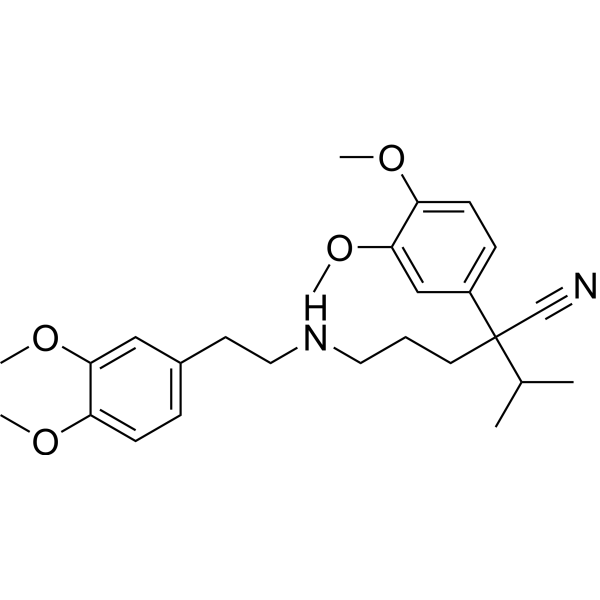
Physicochemical Properties
| Molecular Formula | C26H36N2O4 |
| Molecular Weight | 440.575 |
| Exact Mass | 476.244 |
| Elemental Analysis | C, 70.88; H, 8.24; N, 6.36; O, 14.53 |
| CAS # | 67018-85-3 |
| Related CAS # | Norverapamil hydrochloride;67812-42-4;Norverapamil-d7 hydrochloride;1216413-74-9;Norverapamil-d7;263175-44-6 |
| PubChem CID | 104972 |
| Appearance | Typically exists as solid at room temperature |
| Boiling Point | 586.1ºC at 760 mmHg |
| Flash Point | 308.2ºC |
| LogP | 5.943 |
| Hydrogen Bond Donor Count | 1 |
| Hydrogen Bond Acceptor Count | 6 |
| Rotatable Bond Count | 13 |
| Heavy Atom Count | 32 |
| Complexity | 577 |
| Defined Atom Stereocenter Count | 0 |
| SMILES | O(C)C1=C(C=CC(=C1)C(C#N)(CCCN([H])CCC1C=CC(=C(C=1)OC)OC)C(C)C)OC |
| InChi Key | UPKQNCPKPOLASS-UHFFFAOYSA-N |
| InChi Code | InChI=1S/C26H36N2O4/c1-19(2)26(18-27,21-9-11-23(30-4)25(17-21)32-6)13-7-14-28-15-12-20-8-10-22(29-3)24(16-20)31-5/h8-11,16-17,19,28H,7,12-15H2,1-6H3 |
| Chemical Name | 2-(3,4-dimethoxyphenyl)-5-[2-(3,4-dimethoxyphenyl)ethylamino]-2-propan-2-ylpentanenitrile |
| Synonyms | NORVERAPAMIL (6%); CHEMBL1298; 2-(3,4-dimethoxyphenyl)-5-[2-(3,4-dimethoxyphenyl)ethylamino]-2-propan-2-ylpentanenitrile; 957Z3K3R56; 5-((3,4-dimethoxyphenethyl)amino)-2-(3,4-dimethoxyphenyl)-2-isopropylpentanenitrile; (+/-)-Norverapamil;D591; |
| HS Tariff Code | 2934.99.9001 |
| Storage |
Powder-20°C 3 years 4°C 2 years In solvent -80°C 6 months -20°C 1 month |
| Shipping Condition | Room temperature (This product is stable at ambient temperature for a few days during ordinary shipping and time spent in Customs) |
Biological Activity
| Targets | Calcium channel |
| ln Vitro | Norverapamil ((±)-norverapamil) works well with verapamil to destroy intracellular tuberculosis branches and reduce isoniazid and rifampicin tolerance when no other medications are available. Bacilli produce a comparable result. In addition, norverapamil has comparable serum levels to verapamil and can prevent tolerance induced by macrophages [1]. The CYP3A mechanism-based inhibitors and substrates verapamil and its main metabolite norverapamil were found, and their nonlinear pharmacokinetics in the clinic were reported [3]. |
| ln Vivo | Norverapamil (9 mg/kg; oral) is the main metabolite of verapamil, with terminal half-life, AUC, and Cmax values of 9.4 hours, 260 ng·h/ml, and 41.6 ng/mL, respectively [ 4]. |
| Cell Assay | Drug tolerance likely represents an important barrier to tuberculosis treatment shortening. We previously implicated the Mycobacterium tuberculosis efflux pump Rv1258c as mediating macrophage-induced tolerance to rifampicin and intracellular growth. In this study, we infected the human macrophage-like cell line THP-1 with drug-sensitive and drug-resistant M. tuberculosis strains and found that tolerance developed to most antituberculosis drugs, including the newer agents moxifloxacin, PA-824, linezolid, and bedaquiline. Multiple efflux pump inhibitors in clinical use for other indications reversed tolerance to isoniazid and rifampicin and slowed intracellular growth. Moreover, verapamil reduced tolerance to bedaquiline and moxifloxacin. Verapamil's R isomer and its metabolite norverapamil have substantially less calcium channel blocking activity yet were similarly active as verapamil at inhibiting macrophage-induced drug tolerance. Our finding that verapamil inhibits intracellular M. tuberculosis growth and tolerance suggests its potential for treatment shortening. Norverapamil, R-verapamil, and potentially other derivatives present attractive alternatives that may have improved tolerability[1]. |
| Animal Protocol |
Animal/Disease Models: Male SD (SD (Sprague-Dawley)) rat [4] Doses: 9 mg/kg (pharmacokinetic/PK/PK study) Route of Administration: Oral Experimental Results: t1/2=9.4 hrs (hrs (hours)); AUC=260 ng·h/ml; Cmax =41.6ng/ml. |
| ADME/Pharmacokinetics |
Metabolism / Metabolites Norverapamil has known human metabolites that include 2-(3,4-dimethoxyphenyl)acetaldehyde, 5-Amino-2-(3,4-dimethoxyphenyl)-2-isopropylvaleronitrile, and D-715 (PR-22). Norverapamil is a known human metabolite of Verapamil. |
| References |
[1]. Verapamil, and its metabolite norverapamil, inhibit macrophage-induced, bacterial efflux pump-mediated tolerance to multiple anti-tubercular drugs. J Infect Dis. 2014 Aug 1;210(3):456-66. [2]. Characterization of the major metabolites of verapamil as substrates and inhibitors of P-glycoprotein. J Pharmacol Exp Ther. 2000 May;293(2):376-82. [3]. A semi-physiologically-based pharmacokinetic model characterizing mechanism-based auto-inhibition to predict stereoselective pharmacokinetics of verapamil and its metabolite norverapamil in human. Eur J Pharm Sci. 2013 Nov 20;50(3-4):290-302. [4]. Effects of simvastatin on the pharmacokinetics of verapamil and its main metabolite, norverapamil, in rats. Eur J Drug Metab Pharmacokinet. 2009 Jul-Sep;34(3-4):163-8. |
| Additional Infomation | 2-(3,4-dimethoxyphenyl)-5-{[2-(3,4-dimethoxyphenyl)ethyl]amino}-2-(propan-2-yl)pentanenitrile is a secondary amino compound that is 3,4-dimethoxyphenylethylamine in which one of the hydrogens attached to the nitrogen has been replaced by a 4-cyano-4-(3,4-dimethoxyphenyl)-5-methylhexyl group. It is an aromatic ether, a nitrile, a polyether and a secondary amino compound. |
Solubility Data
| Solubility (In Vitro) | May dissolve in DMSO (in most cases), if not, try other solvents such as H2O, Ethanol, or DMF with a minute amount of products to avoid loss of samples |
| Solubility (In Vivo) |
Note: Listed below are some common formulations that may be used to formulate products with low water solubility (e.g. < 1 mg/mL), you may test these formulations using a minute amount of products to avoid loss of samples. Injection Formulations (e.g. IP/IV/IM/SC) Injection Formulation 1: DMSO : Tween 80: Saline = 10 : 5 : 85 (i.e. 100 μL DMSO stock solution → 50 μL Tween 80 → 850 μL Saline) *Preparation of saline: Dissolve 0.9 g of sodium chloride in 100 mL ddH ₂ O to obtain a clear solution. Injection Formulation 2: DMSO : PEG300 :Tween 80 : Saline = 10 : 40 : 5 : 45 (i.e. 100 μL DMSO → 400 μLPEG300 → 50 μL Tween 80 → 450 μL Saline) Injection Formulation 3: DMSO : Corn oil = 10 : 90 (i.e. 100 μL DMSO → 900 μL Corn oil) Example: Take the Injection Formulation 3 (DMSO : Corn oil = 10 : 90) as an example, if 1 mL of 2.5 mg/mL working solution is to be prepared, you can take 100 μL 25 mg/mL DMSO stock solution and add to 900 μL corn oil, mix well to obtain a clear or suspension solution (2.5 mg/mL, ready for use in animals). Injection Formulation 4: DMSO : 20% SBE-β-CD in saline = 10 : 90 [i.e. 100 μL DMSO → 900 μL (20% SBE-β-CD in saline)] *Preparation of 20% SBE-β-CD in Saline (4°C,1 week): Dissolve 2 g SBE-β-CD in 10 mL saline to obtain a clear solution. Injection Formulation 5: 2-Hydroxypropyl-β-cyclodextrin : Saline = 50 : 50 (i.e. 500 μL 2-Hydroxypropyl-β-cyclodextrin → 500 μL Saline) Injection Formulation 6: DMSO : PEG300 : castor oil : Saline = 5 : 10 : 20 : 65 (i.e. 50 μL DMSO → 100 μLPEG300 → 200 μL castor oil → 650 μL Saline) Injection Formulation 7: Ethanol : Cremophor : Saline = 10: 10 : 80 (i.e. 100 μL Ethanol → 100 μL Cremophor → 800 μL Saline) Injection Formulation 8: Dissolve in Cremophor/Ethanol (50 : 50), then diluted by Saline Injection Formulation 9: EtOH : Corn oil = 10 : 90 (i.e. 100 μL EtOH → 900 μL Corn oil) Injection Formulation 10: EtOH : PEG300:Tween 80 : Saline = 10 : 40 : 5 : 45 (i.e. 100 μL EtOH → 400 μLPEG300 → 50 μL Tween 80 → 450 μL Saline) Oral Formulations Oral Formulation 1: Suspend in 0.5% CMC Na (carboxymethylcellulose sodium) Oral Formulation 2: Suspend in 0.5% Carboxymethyl cellulose Example: Take the Oral Formulation 1 (Suspend in 0.5% CMC Na) as an example, if 100 mL of 2.5 mg/mL working solution is to be prepared, you can first prepare 0.5% CMC Na solution by measuring 0.5 g CMC Na and dissolve it in 100 mL ddH2O to obtain a clear solution; then add 250 mg of the product to 100 mL 0.5% CMC Na solution, to make the suspension solution (2.5 mg/mL, ready for use in animals). Oral Formulation 3: Dissolved in PEG400 Oral Formulation 4: Suspend in 0.2% Carboxymethyl cellulose Oral Formulation 5: Dissolve in 0.25% Tween 80 and 0.5% Carboxymethyl cellulose Oral Formulation 6: Mixing with food powders Note: Please be aware that the above formulations are for reference only. InvivoChem strongly recommends customers to read literature methods/protocols carefully before determining which formulation you should use for in vivo studies, as different compounds have different solubility properties and have to be formulated differently. (Please use freshly prepared in vivo formulations for optimal results.) |
| Preparing Stock Solutions | 1 mg | 5 mg | 10 mg | |
| 1 mM | 2.2697 mL | 11.3487 mL | 22.6974 mL | |
| 5 mM | 0.4539 mL | 2.2697 mL | 4.5395 mL | |
| 10 mM | 0.2270 mL | 1.1349 mL | 2.2697 mL |