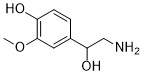
Physicochemical Properties
| Molecular Formula | C9H13NO3 |
| Molecular Weight | 183.21 |
| Exact Mass | 183.09 |
| Elemental Analysis | C, 59.00; H, 7.15; N, 7.65; O, 26.20 |
| CAS # | 97-31-4 |
| Related CAS # | (Rac)-Normetanephrine-d3;1073244-89-9 |
| PubChem CID | 1237 |
| Appearance | White to off-white solid powder |
| Density | 1.249g/cm3 |
| Boiling Point | 393.8ºC at 760 mmHg |
| Melting Point | 204 °C |
| Flash Point | 192ºC |
| Index of Refraction | 1.589 |
| LogP | 1.093 |
| Hydrogen Bond Donor Count | 3 |
| Hydrogen Bond Acceptor Count | 4 |
| Rotatable Bond Count | 3 |
| Heavy Atom Count | 13 |
| Complexity | 154 |
| Defined Atom Stereocenter Count | 0 |
| InChi Key | YNYAYWLBAHXHLL-UHFFFAOYSA-N |
| InChi Code | InChI=1S/C9H13NO3/c1-13-9-4-6(8(12)5-10)2-3-7(9)11/h2-4,8,11-12H,5,10H2,1H3 |
| Chemical Name | 4-(2-amino-1-hydroxyethyl)-2-methoxyphenol |
| Synonyms | NORMETANEPHRINE; Normetadrenaline; 4-(2-Amino-1-hydroxyethyl)-2-methoxyphenol; 97-31-4; 3-Methoxynoradrenaline |
| HS Tariff Code | 2934.99.9001 |
| Storage |
Powder-20°C 3 years 4°C 2 years In solvent -80°C 6 months -20°C 1 month Note: This product requires protection from light (avoid light exposure) during transportation and storage. |
| Shipping Condition | Room temperature (This product is stable at ambient temperature for a few days during ordinary shipping and time spent in Customs) |
Biological Activity
| ln Vitro | Endogenous metabolites are those that the Kyoto Encyclopedia of Genes and Genomes has identified as substrates or products of the roughly 1900 metabolic enzymes that are encoded in our genomes. Numerous studies have conclusively shown that many of these metabolites are hazardous [1]. |
| References |
[1]. Endogenous toxic metabolites and implications in cancer therapy. Oncogene. 2020 Aug;39(35):5709-5720. [2]. The relationships of free to conjugated normetanephrine in plasma and spinal fluid of hypertensive patients. J Clin Endocrinol Metab. 1982 Jul;55(1):81-5. |
| Additional Infomation |
Normetanephrine is a catecholamine. Normetanephrine has been reported in Solanum with data available. A methylated metabolite of norepinephrine that is excreted in the urine and found in certain tissues. It is a marker for tumors. |
Solubility Data
| Solubility (In Vitro) | DMSO : ~250 mg/mL (~1364.63 mM) |
| Solubility (In Vivo) |
Solubility in Formulation 1: ≥ 2.08 mg/mL (11.35 mM) (saturation unknown) in 10% DMSO + 40% PEG300 + 5% Tween80 + 45% Saline (add these co-solvents sequentially from left to right, and one by one), clear solution. For example, if 1 mL of working solution is to be prepared, you can add 100 μL of 20.8 mg/mL clear DMSO stock solution to 400 μL PEG300 and mix evenly; then add 50 μL Tween-80 to the above solution and mix evenly; then add 450 μL normal saline to adjust the volume to 1 mL. Preparation of saline: Dissolve 0.9 g of sodium chloride in 100 mL ddH₂ O to obtain a clear solution. Solubility in Formulation 2: ≥ 2.08 mg/mL (11.35 mM) (saturation unknown) in 10% DMSO + 90% (20% SBE-β-CD in Saline) (add these co-solvents sequentially from left to right, and one by one), clear solution. For example, if 1 mL of working solution is to be prepared, you can add 100 μL of 20.8 mg/mL clear DMSO stock solution to 900 μL of 20% SBE-β-CD physiological saline solution and mix evenly. Preparation of 20% SBE-β-CD in Saline (4°C,1 week): Dissolve 2 g SBE-β-CD in 10 mL saline to obtain a clear solution. Solubility in Formulation 3: ≥ 2.08 mg/mL (11.35 mM) (saturation unknown) in 10% DMSO + 90% Corn Oil (add these co-solvents sequentially from left to right, and one by one), clear solution. For example, if 1 mL of working solution is to be prepared, you can add 100 μL of 20.8 mg/mL clear DMSO stock solution to 900 μL of corn oil and mix evenly. (Please use freshly prepared in vivo formulations for optimal results.) |
| Preparing Stock Solutions | 1 mg | 5 mg | 10 mg | |
| 1 mM | 5.4582 mL | 27.2911 mL | 54.5822 mL | |
| 5 mM | 1.0916 mL | 5.4582 mL | 10.9164 mL | |
| 10 mM | 0.5458 mL | 2.7291 mL | 5.4582 mL |