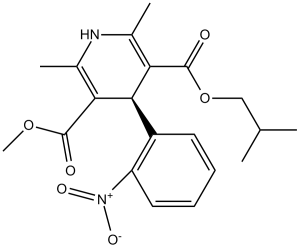
Nisoldipine (BAY-K-5552; Bay K-5552, Sular, Baymycard, Nisocor, Syscor) is a novel CCB-calcium channel blocker of the dihydropyridine (DHP) class with vasodilating and antihypertensive effects. It acts as a potent and specific blocker/inhibitor for L-type Cav1.2 with IC50 of 10 nM. Nisoldipine is used as a potent arterial vasodilator and antihypertensive agent. Nisoldipine is about 30 times less selective for delayed-rectifier K+ channels than for L-type Ca2+ channels, which inhibits IKr (rapidly activating delayed-rectifier K+ current) with IC50 of 23 μM, and IKs (slowly activating delayed-rectifier K+ current) with IC50 of 40 μM in guinea-pig ventricular myocytes.
Physicochemical Properties
| Molecular Formula | C20H24N2O6 | |
| Molecular Weight | 388.4144 | |
| Exact Mass | 388.163 | |
| CAS # | 63675-72-9 | |
| Related CAS # | Nisoldipine-d6;1285910-03-3;Nisoldipine-d4;1219795-47-7;Nisoldipine-d7;1189718-34-0 | |
| PubChem CID | 4499 | |
| Appearance | Light yellow to yellow solid powder | |
| Density | 1.2±0.1 g/cm3 | |
| Boiling Point | 505.8±50.0 °C at 760 mmHg | |
| Melting Point | 147-148°C | |
| Flash Point | 259.7±30.1 °C | |
| Vapour Pressure | 0.0±1.3 mmHg at 25°C | |
| Index of Refraction | 1.544 | |
| LogP | 3.3 | |
| Hydrogen Bond Donor Count | 1 | |
| Hydrogen Bond Acceptor Count | 7 | |
| Rotatable Bond Count | 7 | |
| Heavy Atom Count | 28 | |
| Complexity | 704 | |
| Defined Atom Stereocenter Count | 0 | |
| SMILES | O(C([H])([H])C([H])(C([H])([H])[H])C([H])([H])[H])C(C1=C(C([H])([H])[H])N([H])C(C([H])([H])[H])=C(C(=O)OC([H])([H])[H])C1([H])C1=C([H])C([H])=C([H])C([H])=C1[N+](=O)[O-])=O |
|
| InChi Key | VKQFCGNPDRICFG-UHFFFAOYSA-N | |
| InChi Code | InChI=1S/C20H24N2O6/c1-11(2)10-28-20(24)17-13(4)21-12(3)16(19(23)27-5)18(17)14-8-6-7-9-15(14)22(25)26/h6-9,11,18,21H,10H2,1-5H3 | |
| Chemical Name | 3-isobutyl 5-methyl 2,6-dimethyl-4-(2-nitrophenyl)-1,4-dihydropyridine-3,5-dicarboxylate | |
| Synonyms |
|
|
| HS Tariff Code | 2934.99.9001 | |
| Storage |
Powder-20°C 3 years 4°C 2 years In solvent -80°C 6 months -20°C 1 month Note: This product requires protection from light (avoid light exposure) during transportation and storage. |
|
| Shipping Condition | Room temperature (This product is stable at ambient temperature for a few days during ordinary shipping and time spent in Customs) |
Biological Activity
| ln Vitro |
|
||
| ln Vivo |
|
||
| Animal Protocol |
|
||
| ADME/Pharmacokinetics |
Absorption, Distribution and Excretion Relatively well absorbed into the systemic circulation with 87% of the radiolabeled drug recovered in urine and feces. The absolute bioavailability of nisoldipine is about 5%. Although 60-80% of an oral dose undergoes urinary excretion, only traces of unchanged nisoldipine are found in urine. Metabolism / Metabolites Pre-systemic metabolism in the gut wall, and this metabolism decreases from the proximal to the distal parts of the intestine. Nisoldipine is highly metabolized; 5 major urinary metabolites have been identified. The major biotransformation pathway appears to be the hydroxylation of the isobutyl ester. A hydroxylated derivative of the side chain, present in plasma at concentrations approximately equal to the parent compound, appears to be the only active metabolite and has about 10% of the activity of the parent compound. Cytochrome P450 enzymes are believed to play a major role in the metabolism of nisoldipine. The particular isoenzyme system responsible for its metabolism has not been identified, but other dihydropyridines are metabolized by cytochrome P450 IIIA4. Nisoldipine has known human metabolites that include 2,6-Dimethyl-5-(2-methylpropoxycarbonyl)-4-(2-nitrophenyl)-1,4-dihydropyridine-3-carboxylic acid, Dehydro Nisoldipine, and 5-O-(1-hydroxy-2-methylpropyl) 3-O-methyl 2,6-dimethyl-4-(2-nitrophenyl)-1,4-dihydropyridine-3,5-dicarboxylate. Biological Half-Life 7-12 hours |
||
| Toxicity/Toxicokinetics |
Effects During Pregnancy and Lactation ◉ Summary of Use during Lactation Because no information is available on the use of nisoldipine during breastfeeding, an alternate drug may be preferred. ◉ Effects in Breastfed Infants Relevant published information was not found as of the revision date. ◉ Effects on Lactation and Breastmilk Relevant published information was not found as of the revision date. Protein Binding 99% |
||
| References | Br J Pharmacol.1998;125(5):1005-12;Br J Pharmacol.2003;140(5):863-70;Hepatology.1996;24(2):391-7. | ||
| Additional Infomation |
Methyl 2-methylpropyl 2,6-dimethyl-4-(2-nitrophenyl)-1,4-dihydropyridine-3,5-dicarboxylate is a dihydropyridine that is 1,4-dihydropyridine which is substituted by methyl groups at positions 2 and 6, a methoxycarbonyl group at position 3, an o-nitrophenyl group at position 4, and an isobutoxycarbonyl group at position 5. The racemate, a calcium channel blocker, is used in the treatment of hypertension and angina pectoris. It is a C-nitro compound, a diester, a dihydropyridine, a methyl ester and a member of dicarboxylic acids and O-substituted derivatives. Nisoldipine is a 1,4-dihydropyridine calcium channel blocker. It acts primarily on vascular smooth muscle cells by stabilizing voltage-gated L-type calcium channels in their inactive conformation. By inhibiting the influx of calcium in smooth muscle cells, nisoldipine prevents calcium-dependent smooth muscle contraction and subsequent vasoconstriction. Nisoldipine may be used in alone or in combination with other agents in the management of hypertension. Nisoldipine is a Dihydropyridine Calcium Channel Blocker. The mechanism of action of nisoldipine is as a Calcium Channel Antagonist. The physiologic effect of nisoldipine is by means of Decreased Blood Pressure. Nisoldipine is a second generation calcium channel blocker and commonly used antihypertensive agent. Nisoldipine therapy is associated with a low rate of serum enzyme elevations, but has not been specifically linked to instances of clinical apparent acute liver injury. Nisoldipine is a dihydropyridine calcium channel blocking agent. Nisoldipine inhibits the transmembrane influx of extracellular calcium ions into myocardial and vascular smooth muscle cells, causing dilatation of the main coronary and systemic arteries and decreasing myocardial contractility. This agent also inhibits the drug efflux pump P-glycoprotein which is overexpressed in some multi-drug resistant tumors and may improve the efficacy of some antineoplastic agents. (NCI04) A dihydropyridine calcium channel antagonist that acts as a potent arterial vasodilator and antihypertensive agent. It is also effective in patients with cardiac failure and angina. Drug Indication For the treatment of hypertension. It may be used alone or in combination with other antihypertensive agents. Mechanism of Action By deforming the channel, inhibiting ion-control gating mechanisms, and/or interfering with the release of calcium from the sarcoplasmic reticulum, Nisoldipine inhibits the influx of extracellular calcium across the myocardial and vascular smooth muscle cell membranes The decrease in intracellular calcium inhibits the contractile processes of the myocardial smooth muscle cells, causing dilation of the coronary and systemic arteries, increased oxygen delivery to the myocardial tissue, decreased total peripheral resistance, decreased systemic blood pressure, and decreased afterload. Pharmacodynamics Nisoldipine, a dihydropyridine calcium-channel blocker, is used alone or with an angiotensin-converting enzyme inhibitor, to treat hypertension, chronic stable angina pectoris, and Prinzmetal's variant angina. Nisoldipine is similar to other peripheral vasodilators. Nisoldipine inhibits the influx of extra cellular calcium across the myocardial and vascular smooth muscle cell membranes possibly by deforming the channel, inhibiting ion-control gating mechanisms, and/or interfering with the release of calcium from the sarcoplasmic reticulum. The decrease in intracellular calcium inhibits the contractile processes of the myocardial smooth muscle cells, causing dilation of the coronary and systemic arteries, increased oxygen delivery to the myocardial tissue, decreased total peripheral resistance, decreased systemic blood pressure, and decreased afterload. |
Solubility Data
| Solubility (In Vitro) |
|
|||
| Solubility (In Vivo) |
Solubility in Formulation 1: ≥ 2.5 mg/mL (6.44 mM) (saturation unknown) in 10% DMSO + 40% PEG300 + 5% Tween80 + 45% Saline (add these co-solvents sequentially from left to right, and one by one), clear solution. For example, if 1 mL of working solution is to be prepared, you can add 100 μL of 25.0 mg/mL clear DMSO stock solution to 400 μL PEG300 and mix evenly; then add 50 μL Tween-80 to the above solution and mix evenly; then add 450 μL normal saline to adjust the volume to 1 mL. Preparation of saline: Dissolve 0.9 g of sodium chloride in 100 mL ddH₂ O to obtain a clear solution. Solubility in Formulation 2: ≥ 2.5 mg/mL (6.44 mM) (saturation unknown) in 10% DMSO + 90% (20% SBE-β-CD in Saline) (add these co-solvents sequentially from left to right, and one by one), clear solution. For example, if 1 mL of working solution is to be prepared, you can add 100 μL of 25.0 mg/mL clear DMSO stock solution to 900 μL of 20% SBE-β-CD physiological saline solution and mix evenly. Preparation of 20% SBE-β-CD in Saline (4°C,1 week): Dissolve 2 g SBE-β-CD in 10 mL saline to obtain a clear solution. (Please use freshly prepared in vivo formulations for optimal results.) |
| Preparing Stock Solutions | 1 mg | 5 mg | 10 mg | |
| 1 mM | 2.5746 mL | 12.8730 mL | 25.7460 mL | |
| 5 mM | 0.5149 mL | 2.5746 mL | 5.1492 mL | |
| 10 mM | 0.2575 mL | 1.2873 mL | 2.5746 mL |