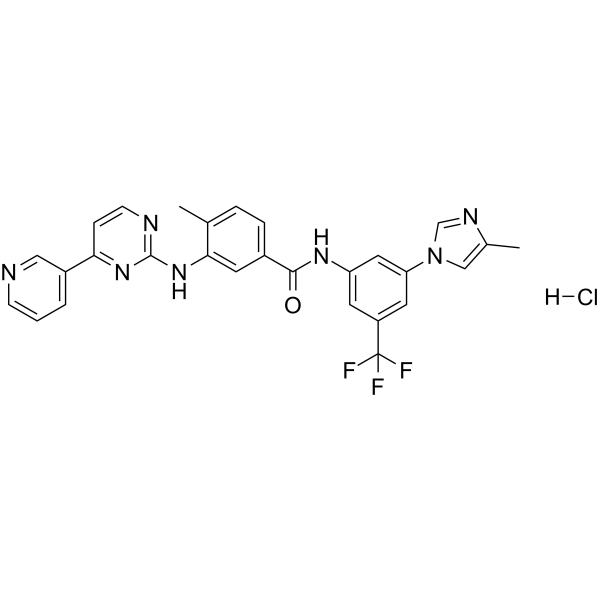
Nilotinib HCl is a potent Bcr-Abl tyrosine kinase inhibitor and an FDA-approved drug for the treatment of imatinib-resistant chronic myelogenous leukemia.
Physicochemical Properties
| Molecular Formula | C28H22N7OF3.HCL |
| Molecular Weight | 565.97672 |
| Exact Mass | 565.16 |
| CAS # | 923288-95-3 |
| Related CAS # | Nilotinib;641571-10-0;Nilotinib monohydrochloride monohydrate;923288-90-8;Nilotinib-d6;1268356-17-7 |
| PubChem CID | 16006490 |
| Appearance | Typically exists as solid at room temperature |
| LogP | 7.614 |
| Hydrogen Bond Donor Count | 3 |
| Hydrogen Bond Acceptor Count | 9 |
| Rotatable Bond Count | 6 |
| Heavy Atom Count | 40 |
| Complexity | 817 |
| Defined Atom Stereocenter Count | 0 |
| SMILES | Cl.O=C(C1C=C(NC2N=C(C3C=CC=NC=3)C=CN=2)C(C)=CC=1)NC1C=C(C(F)(F)F)C=C(N2C=C(C)N=C2)C=1 |
| InChi Key | VTGGYCCJUPYZSX-UHFFFAOYSA-N |
| InChi Code | InChI=1S/C28H22F3N7O.ClH/c1-17-5-6-19(10-25(17)37-27-33-9-7-24(36-27)20-4-3-8-32-14-20)26(39)35-22-11-21(28(29,30)31)12-23(13-22)38-15-18(2)34-16-38;/h3-16H,1-2H3,(H,35,39)(H,33,36,37);1H |
| Chemical Name | 4-methyl-N-[3-(4-methylimidazol-1-yl)-5-(trifluoromethyl)phenyl]-3-[(4-pyridin-3-ylpyrimidin-2-yl)amino]benzamide;hydrochloride |
| HS Tariff Code | 2934.99.9001 |
| Storage |
Powder-20°C 3 years 4°C 2 years In solvent -80°C 6 months -20°C 1 month |
| Shipping Condition | Room temperature (This product is stable at ambient temperature for a few days during ordinary shipping and time spent in Customs) |
Biological Activity
| ln Vitro | Being more potent than imatinib (IC50<30 nM), nilotinib hydrochloride is a selective Abl inhibitor that is intended to interact with the ATP binding site of BCR-ABL with a higher affinity [1]. It also maintains its activity against the majority of BCR-ABL point mutants that confer imatinib resistance. Significant anti-tumor efficaciousness of nilotinib hydrochloride was demonstrated against GIST xenograft cell lines and GIST cell lines resistant to imatinib. Among them, the parent cell lines GK1C and GK3C, with IC50 values of 4.59± and 4.59±, respectively, demonstrated imatinib sensitivity. 11.15±1.48 µM and 0.97 µM. Imatinib resistance was demonstrated by the imatinib-resistant cell line GK1C-IR GK3C-IR, with IC50 values of 41.37±1.07 µM (P<0.001) and 11.74±0.17 µM (P<0.001)[2]. |
| ln Vivo | In GIST xenograft BALB/cSLc-nu/nu mice, nilotinib hydrochloride (oral gavage, 40 mg/kg, daily, 4 weeks) exhibited comparable or greater anti-tumor effects [2]. In a rat model of indomethacin-induced enterocolitis, nilotinib hydrochloride significantly improves macroscopic and microscopic pathological scores, promoting significant mucosal healing and lowering colonic cell counts and PDGFRα and β levels. Score of apoptosis[3]. |
| Animal Protocol |
Animal/Disease Models: GIST xenograft BALB/cSLc-nu/nu (nude) mice (GK1X, GK2X and GK3X) [2] Doses: 40 mg/kg Route of Administration: po (oral gavage); daily; 4 weeks Experimental Results: in GK1X Tumor growth inhibition was 69.6%, 85.3% in GK2X, and 47.5% in the GK3X xenograft cell line. |
| References |
[1]. Beneficial effects of combining nilotinib and imatinib in preclinical models of BCR-ABL+ leukemias. Blood. 2007 Mar 1;109(5):2112-20. [2]. Antitumor effect of the tyrosine kinase inhibitor Nilotinib on gastrointestinal stromal tumor (GIST) and Imatinib-resistant GIST cells. PLoS One. 2014 Sep 15;9(9):e107613. [3]. Targeting invadopodia-mediated breast cancer metastasis by using ABL kinase inhibitors. Oncotarget. 2018 Apr 24;9(31):22158-22183. |
| Additional Infomation |
Nilotinib Hydrochloride Anhydrous is the hydrochloride salt of nilotinib, an orally bioavailable aminopyrimidine-derivative Bcr-Abl tyrosine kinase inhibitor with antineoplastic activity. Designed to overcome imatinib resistance, nilotinib binds to and stabilizes the inactive conformation of the kinase domain of the Abl protein of the Bcr-Abl fusion protein, resulting in the inhibition of the Bcr-Abl-mediated proliferation of Philadelphia chromosome-positive (Ph+) chronic myeloid leukemia (CML) cells. This agent also inhibits the receptor tyrosine kinases platelet-derived growth factor receptor (PDGF-R) and c-kit, a receptor tyrosine kinase mutated and constitutively activated in most gastrointestinal stromal tumors (GISTs). With a binding mode that is energetically more favorable than that of imatinib, nilotinib has been shown to have an approximately 20-fold increased potency in kinase and proliferation assays compared to imatinib. See also: Nilotinib (has active moiety). |
Solubility Data
| Solubility (In Vitro) | May dissolve in DMSO (in most cases), if not, try other solvents such as H2O, Ethanol, or DMF with a minute amount of products to avoid loss of samples |
| Solubility (In Vivo) |
Note: Listed below are some common formulations that may be used to formulate products with low water solubility (e.g. < 1 mg/mL), you may test these formulations using a minute amount of products to avoid loss of samples. Injection Formulations (e.g. IP/IV/IM/SC) Injection Formulation 1: DMSO : Tween 80: Saline = 10 : 5 : 85 (i.e. 100 μL DMSO stock solution → 50 μL Tween 80 → 850 μL Saline) *Preparation of saline: Dissolve 0.9 g of sodium chloride in 100 mL ddH ₂ O to obtain a clear solution. Injection Formulation 2: DMSO : PEG300 :Tween 80 : Saline = 10 : 40 : 5 : 45 (i.e. 100 μL DMSO → 400 μLPEG300 → 50 μL Tween 80 → 450 μL Saline) Injection Formulation 3: DMSO : Corn oil = 10 : 90 (i.e. 100 μL DMSO → 900 μL Corn oil) Example: Take the Injection Formulation 3 (DMSO : Corn oil = 10 : 90) as an example, if 1 mL of 2.5 mg/mL working solution is to be prepared, you can take 100 μL 25 mg/mL DMSO stock solution and add to 900 μL corn oil, mix well to obtain a clear or suspension solution (2.5 mg/mL, ready for use in animals). Injection Formulation 4: DMSO : 20% SBE-β-CD in saline = 10 : 90 [i.e. 100 μL DMSO → 900 μL (20% SBE-β-CD in saline)] *Preparation of 20% SBE-β-CD in Saline (4°C,1 week): Dissolve 2 g SBE-β-CD in 10 mL saline to obtain a clear solution. Injection Formulation 5: 2-Hydroxypropyl-β-cyclodextrin : Saline = 50 : 50 (i.e. 500 μL 2-Hydroxypropyl-β-cyclodextrin → 500 μL Saline) Injection Formulation 6: DMSO : PEG300 : castor oil : Saline = 5 : 10 : 20 : 65 (i.e. 50 μL DMSO → 100 μLPEG300 → 200 μL castor oil → 650 μL Saline) Injection Formulation 7: Ethanol : Cremophor : Saline = 10: 10 : 80 (i.e. 100 μL Ethanol → 100 μL Cremophor → 800 μL Saline) Injection Formulation 8: Dissolve in Cremophor/Ethanol (50 : 50), then diluted by Saline Injection Formulation 9: EtOH : Corn oil = 10 : 90 (i.e. 100 μL EtOH → 900 μL Corn oil) Injection Formulation 10: EtOH : PEG300:Tween 80 : Saline = 10 : 40 : 5 : 45 (i.e. 100 μL EtOH → 400 μLPEG300 → 50 μL Tween 80 → 450 μL Saline) Oral Formulations Oral Formulation 1: Suspend in 0.5% CMC Na (carboxymethylcellulose sodium) Oral Formulation 2: Suspend in 0.5% Carboxymethyl cellulose Example: Take the Oral Formulation 1 (Suspend in 0.5% CMC Na) as an example, if 100 mL of 2.5 mg/mL working solution is to be prepared, you can first prepare 0.5% CMC Na solution by measuring 0.5 g CMC Na and dissolve it in 100 mL ddH2O to obtain a clear solution; then add 250 mg of the product to 100 mL 0.5% CMC Na solution, to make the suspension solution (2.5 mg/mL, ready for use in animals). Oral Formulation 3: Dissolved in PEG400 Oral Formulation 4: Suspend in 0.2% Carboxymethyl cellulose Oral Formulation 5: Dissolve in 0.25% Tween 80 and 0.5% Carboxymethyl cellulose Oral Formulation 6: Mixing with food powders Note: Please be aware that the above formulations are for reference only. InvivoChem strongly recommends customers to read literature methods/protocols carefully before determining which formulation you should use for in vivo studies, as different compounds have different solubility properties and have to be formulated differently. (Please use freshly prepared in vivo formulations for optimal results.) |
| Preparing Stock Solutions | 1 mg | 5 mg | 10 mg | |
| 1 mM | 1.7668 mL | 8.8342 mL | 17.6685 mL | |
| 5 mM | 0.3534 mL | 1.7668 mL | 3.5337 mL | |
| 10 mM | 0.1767 mL | 0.8834 mL | 1.7668 mL |