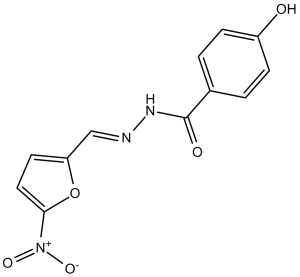
Nifuroxazide (Bacifurane; Diafuryl; Ambatrol; Antinal; Diarlidan) is a potent, cell-permeable and orally bioavailable nitrofuran-based antidiarrheal agent that effectively suppresses the activation of cellular STAT1/3/5 transcription activity with IC50 of 3 μM against IL-6-induced STAT3 activation in U3A cells. It is a nitrofuran antibiotic that has been approved for treating colitis and diarrhea. Nifuroxazide is described to block constitutive phosphorylation of STAT3 by reducing Jak kinase autophosphorylation, decreasing the viability of myeloma cells depending on constitutive STAT3 activity for survival while not affecting normal peripheral blood mononuclear cells.
Physicochemical Properties
| Molecular Formula | C12H9N3O5 | |
| Molecular Weight | 275.22 | |
| Exact Mass | 275.054 | |
| CAS # | 965-52-6 | |
| Related CAS # |
|
|
| PubChem CID | 5337997 | |
| Appearance | Light yellow to yellow solid powder | |
| Density | 1.5±0.1 g/cm3 | |
| Melting Point | 281-283°C | |
| Index of Refraction | 1.653 | |
| LogP | 0.59 | |
| Hydrogen Bond Donor Count | 2 | |
| Hydrogen Bond Acceptor Count | 6 | |
| Rotatable Bond Count | 3 | |
| Heavy Atom Count | 20 | |
| Complexity | 387 | |
| Defined Atom Stereocenter Count | 0 | |
| SMILES | C1=CC(=CC=C1C(=O)N/N=C/C2=CC=C(O2)[N+](=O)[O-])O |
|
| InChi Key | YCWSUKQGVSGXJO-NTUHNPAUSA-N | |
| InChi Code | InChI=1S/C12H9N3O5/c16-9-3-1-8(2-4-9)12(17)14-13-7-10-5-6-11(20-10)15(18)19/h1-7,16H,(H,14,17)/b13-7+ | |
| Chemical Name | 4-Hydroxy-N-[(E)-(5-nitrofuran-2-yl)methylideneamino]benzamide | |
| Synonyms |
|
|
| HS Tariff Code | 2934.99.9001 | |
| Storage |
Powder-20°C 3 years 4°C 2 years In solvent -80°C 6 months -20°C 1 month |
|
| Shipping Condition | Room temperature (This product is stable at ambient temperature for a few days during ordinary shipping and time spent in Customs) |
Biological Activity
| Targets |
Nifuroxazide targets signal transducer and activator of transcription 3 (STAT3) with an IC50 of 10 μM for STAT3 phosphorylation (Tyr705) inhibition [1] Nifuroxazide specifically inhibits STAT3 signaling without affecting STAT1, STAT5, or NF-κB pathways [1,2] |
| ln Vitro |
Nifuroxazide treatment of U266 cells results in a notable dose-dependent reduction in STAT3 tyrosine phosphorylation. As early as one hour after therapy, STAT3 tyrosine phosphorylation is rapidly inhibited, and this suppression lasts for at least twenty-four hours. Nifuroxazide treatment of U266 or INA6 cells for 48 hours causes a dose-dependent decrease of cell viability in both cell types, with an EC50 of roughly 4.5 μM. Notably, nifuroxazide has no harmful effect on MM cells that lack constitutive STAT3 activation[1]. Nifuroxazide (5-25 μM) dose-dependently inhibited proliferation of human multiple myeloma (MM) cells (MM.1S, RPMI8226, U266) with IC50 values of 8 μM, 10 μM, and 12 μM respectively [1] Nifuroxazide (10 μM) directly bound to STAT3 SH2 domain, suppressed STAT3 phosphorylation (Tyr705) by 75%, and blocked STAT3 dimerization and nuclear translocation in MM cells [1] Nifuroxazide (10-15 μM) induced apoptosis in MM cells: apoptotic rate increased by 48% (Annexin V/PI staining), caspase-3/-9 activity enhanced by 3.2-fold, and anti-apoptotic proteins Bcl-2, Bcl-XL, and Survivin downregulated by 0.4-0.6-fold [1] Nifuroxazide (10-25 μM) inhibited proliferation of human melanoma cells (B16F10, A375) with IC50 values of 15 μM and 20 μM respectively [2] Nifuroxazide (20 μM) suppressed migration and invasion of B16F10 melanoma cells by 65% and 70% respectively, as measured by Transwell assays [2] Nifuroxazide (15 μM) downregulated STAT3 target genes (MMP-2, MMP-9, VEGF) mRNA levels by 55-68% in melanoma cells [2] |
| ln Vivo |
Treatment with Nifuroxazide could, in a dose-dependent way, suppress tumor growth and weight in comparison to the vehicle group, with the inhibition rate of tumor volumes being 43.0% and 62.1% at 25 mg/kg and 50 mg/kg, respectively. Additionally, it has been demonstrated that nifuroxazide causes cleaved caspase-3-positive cells to undergo apoptosis and dramatically reduces the growth of nuclear Ki-67-positive cells. Furthermore, it has been discovered that nifuroxazide therapy may suppress the expression of p-Stat3, MMP-2, and MMP-9 in A375 tumor tissues. Additionally, Nifuroxazide prevents MDSC penetration into the lung, which may be linked to the B16-F10 melanoma metastatic model's reduction of tumor cell distant colonization[2]. Nifuroxazide (50 mg/kg, p.o., daily for 21 days) inhibited tumor growth in nude mice bearing RPMI8226 MM xenografts: tumor volume reduced by 55% and tumor weight decreased by 52% compared to the vehicle group [1] Nifuroxazide (50 mg/kg, p.o.) reduced STAT3 phosphorylation (62%) and increased apoptotic index (TUNEL staining, 3.0-fold) in MM xenograft tissues [1] Nifuroxazide (50 mg/kg, p.o., daily for 14 days) suppressed B16F10 melanoma growth in C57BL/6 mice: tumor weight reduced by 60% [2] Nifuroxazide (50 mg/kg, p.o.) inhibited lung metastasis of B16F10 melanoma in mice by 70%, as evidenced by reduced number of metastatic nodules [2] Nifuroxazide treatment in melanoma mice downregulated MMP-2/9 protein levels (58-65%) and STAT3 phosphorylation (55%) in tumor tissues [2] |
| Enzyme Assay |
Recombinant STAT3 protein was incubated with biotin-labeled STAT3 SH2 domain-binding peptide and serial concentrations of Nifuroxazide (5-30 μM) in binding buffer at 37°C for 1 hour. The binding complex was captured by streptavidin-coated plates, and bound STAT3 was detected using a specific antibody. IC50 was calculated by fitting the dose-response inhibition curve [1] STAT3 luciferase reporter plasmid-transfected HEK293 cells were treated with Nifuroxazide (5-20 μM) for 24 hours. Luciferase activity was measured using a dual-luciferase assay system to evaluate STAT3 transcriptional inhibition [1] |
| Cell Assay |
MM cells (MM.1S, RPMI8226, U266) were seeded in 96-well plates (5×10^3 cells/well) and treated with Nifuroxazide (5-25 μM) for 72 hours. Cell viability was assessed by MTT assay, and IC50 values were calculated [1] MM cells were seeded in 6-well plates (1×10^5 cells/well) and treated with Nifuroxazide (10-15 μM) for 24 hours. Cells were lysed for western blot analysis of phosphorylated STAT3 (Tyr705), total STAT3, Bcl-2, Bcl-XL, Survivin, and cleaved caspase-3 [1] Melanoma cells (B16F10, A375) were seeded in 96-well plates (5×10^3 cells/well) and treated with Nifuroxazide (10-25 μM) for 72 hours. Cell proliferation was measured by CCK-8 assay [2] For melanoma cell migration/invasion assays: B16F10 cells were seeded in the upper chamber of Transwell inserts (uncoated for migration, Matrigel-coated for invasion), and Nifuroxazide (20 μM) was added to both chambers. After 24 hours (migration) or 48 hours (invasion), migrated/invaded cells were fixed, stained, and counted [2] MM cells were treated with Nifuroxazide (10 μM) for 24 hours, stained with Annexin V-FITC/PI, and apoptotic cells were analyzed by flow cytometry [1] |
| Animal Protocol |
25 mg/kg, 50 mg/kg; i.p. Mice Nude mice (6-8 weeks old) were subcutaneously injected with RPMI8226 MM cells (2×10^6 cells/mouse) to establish xenografts. When tumors reached 100 mm³, mice were randomly divided into vehicle and Nifuroxazide groups (n=6 per group). Nifuroxazide was suspended in 0.5% carboxymethylcellulose (CMC) and administered orally at 50 mg/kg once daily for 21 days. Tumor volume was measured every 3 days, and mice were euthanized for tumor weight and western blot analysis [1] C57BL/6 mice (6-8 weeks old) were subcutaneously injected with B16F10 melanoma cells (1×10^6 cells/mouse) for primary tumor model, or intravenously injected (2×10^5 cells/mouse) for lung metastasis model. Mice were treated with Nifuroxazide (50 mg/kg, p.o., daily for 14 days) starting 1 day post-inoculation. Primary tumor weight was measured, and lung metastatic nodules were counted after euthanasia [2] |
| Toxicity/Toxicokinetics |
In mice treated with Nifuroxazide (50 mg/kg, p.o., up to 21 days), no significant weight loss or abnormal clinical signs were observed [1,2] Serum levels of liver function markers (ALT, AST) and kidney function markers (BUN, Cr) in Nifuroxazide-treated mice were within the normal range, with no significant difference from the vehicle group [1,2] Nifuroxazide (up to 25 μM in vitro) showed no significant cytotoxicity to normal human peripheral blood mononuclear cells (PBMCs) [1] |
| References |
[1]. Nifuroxazide inhibits survival of multiple myeloma cells by directly inhibiting STAT3. Blood. 2008 Dec 15;112(13):5095-102. [2]. Nifuroxazide exerts potent anti-tumor and anti-metastasis activity in melanoma. Sci Rep. 2016 Feb 2;6:20253. |
| Additional Infomation |
Nifuroxazide is a member of benzoic acids. Nifuroxazide is an oral nitrofuran derivative originally approved as an antibacterial drug for the treatment of gastrointestinal infections [1,2] Nifuroxazide exerts antitumor effects by directly binding to the STAT3 SH2 domain, inhibiting STAT3 phosphorylation, dimerization, and nuclear translocation, thereby suppressing the transcription of STAT3-dependent pro-survival and pro-metastatic genes [1,2] Nifuroxazide has been repurposed as a potential antitumor agent for multiple myeloma and melanoma, with advantages of oral bioavailability and low toxicity [1,2] |
Solubility Data
| Solubility (In Vitro) |
|
|||
| Solubility (In Vivo) |
Solubility in Formulation 1: ≥ 2.58 mg/mL (9.37 mM) (saturation unknown) in 10% DMSO + 40% PEG300 + 5% Tween80 + 45% Saline (add these co-solvents sequentially from left to right, and one by one), suspension solution. For example, if 1 mL of working solution is to be prepared, you can add 100 μL of 25.8 mg/mL clear DMSO stock solution to 400 μL PEG300 and mix evenly; then add 50 μL Tween-80 to the above solution and mix evenly; then add 450 μL normal saline to adjust the volume to 1 mL. Preparation of saline: Dissolve 0.9 g of sodium chloride in 100 mL ddH₂ O to obtain a clear solution. Solubility in Formulation 2: ≥ 2.58 mg/mL (9.37 mM) (saturation unknown) in 10% DMSO + 90% Corn Oil (add these co-solvents sequentially from left to right, and one by one), suspension solution. For example, if 1 mL of working solution is to be prepared, you can add 100 μL of 25.8 mg/mL clear DMSO stock solution to 900 μL of corn oil and mix evenly. (Please use freshly prepared in vivo formulations for optimal results.) |
| Preparing Stock Solutions | 1 mg | 5 mg | 10 mg | |
| 1 mM | 3.6335 mL | 18.1673 mL | 36.3346 mL | |
| 5 mM | 0.7267 mL | 3.6335 mL | 7.2669 mL | |
| 10 mM | 0.3633 mL | 1.8167 mL | 3.6335 mL |