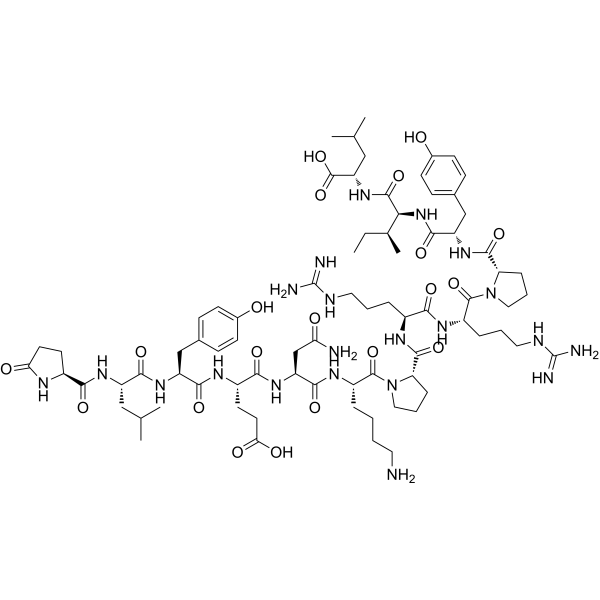
Physicochemical Properties
| Molecular Formula | C78H121N21O20 |
| Molecular Weight | 1672.92404 |
| Exact Mass | 1671.91 |
| CAS # | 39379-15-2 |
| PubChem CID | 25077406 |
| Appearance | White to off-white solid powder |
| Density | 1.46g/cm3 |
| Index of Refraction | 1.666 |
| LogP | 4.506 |
| Hydrogen Bond Donor Count | 21 |
| Hydrogen Bond Acceptor Count | 23 |
| Rotatable Bond Count | 50 |
| Heavy Atom Count | 119 |
| Complexity | 3530 |
| Defined Atom Stereocenter Count | 14 |
| SMILES | CC[C@H](C)[C@@H](C(=O)N[C@@H](CC(C)C)C(=O)O)NC(=O)[C@H](CC1=CC=C(C=C1)O)NC(=O)[C@@H]2CCCN2C(=O)[C@H](CCCN=C(N)N)NC(=O)[C@H](CCCN=C(N)N)NC(=O)[C@@H]3CCCN3C(=O)[C@H](CCCCN)NC(=O)[C@H](CC(=O)N)NC(=O)[C@H](CCC(=O)O)NC(=O)[C@H](CC4=CC=C(C=C4)O)NC(=O)[C@H](CC(C)C)NC(=O)[C@@H]5CCC(=O)N5 |
| InChi Key | PCJGZPGTCUMMOT-ISULXFBGSA-N |
| InChi Code | InChI=1S/C78H121N21O20/c1-7-43(6)63(73(115)96-57(76(118)119)37-42(4)5)97-70(112)55(39-45-21-25-47(101)26-22-45)95-72(114)59-18-13-35-99(59)75(117)52(16-11-33-86-78(83)84)90-64(106)48(15-10-32-85-77(81)82)89-71(113)58-17-12-34-98(58)74(116)51(14-8-9-31-79)91-69(111)56(40-60(80)102)94-66(108)50(28-30-62(104)105)88-68(110)54(38-44-19-23-46(100)24-20-44)93-67(109)53(36-41(2)3)92-65(107)49-27-29-61(103)87-49/h19-26,41-43,48-59,63,100-101H,7-18,27-40,79H2,1-6H3,(H2,80,102)(H,87,103)(H,88,110)(H,89,113)(H,90,106)(H,91,111)(H,92,107)(H,93,109)(H,94,108)(H,95,114)(H,96,115)(H,97,112)(H,104,105)(H,118,119)(H4,81,82,85)(H4,83,84,86)/t43-,48-,49-,50-,51-,52-,53-,54-,55-,56-,57-,58-,59-,63-/m0/s1 |
| Chemical Name | (2S)-2-[[(2S,3S)-2-[[(2S)-2-[[(2S)-1-[(2S)-2-[[(2S)-2-[[(2S)-1-[(2S)-6-amino-2-[[(2S)-4-amino-2-[[(2S)-4-carboxy-2-[[(2S)-3-(4-hydroxyphenyl)-2-[[(2S)-4-methyl-2-[[(2S)-5-oxopyrrolidine-2-carbonyl]amino]pentanoyl]amino]propanoyl]amino]butanoyl]amino]-4-oxobutanoyl]amino]hexanoyl]pyrrolidine-2-carbonyl]amino]-5-(diaminomethylideneamino)pentanoyl]amino]-5-(diaminomethylideneamino)pentanoyl]pyrrolidine-2-carbonyl]amino]-3-(4-hydroxyphenyl)propanoyl]amino]-3-methylpentanoyl]amino]-4-methylpentanoic acid |
| HS Tariff Code | 2934.99.9001 |
| Storage |
Powder-20°C 3 years 4°C 2 years In solvent -80°C 6 months -20°C 1 month Note: Please store this product in a sealed and protected environment, avoid exposure to moisture. |
| Shipping Condition | Room temperature (This product is stable at ambient temperature for a few days during ordinary shipping and time spent in Customs) |
Biological Activity
| Targets |
The action target of Neurotensin is neurotensin receptor 1 (NTR1) expressed on HCT116 human colon cancer cells. [1] |
| ln Vitro |
Neurotensin promotes the release of IL-8 in an untransformed colon epithelial cell line stably transfected with NTR and induces the expression of MIP-2, MCP-1, IL-1β, and TNFα in animal microglia. The majority of human pancreatic and colorectal malignancies include high-affinity NTRs, which belong to the G protein-coupled receptor (GPCR) family and imply that neurotensin (NT) may have an endocrine effect on tumor growth. Numerous signal transduction pathways, including as intracellular calcium ([Ca2+]i), mitogen-activated protein kinase (MAPK), ERK and JNK, and different PKC isoforms, are known to be stimulated by neurotensin through NTR1. Neurotensin therapy (100 nM) significantly boosted HCT116 cell migration (about three times) as compared to vehicle treatment; pretreatment with curcumin (10 μM) inhibited the stimulating effect of NT on HCT116 cell migration. The proliferative effects of neurotensin are partly attributed to NT stimulation of MEK/ERK and regulation of downstream AP-1 transcription factors [1]. 1. Induction of interleukin-8 (IL-8) production in HCT116 cells: HCT116 human colon cancer cells were treated with Neurotensin at concentrations of 10^-10 M, 10^-9 M, 10^-8 M, and 10^-7 M for 24 hours. The supernatant was collected, and ELISA was used to detect IL-8 levels. The results showed that Neurotensin induced IL-8 production in a concentration-dependent manner; compared with the control group, 10^-7 M Neurotensin increased IL-8 secretion by approximately 5-fold [1] 2. Promotion of HCT116 cell migration: Transwell migration assay was used to evaluate the effect of Neurotensin on cell migration. HCT116 cells were seeded in the upper chamber of Transwell, and Neurotensin (10^-8 M) was added to the lower chamber. After 24 hours of incubation, the cells that migrated to the lower chamber were fixed, stained, and counted. The results indicated that Neurotensin significantly increased the migration number of HCT116 cells by approximately 2.5-fold compared with the control group [1] 3. Activation of intracellular signaling pathways: HCT116 cells were treated with Neurotensin (10^-8 M) for 5 minutes, 15 minutes, 30 minutes, and 60 minutes. Western blot analysis was performed to detect the phosphorylation levels of protein kinase C (PKC), extracellular signal-regulated kinase 1/2 (ERK1/2), and p38 mitogen-activated protein kinase (p38 MAPK). The results showed that Neurotensin rapidly activated PKC, ERK1/2, and p38 MAPK; the phosphorylation levels peaked at 5-15 minutes and gradually decreased thereafter [1] |
| Cell Assay |
1. IL-8 detection assay in HCT116 cells: HCT116 cells were seeded in 24-well plates at a density of 5×10^4 cells per well and cultured in RPMI 1640 medium containing 10% fetal bovine serum until they reached 70%-80% confluence. The medium was replaced with serum-free RPMI 1640 medium, and the cells were starved for 12 hours. Then, Neurotensin was added to the wells at final concentrations of 10^-10 M, 10^-9 M, 10^-8 M, and 10^-7 M (with or without curcumin pretreatment). After 24 hours of incubation at 37°C in a 5% CO2 incubator, the culture supernatant was collected by centrifugation at 1000×g for 10 minutes. The concentration of IL-8 in the supernatant was measured using a specific ELISA kit, and the absorbance was read at 450 nm with a microplate reader [1] 2. HCT116 cell migration assay (Transwell assay): The upper chamber of Transwell inserts (with 8-μm pores) was coated with collagen I overnight at 4°C. HCT116 cells were digested with trypsin, resuspended in serum-free RPMI 1640 medium, and adjusted to a concentration of 1×10^5 cells/mL. A total of 200 μL of the cell suspension was added to the upper chamber, and 600 μL of RPMI 1640 medium containing 10% fetal bovine serum and Neurotensin (10^-8 M) was added to the lower chamber. After incubation at 37°C in a 5% CO2 incubator for 24 hours, the non-migrated cells on the upper surface of the membrane were wiped off with a cotton swab. The migrated cells on the lower surface were fixed with 4% paraformaldehyde for 15 minutes and stained with crystal violet for 20 minutes. The stained cells were observed under a light microscope, and 5 random fields of view were selected for counting to quantify the migration ability [1] |
| References |
[1]. Curcumin inhibits neurotensin-mediated interleukin-8 production and migration of HCT116 human colon cancer cells. Clin Cancer Res. 2006 Sep 15;12(18):5346-55. |
| Additional Infomation |
Neurotensin is a 13 amino acid peptide hormone which is found in the central nervous system and the gastrointestinal tract. It behaves as a neurotransmitter in the brain, as a hormone in the gut, and also as a neuromodulator. It is implicated in the pathophysiology of several CNS disorders (including schizophrenia, Parkinson's disease, drug abuse, pain, cancer, inflammation, eating disorders and central control of blood pressure) due to its association with a wide variety of neurotransmitter systems such as dopaminergic, sertonergic, glutamatergic, GABAergic, and cholinergic systems. It has a role as a human metabolite, a mitogen, a neurotransmitter and a vulnerary. It is a conjugate base of a neurotensin(1+). A biologically active tridecapeptide isolated from the hypothalamus. It has been shown to induce hypotension in the rat, to stimulate contraction of guinea pig ileum and rat uterus, and to cause relaxation of rat duodenum. There is also evidence that it acts as both a peripheral and a central nervous system neurotransmitter. 1. Neurotensin is a 13-amino acid neuropeptide that is widely distributed in the central nervous system and gastrointestinal tract. In the gastrointestinal system, it regulates intestinal motility, secretion, and nutrient absorption; in cancer, it acts as a growth factor to promote the proliferation, migration, and invasion of certain tumor cells (including colon cancer cells) [1] 2. The mechanism by which Neurotensin mediates HCT116 cell biological effects involves binding to its specific receptor NTR1 on the cell membrane, which further activates downstream signaling pathways such as PKC, ERK1/2, and p38 MAPK. These activated pathways collectively promote the transcription and secretion of IL-8 and enhance the migration ability of colon cancer cells [1] 3. In this study, Neurotensin was used as a positive stimulus to induce pro-tumorigenic biological behaviors (IL-8 production and cell migration) in HCT116 cells, and the inhibitory effect of curcumin on these Neurotensin-mediated behaviors was further explored [1] |
Solubility Data
| Solubility (In Vitro) | H2O : ~33.33 mg/mL (~19.92 mM) |
| Solubility (In Vivo) |
Solubility in Formulation 1: 20 mg/mL (11.96 mM) in PBS (add these co-solvents sequentially from left to right, and one by one), clear solution; with sonication. (Please use freshly prepared in vivo formulations for optimal results.) |
| Preparing Stock Solutions | 1 mg | 5 mg | 10 mg | |
| 1 mM | 0.5978 mL | 2.9888 mL | 5.9776 mL | |
| 5 mM | 0.1196 mL | 0.5978 mL | 1.1955 mL | |
| 10 mM | 0.0598 mL | 0.2989 mL | 0.5978 mL |