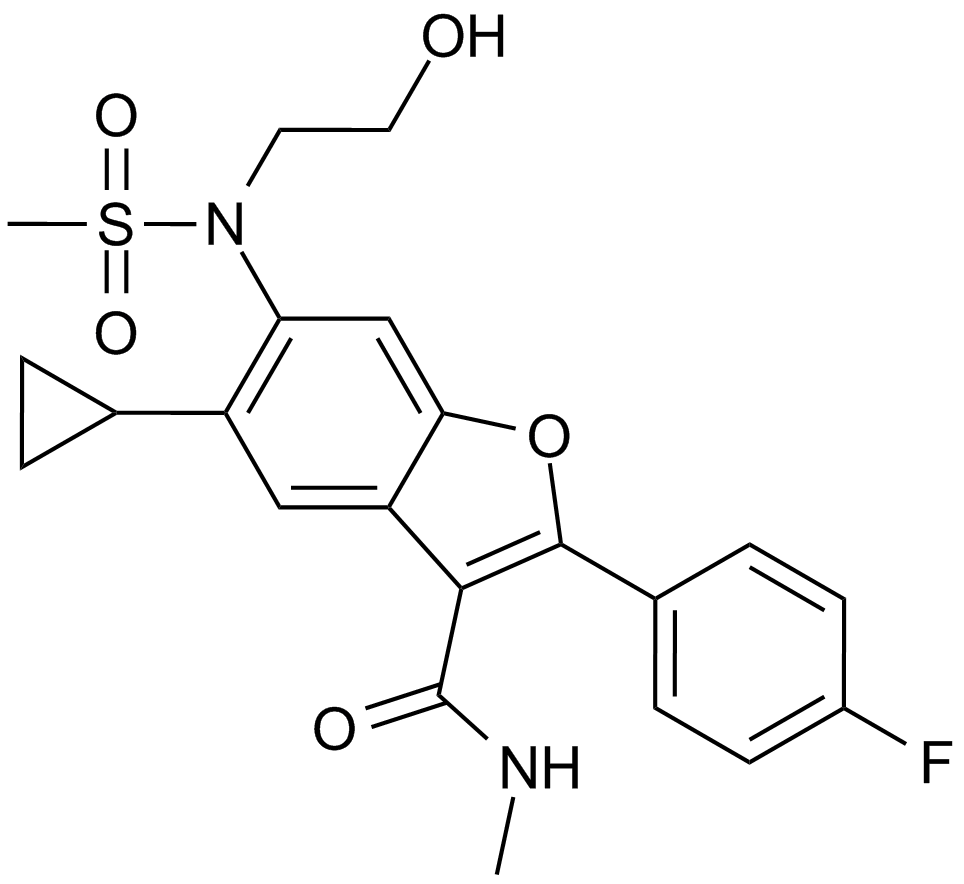
Nesbuvir (VB-19796 ; VB19796; HC-V796; HCV796) is a novel and potent NS5B (nonstructural protein 5B) polymerase inhibitor that has the potential for HCV treatment.
Physicochemical Properties
| Molecular Formula | C22H23FN2O5S |
| Molecular Weight | 446.4934 |
| Exact Mass | 446.131 |
| Elemental Analysis | C, 59.18; H, 5.19; F, 4.26; N, 6.27; O, 17.92; S, 7.18 |
| CAS # | 691852-58-1 |
| PubChem CID | 11561383 |
| Appearance | White to off-white solid powder |
| LogP | 4.705 |
| Hydrogen Bond Donor Count | 2 |
| Hydrogen Bond Acceptor Count | 7 |
| Rotatable Bond Count | 7 |
| Heavy Atom Count | 31 |
| Complexity | 748 |
| Defined Atom Stereocenter Count | 0 |
| SMILES | O=C(C1=C(C2=CC=C(F)C=C2)OC3=CC(N(CCO)S(=O)(C)=O)=C(C4CC4)C=C13)NC |
| InChi Key | WTDWVLJJJOTABN-UHFFFAOYSA-N |
| InChi Code | InChI=1S/C22H23FN2O5S/c1-24-22(27)20-17-11-16(13-3-4-13)18(25(9-10-26)31(2,28)29)12-19(17)30-21(20)14-5-7-15(23)8-6-14/h5-8,11-13,26H,3-4,9-10H2,1-2H3,(H,24,27) |
| Chemical Name | 5-Cyclopropyl-2-(4-fluorophenyl)-6-((2-hydroxyethyl)(methylsulfonyl)amino)-N-methyl-1-benzofuran-3-carboxamide |
| Synonyms | HCV-796; HCV 796; VB-19796 ; VB19796; HCV796; Nesbuvir. |
| HS Tariff Code | 2934.99.9001 |
| Storage |
Powder-20°C 3 years 4°C 2 years In solvent -80°C 6 months -20°C 1 month |
| Shipping Condition | Room temperature (This product is stable at ambient temperature for a few days during ordinary shipping and time spent in Customs) |
Biological Activity
| ln Vitro | G418 at a concentration of 1 mg/mL and mixtures of the two substances are used to treat replican cells. In a 3-day replicon inhibition assay, nesbuvir (HCV-796) is added at 40 or 80 nM (roughly 10 and 20 times the EC50), while boseprevir is added at 400 or 800 nM (roughly 2 and 4 times the EC50).The transient expression assay's EC50s for Nesbuvir and Boceprevir for the parental replicon are similar to those found in the 3-day inhibition assay using the stable replicon cells. Nesbuvir's EC50 is 14 nM in the transient expression assay, while it is 5 nM for the stable replicon, and Boceprevir's EC50 is 608 nM in the transient expression assay, compared to 201 nM for the stable replicon[1]. |
| ln Vivo | Nesbuvir (HCV-796), a benzofurane derivative, is one of the many nucleoside and non-nucleoside inhibitors (NNI) that have not yet been fully characterized. It has been shown to produce notable antiviral effects in both patients and mice with hepatitis C virus infection. The "palm" domain of NS5B contains a hydrophobic binding pocket that HCV-796 binds to, although its mode of inhibition is still unknown[2]. |
| References |
[1]. Selection and characterization of hepatitis C virus replicons dually resistant to the polymerase and protease inhibitors HCV-796 and boceprevir (SCH 503034). Antimicrob Agents Chemother. 2009 Feb;53(2):401-11. [2]. Mechanisms of activity and inhibition of the hepatitis C virus RNA-dependent RNA polymerase. J Biol Chem. 2010 Apr 30;285(18):13685-93. |
| Additional Infomation |
Nesbuvir has been investigated for the treatment of Hepatitis C. Nesbuvir is a non-nuceoside polymerase inhibitor with activity against hepatitis C virus (HCV). Nesbuvir binds to the palm site II pocket of HCV NS5B polymerase and inhibits viral genome replication. |
Solubility Data
| Solubility (In Vitro) | DMSO : ≥ 50 mg/mL (~111.98 mM) |
| Solubility (In Vivo) |
Solubility in Formulation 1: ≥ 2.5 mg/mL (5.60 mM) (saturation unknown) in 10% DMSO + 40% PEG300 + 5% Tween80 + 45% Saline (add these co-solvents sequentially from left to right, and one by one), clear solution. For example, if 1 mL of working solution is to be prepared, you can add 100 μL of 25.0 mg/mL clear DMSO stock solution to 400 μL PEG300 and mix evenly; then add 50 μL Tween-80 to the above solution and mix evenly; then add 450 μL normal saline to adjust the volume to 1 mL. Preparation of saline: Dissolve 0.9 g of sodium chloride in 100 mL ddH₂ O to obtain a clear solution. Solubility in Formulation 2: ≥ 2.5 mg/mL (5.60 mM) (saturation unknown) in 10% DMSO + 90% (20% SBE-β-CD in Saline) (add these co-solvents sequentially from left to right, and one by one), clear solution. For example, if 1 mL of working solution is to be prepared, you can add 100 μL of 25.0 mg/mL clear DMSO stock solution to 900 μL of 20% SBE-β-CD physiological saline solution and mix evenly. Preparation of 20% SBE-β-CD in Saline (4°C,1 week): Dissolve 2 g SBE-β-CD in 10 mL saline to obtain a clear solution. Solubility in Formulation 3: ≥ 2.5 mg/mL (5.60 mM) (saturation unknown) in 10% DMSO + 90% Corn Oil (add these co-solvents sequentially from left to right, and one by one), clear solution. For example, if 1 mL of working solution is to be prepared, you can add 100 μL of 25.0 mg/mL clear DMSO stock solution to 900 μL of corn oil and mix evenly. Solubility in Formulation 4: 10% DMSO+40% PEG300+5% Tween-80+45% Saline: ≥ 2.5 mg/mL (5.60 mM) (Please use freshly prepared in vivo formulations for optimal results.) |
| Preparing Stock Solutions | 1 mg | 5 mg | 10 mg | |
| 1 mM | 2.2397 mL | 11.1985 mL | 22.3969 mL | |
| 5 mM | 0.4479 mL | 2.2397 mL | 4.4794 mL | |
| 10 mM | 0.2240 mL | 1.1198 mL | 2.2397 mL |