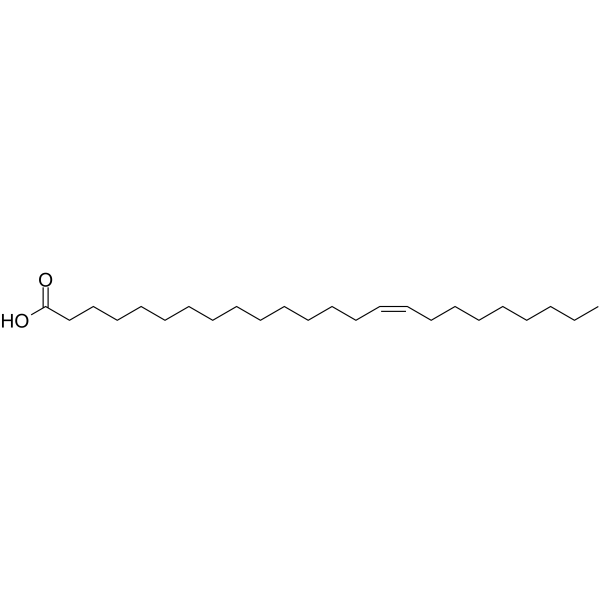
Physicochemical Properties
| Molecular Formula | C24H46O2 |
| Molecular Weight | 366.6208 |
| Exact Mass | 366.349 |
| CAS # | 506-37-6 |
| PubChem CID | 5281120 |
| Appearance | White to off-white solid powder |
| Density | 0.9±0.1 g/cm3 |
| Boiling Point | 479.2±14.0 °C at 760 mmHg |
| Melting Point | 42-43 °C(lit.) |
| Flash Point | 375.8±15.2 °C |
| Vapour Pressure | 0.0±2.6 mmHg at 25°C |
| Index of Refraction | 1.468 |
| LogP | 10.89 |
| Hydrogen Bond Donor Count | 1 |
| Hydrogen Bond Acceptor Count | 2 |
| Rotatable Bond Count | 21 |
| Heavy Atom Count | 26 |
| Complexity | 309 |
| Defined Atom Stereocenter Count | 0 |
| SMILES | CCCCCCCC/C=C\CCCCCCCCCCCCCC(=O)O |
| InChi Key | GWHCXVQVJPWHRF-KTKRTIGZSA-N |
| InChi Code | InChI=1S/C24H46O2/c1-2-3-4-5-6-7-8-9-10-11-12-13-14-15-16-17-18-19-20-21-22-23-24(25)26/h9-10H,2-8,11-23H2,1H3,(H,25,26)/b10-9- |
| Chemical Name | (Z)-tetracos-15-enoic acid |
| HS Tariff Code | 2934.99.9001 |
| Storage |
Powder-20°C 3 years 4°C 2 years In solvent -80°C 6 months -20°C 1 month Note: This product requires protection from light (avoid light exposure) during transportation and storage. |
| Shipping Condition | Room temperature (This product is stable at ambient temperature for a few days during ordinary shipping and time spent in Customs) |
Biological Activity
| Targets |
- Nervonic acid targets oxidative stress-related molecules [1] - Nervonic acid acts on dopamine neuron protection-related targets [2] - Nervonic acid targets the nuclear factor-kappa B (NF-κB) signaling pathway [3] |
| ln Vitro |
- In 6-hydroxydopamine (6-OHDA)-induced PC-12 cells (a dopaminergic neuron-like cell line), Nervonic acid (10-40 μM) exhibited concentration-dependent protective effects against oxidative stress. At 40 μM: 1) Cell viability increased by 42% compared to the 6-OHDA-only group (MTT assay); 2) Intracellular reactive oxygen species (ROS) levels decreased by 55% (DCFH-DA fluorescence assay); 3) Antioxidant enzyme activities increased (superoxide dismutase [SOD] +38%, glutathione peroxidase [GPx] +45%); 4) Apoptosis rate reduced from 35% (6-OHDA group) to 12% (Annexin V-FITC/PI staining); 5) Pro-apoptotic protein Bax decreased by 52%, anti-apoptotic protein Bcl-2 increased by 48% (Western blot) [1] |
| ln Vivo |
- Parkinson's disease (PD) mouse model ([2]): In 1-methyl-4-phenyl-1,2,3,6-tetrahydropyridine (MPTP)-induced PD mice, Nervonic acid was administered via intragastric gavage at 20 mg/kg and 40 mg/kg, once daily for 21 days. The 40 mg/kg group: 1) Improved motor disorders (rotarod test latency increased by 55%, pole test time decreased by 42% compared to the MPTP-only group); 2) Increased dopamine (DA) and its metabolites (DOPAC, HVA) in the substantia nigra (DA +48%, DOPAC +42%, HVA +38%); 3) Reduced loss of tyrosine hydroxylase (TH)-positive neurons (TH+ cell number increased by 50% in the substantia nigra) [2] - DSS-induced colitis mouse model ([3]): In dextran sulfate sodium (DSS)-induced colitis mice, Nervonic acid (50 mg/kg, 100 mg/kg, intragastric gavage, once daily for 7 days) alleviated colonic inflammation. The 100 mg/kg group: 1) Increased colon length by 35% (from 4.2 cm to 5.7 cm); 2) Reduced colonic damage score by 60% (histological scoring); 3) Decreased serum pro-inflammatory cytokines (TNF-α -52%, IL-6 -48%, IL-1β -45%); 4) Inhibited NF-κB activation (phospho-NF-κB p65 protein decreased by 55%, IκBα protein increased by 42% in colon tissues) [3] |
| Cell Assay |
- PC-12 cell assay ([1]): PC-12 cells were seeded in 96-well plates (5×10³ cells/well) or 6-well plates (2×10⁵ cells/well) and cultured in RPMI-1640 medium containing 10% fetal bovine serum. Cells were divided into: 1) Control group; 2) 6-OHDA group (200 μM); 3) Nervonic acid (10/20/40 μM) + 6-OHDA group. After 24 hours of treatment: 1) Cell viability was detected by MTT assay (absorbance at 570 nm); 2) ROS levels were measured via DCFH-DA staining and flow cytometry; 3) SOD and GPx activities were detected using respective assay kits; 4) Apoptosis was analyzed by Annexin V-FITC/PI staining and flow cytometry; 5) Bax and Bcl-2 protein levels were detected by Western blot (β-actin as internal control) [1] |
| Animal Protocol |
- PD mouse model ([2]): 1. Model establishment: Male C57BL/6 mice (8-10 weeks old) were intraperitoneally injected with MPTP (20 mg/kg) once daily for 5 days to induce PD-like symptoms. 2. Grouping and administration: Mice were divided into 3 groups (n=10): Control group, MPTP group, MPTP + Nervonic acid (20/40 mg/kg) group. Nervonic acid was dissolved in 0.5% carboxymethyl cellulose sodium (CMC-Na) and administered via intragastric gavage once daily for 21 days (starting 1 day after MPTP injection). 3. Detection: Rotarod test (latency to fall) and pole test (time to reach the bottom) were performed to evaluate motor function; substantia nigra tissues were collected to detect DA, DOPAC, HVA levels (HPLC) and TH-positive neurons (immunohistochemistry) [2] - Colitis mouse model ([3]): 1. Model establishment: Male BALB/c mice (6-8 weeks old) were given 3% DSS in drinking water for 7 days to induce colitis. 2. Grouping and administration: Mice were divided into 3 groups (n=10): Control group (normal water), DSS group, DSS + Nervonic acid (50/100 mg/kg) group. Nervonic acid was dissolved in 0.5% CMC-Na and administered via intragastric gavage once daily for 7 days (coinciding with DSS treatment). 3. Detection: Colon length was measured; colonic tissues were stained with HE to score histological damage; serum TNF-α, IL-6, IL-1β levels were detected by ELISA; colon tissue phospho-NF-κB p65 and IκBα protein levels were detected by Western blot [3] |
| Toxicity/Toxicokinetics |
- In vitro toxicity ([1]): Nervonic acid at concentrations up to 50 μM had no significant cytotoxicity on normal PC-12 cells (cell viability >90% compared to control) [1] - In vivo toxicity ([2][3]): Nervonic acid (20-100 mg/kg, intragastric gavage for 21/7 days) did not cause significant changes in mouse body weight (weight change <5% compared to control) or obvious pathological damage to liver and kidney tissues (HE staining showed no necrosis or inflammation) [2][3] |
| References |
[1]. Protective Effect of Nervonic Acid Against 6-Hydroxydopamine-Induced Oxidative Stress in PC-12 Cells. J Oleo Sci. 2021;70(1):95-102. [2]. Nervonic acid amends motor disorder in a mouse model of Parkinson's disease. Transl Neurosci. 2022 Apr 20;13(1):71. [3]. Improved colonic inflammation by nervonic acid via inhibition of NF-κB signaling pathway of DSS-induced colitis mice. Phytomedicine. 2023 Apr;112:154702. |
| Additional Infomation |
(15Z)-tetracosenoic acid is a tetracosenoic acid having a cis-double bond at position 15. It is a conjugate acid of a (15Z)-tetracosenoate. Nervonic acid has been reported in Calophyllum calaba, Homo sapiens, and other organisms with data available. Nervonic Acid is a monounsaturated fatty acid with a 24-carbon backbone and the sole double bond originating from the 9th carbon from the methyl end, with this bond in the cis- configuration. Selacholeic Acid is a monounsaturated fatty acid with a 24-carbon backbone and the sole double bond originating from the 9th carbon from the methyl end. See also: Borage Seed Oil (part of). - Nervonic acid is a very long-chain monounsaturated fatty acid (C24:1) naturally present in brain tissue, nerve fibers, and some plant seeds (e.g., Acer truncatum seeds). It plays a role in maintaining nerve cell structure and function [1][2][3] - Its protective effects are mediated by: 1) Scavenging ROS and enhancing antioxidant enzyme activity (against oxidative stress, [1]); 2) Protecting dopaminergic neurons and restoring dopamine levels (alleviating PD motor disorders, [2]); 3) Inhibiting NF-κB activation to reduce inflammatory responses (alleviating colitis, [3]) [1][2][3] |
Solubility Data
| Solubility (In Vitro) | DMSO : ~100 mg/mL (~272.76 mM) |
| Solubility (In Vivo) |
Solubility in Formulation 1: ≥ 1.67 mg/mL (4.56 mM) (saturation unknown) in 10% DMSO + 40% PEG300 + 5% Tween80 + 45% Saline (add these co-solvents sequentially from left to right, and one by one), clear solution. For example, if 1 mL of working solution is to be prepared, you can add 100 μL of 16.7 mg/mL clear DMSO stock solution to 400 μL PEG300 and mix evenly; then add 50 μL Tween-80 to the above solution and mix evenly; then add 450 μL normal saline to adjust the volume to 1 mL. Preparation of saline: Dissolve 0.9 g of sodium chloride in 100 mL ddH₂ O to obtain a clear solution. Solubility in Formulation 2: ≥ 1.67 mg/mL (4.56 mM) (saturation unknown) in 10% DMSO + 90% (20% SBE-β-CD in Saline) (add these co-solvents sequentially from left to right, and one by one), clear solution. For example, if 1 mL of working solution is to be prepared, you can add 100 μL of 16.7 mg/mL clear DMSO stock solution to 900 μL of 20% SBE-β-CD physiological saline solution and mix evenly. Preparation of 20% SBE-β-CD in Saline (4°C,1 week): Dissolve 2 g SBE-β-CD in 10 mL saline to obtain a clear solution. Solubility in Formulation 3: ≥ 1.67 mg/mL (4.56 mM) (saturation unknown) in 10% DMSO + 90% Corn Oil (add these co-solvents sequentially from left to right, and one by one), clear solution. For example, if 1 mL of working solution is to be prepared, you can add 100 μL of 16.7 mg/mL clear DMSO stock solution to 900 μL of corn oil and mix evenly. (Please use freshly prepared in vivo formulations for optimal results.) |
| Preparing Stock Solutions | 1 mg | 5 mg | 10 mg | |
| 1 mM | 2.7276 mL | 13.6381 mL | 27.2762 mL | |
| 5 mM | 0.5455 mL | 2.7276 mL | 5.4552 mL | |
| 10 mM | 0.2728 mL | 1.3638 mL | 2.7276 mL |