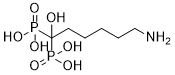
Neridronate (also known as Neridronic acid) is an aminobisphosphonate used in Italy for the treatment of osteogenesis imperfecta (OI) and Paget’s disease of bone (PDB). Neridronate is effective also in other skeletal diseases such as osteoporosis, algodystrophy, hypercalcemia of malignancy, and bone metastases. Neridronic acid, also known neridronate, is a bisphosphonate. Neridronic acid treatment has been reported to be effective also in other skeletal diseases such as osteoporosis, algodystrophy, hypercalcemia of malignancy and bone metastasis. Neridronic acid has been developed only for parenteral use, and it is the only one used as intramuscular injection.
Physicochemical Properties
| Molecular Formula | C6H17NO7P2 |
| Molecular Weight | 277.14928 |
| Exact Mass | 277.048 |
| CAS # | 79778-41-9 |
| Related CAS # | 80729-79-9 (sodium);79778-41-9 (free acid); |
| PubChem CID | 71237 |
| Appearance | White to off-white solid powder |
| Density | 1.7±0.1 g/cm3 |
| Boiling Point | 600.1±65.0 °C at 760 mmHg |
| Melting Point | 245° |
| Flash Point | 316.7±34.3 °C |
| Vapour Pressure | 0.0±3.9 mmHg at 25°C |
| Index of Refraction | 1.569 |
| LogP | -3.36 |
| Hydrogen Bond Donor Count | 6 |
| Hydrogen Bond Acceptor Count | 8 |
| Rotatable Bond Count | 7 |
| Heavy Atom Count | 16 |
| Complexity | 286 |
| Defined Atom Stereocenter Count | 0 |
| SMILES | O=P(C(P(O)(O)=O)(CCCCCN)O)(O)O |
| InChi Key | PUUSSSIBPPTKTP-UHFFFAOYSA-N |
| InChi Code | InChI=1S/C6H17NO7P2/c7-5-3-1-2-4-6(8,15(9,10)11)16(12,13)14/h8H,1-5,7H2,(H2,9,10,11)(H2,12,13,14) |
| Chemical Name | (6-Amino-1-hydroxyhexylidene)diphosphonic acid |
| Synonyms | Neridronic acid; Nerixia. |
| HS Tariff Code | 2934.99.9001 |
| Storage |
Powder-20°C 3 years 4°C 2 years In solvent -80°C 6 months -20°C 1 month |
| Shipping Condition | Room temperature (This product is stable at ambient temperature for a few days during ordinary shipping and time spent in Customs) |
Biological Activity
| References | Ther Clin Risk Manag. 2013;9:139-47.;Int J Endocrinol. 2019 Feb 6;2019:9802827. |
| Additional Infomation |
Neridronic acid is a 1,1-bis(phosphonic acid). Neridronic Acid is a third-generation, aminohexane bisphosphonate with anti-resorptive and anti-hypercalcemic activities. Although the exact mechanism of action has yet to be fully elucidated, neridronic acid binds to and adsorbs onto hydroxyapatite crystals in bone matrix, thereby preventing osteoclast resorption. This agent also binds to and inhibits farnesyl pyrophosphate synthase, an enzyme that plays an important role in the mevalonate pathway. This inhibits the formation of isoprenoids that are substrates for protein prenylation. This prevents farnesylation and geranylgeranylation of proteins essential for osteoclast function, thereby leading to the induction of apoptosis of osteoclasts. By preventing osteoclast-mediated bone resorption, neridronic acid decreases bone turnover rate, stabilizes the bone matrix and reduces hypercalcemia. |
Solubility Data
| Solubility (In Vitro) | H2O : ~5 mg/mL (~18.04 mM) |
| Solubility (In Vivo) |
Solubility in Formulation 1: 2 mg/mL (7.22 mM) in PBS (add these co-solvents sequentially from left to right, and one by one), clear solution; with sonication (<60°C). (Please use freshly prepared in vivo formulations for optimal results.) |
| Preparing Stock Solutions | 1 mg | 5 mg | 10 mg | |
| 1 mM | 3.6082 mL | 18.0408 mL | 36.0815 mL | |
| 5 mM | 0.7216 mL | 3.6082 mL | 7.2163 mL | |
| 10 mM | 0.3608 mL | 1.8041 mL | 3.6082 mL |