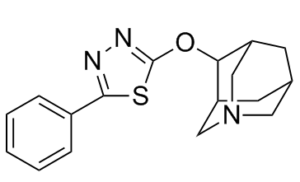
Nelonicline (aslo known as ABT-126) is a novel, potent and selective neuronal nicotinic receptor agonist. Nelonicline is potentially useful for the treatment of Alzheimer's diseases. ABT-126 may be useful to reduce dyskinesias in both early- and later-stage Parkinson's disease. Accumulating evidence suggests that the α7 subtype of nicotinic acetylcholine receptors (nAChRs) plays a key role in inflammatory processes, thought to be involved in the pathophysiology of neuropsychiatric diseases, such as schizophrenia and Alzheimer's disease.
Physicochemical Properties
| Molecular Formula | C17H19N3OS |
| Molecular Weight | 313.41726231575 |
| Exact Mass | 313.124 |
| CAS # | 1026134-63-3 |
| PubChem CID | 24795933 |
| Appearance | White to off-white solid powder |
| Density | 1.4±0.1 g/cm3 |
| Boiling Point | 460.2±55.0 °C at 760 mmHg |
| Flash Point | 232.1±31.5 °C |
| Vapour Pressure | 0.0±1.1 mmHg at 25°C |
| Index of Refraction | 1.668 |
| LogP | 4.06 |
| Hydrogen Bond Donor Count | 0 |
| Hydrogen Bond Acceptor Count | 5 |
| Rotatable Bond Count | 3 |
| Heavy Atom Count | 22 |
| Complexity | 401 |
| Defined Atom Stereocenter Count | 2 |
| SMILES | C1[C@@H]2CN3C[C@@H](C2OC4=NN=C(S4)C5=CC=CC=C5)CC1C3 |
| InChi Key | QZDCYUCETTWCMO-OFTMQHFLSA-N |
| InChi Code | InChI=1S/C17H19N3OS/c1-2-4-12(5-3-1)16-18-19-17(22-16)21-15-13-6-11-7-14(15)10-20(8-11)9-13/h1-5,11,13-15H,6-10H2/t11-,13-,14+,15+ |
| Chemical Name | 2-(((3R,4r,5S,7s)-1-azaadamantan-4-yl)oxy)-5-phenyl-1,3,4-thiadiazole |
| Synonyms | ABT-126; ABT126; ABT 126 |
| HS Tariff Code | 2934.99.9001 |
| Storage |
Powder-20°C 3 years 4°C 2 years In solvent -80°C 6 months -20°C 1 month Note: Please store this product in a sealed and protected environment (e.g. under nitrogen), avoid exposure to moisture. |
| Shipping Condition | Room temperature (This product is stable at ambient temperature for a few days during ordinary shipping and time spent in Customs) |
Biological Activity
| ln Vitro | Nelonicline is an agonist that exhibits a high affinity (Ki = 12.3 nM) for human brain α7 nAChR. It also causes currents to be activated in Xenopus laevis oocytes that express recombinant human α7 nAChR (EC50 = 2 μM; 74% intrinsic activity in relation to acetylcholine). In human IMR-32 neuroblastoma cells, neronicline does bind to α3β4* nAChR (Ki=60 nM); however, in calcium flux tests in these cells, it is only 12% effective at 100,000 nM. Nelonicline is a 5-HT3 receptor antagonist, just like some other α7 nAChR agonists, however its affinity for this receptor is more than ten times lower than that of α7 nAChR (Ki of 140 nM) [1]. |
| References |
[1]. α7 nicotinic receptor agonists reduce levodopa-induced dyskinesias with severe nigrostriatal damage. Mov Disord. 2015;30(14):1901-1911. [2]. The α7 Nicotinic Agonist ABT-126 in the Treatment of Cognitive Impairment Associated with Schizophrenia in Nonsmokers: Results from a Randomized Controlled Phase 2b Study. Neuropsychopharmacology. 2016;41(12):2893-2902. [3]. ABT-126 monotherapy in mild-to-moderate Alzheimer's dementia: randomized double-blind, placebo and active controlled adaptive trial and open-label extension. Alzheimers Res Ther. 2016;8(1):44. Published 2016 Oct 18. |
Solubility Data
| Solubility (In Vitro) | DMSO : ~12.5 mg/mL (~39.88 mM) |
| Solubility (In Vivo) |
Solubility in Formulation 1: ≥ 1.25 mg/mL (3.99 mM) (saturation unknown) in 10% DMSO + 40% PEG300 + 5% Tween80 + 45% Saline (add these co-solvents sequentially from left to right, and one by one), clear solution. For example, if 1 mL of working solution is to be prepared, you can add 100 μL of 12.5 mg/mL clear DMSO stock solution to 400 μL PEG300 and mix evenly; then add 50 μL Tween-80 to the above solution and mix evenly; then add 450 μL normal saline to adjust the volume to 1 mL. Preparation of saline: Dissolve 0.9 g of sodium chloride in 100 mL ddH₂ O to obtain a clear solution. Solubility in Formulation 2: ≥ 1.25 mg/mL (3.99 mM) (saturation unknown) in 10% DMSO + 90% (20% SBE-β-CD in Saline) (add these co-solvents sequentially from left to right, and one by one), clear solution. For example, if 1 mL of working solution is to be prepared, you can add 100 μL of 12.5 mg/mL clear DMSO stock solution to 900 μL of 20% SBE-β-CD physiological saline solution and mix evenly. Preparation of 20% SBE-β-CD in Saline (4°C,1 week): Dissolve 2 g SBE-β-CD in 10 mL saline to obtain a clear solution. Solubility in Formulation 3: ≥ 1.25 mg/mL (3.99 mM) (saturation unknown) in 10% DMSO + 90% Corn Oil (add these co-solvents sequentially from left to right, and one by one), clear solution. For example, if 1 mL of working solution is to be prepared, you can add 100 μL of 12.5 mg/mL clear DMSO stock solution to 900 μL of corn oil and mix evenly. (Please use freshly prepared in vivo formulations for optimal results.) |
| Preparing Stock Solutions | 1 mg | 5 mg | 10 mg | |
| 1 mM | 3.1906 mL | 15.9530 mL | 31.9061 mL | |
| 5 mM | 0.6381 mL | 3.1906 mL | 6.3812 mL | |
| 10 mM | 0.3191 mL | 1.5953 mL | 3.1906 mL |