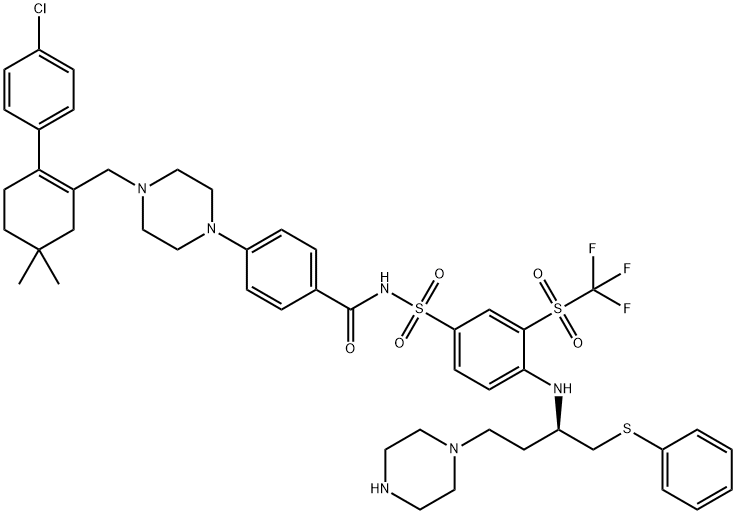
Navitoclax-piperazine (ABT-263-piperazine) is a drug-linker conjugate used in the synthesis of PROTAC DT2216, which is a degrader of B-cell lymphoma extra large (BCL-XL).
Physicochemical Properties
| Molecular Formula | C47H56CLF3N6O5S3 |
| Molecular Weight | 973.627957344055 |
| Exact Mass | 972.311 |
| Elemental Analysis | C, 57.98; H, 5.80; Cl, 3.64; F, 5.85; N, 8.63; O, 8.22; S, 9.88 |
| CAS # | 2143096-93-7 |
| Related CAS # | 923564-51-6; 1093851-28-5 (HCl); 2143096-93-7 (Navitoclax-piperazine) |
| PubChem CID | 132020434 |
| Appearance | Typically exists as White to off-white solids |
| LogP | 9.3 |
| Hydrogen Bond Donor Count | 3 |
| Hydrogen Bond Acceptor Count | 14 |
| Rotatable Bond Count | 16 |
| Heavy Atom Count | 65 |
| Complexity | 1800 |
| Defined Atom Stereocenter Count | 1 |
| SMILES | CC1(CCC(=C(C1)CN2CCN(CC2)C3=CC=C(C=C3)C(=O)NS(=O)(=O)C4=CC(=C(C=C4)N[C@H](CCN5CCNCC5)CSC6=CC=CC=C6)S(=O)(=O)C(F)(F)F)C7=CC=C(C=C7)Cl)C |
| InChi Key | CRPNZDFOWRFBLZ-KXQOOQHDSA-N |
| InChi Code | InChI=1S/C47H56ClF3N6O5S3/c1-46(2)20-18-42(34-8-12-37(48)13-9-34)36(31-46)32-56-26-28-57(29-27-56)39-14-10-35(11-15-39)45(58)54-65(61,62)41-16-17-43(44(30-41)64(59,60)47(49,50)51)53-38(19-23-55-24-21-52-22-25-55)33-63-40-6-4-3-5-7-40/h3-17,30,38,52-53H,18-29,31-33H2,1-2H3,(H,54,58)/t38-/m1/s1 |
| Chemical Name | 4-[4-[[2-(4-chlorophenyl)-5,5-dimethylcyclohexen-1-yl]methyl]piperazin-1-yl]-N-[4-[[(2R)-1-phenylsulfanyl-4-piperazin-1-ylbutan-2-yl]amino]-3-(trifluoromethylsulfonyl)phenyl]sulfonylbenzamide |
| Synonyms | Navitoclax-piperazine; 2143096-93-7; (r)-4-(4-((4'-chloro-4,4-dimethyl-3,4,5,6-tetrahydro-[1,1'-biphenyl]-2-yl)methyl)piperazin-1-yl)-N-((4-((1-(phenylthio)-4-(piperazin-1-yl)butan-2-yl)amino)-3-((trifluoromethyl)sulfonyl)phenyl)sulfonyl)benzamide; 4-[4-[[2-(4-chlorophenyl)-5,5-dimethylcyclohexen-1-yl]methyl]piperazin-1-yl]-N-[4-[[(2R)-1-phenylsulfanyl-4-piperazin-1-ylbutan-2-yl]amino]-3-(trifluoromethylsulfonyl)phenyl]sulfonylbenzamide; SCHEMBL19475750; CRPNZDFOWRFBLZ-KXQOOQHDSA-N; |
| HS Tariff Code | 2934.99.9001 |
| Storage |
Powder-20°C 3 years 4°C 2 years In solvent -80°C 6 months -20°C 1 month |
| Shipping Condition | Room temperature (This product is stable at ambient temperature for a few days during ordinary shipping and time spent in Customs) |
Biological Activity
| Targets | BCL-XL/B-cell lymphoma extra large |
| ln Vitro | B-cell lymphoma extra large (BCL-XL) is a well-validated cancer target. However, the on-target and dose-limiting thrombocytopenia limits the use of BCL-XL inhibitors, such as ABT263, as safe and effective anticancer agents. To reduce the toxicity of ABT263, we converted it into DT2216, a BCL-XL proteolysis-targeting chimera (PROTAC), that targets BCL-XL to the Von Hippel-Lindau (VHL) E3 ligase for degradation. We found that DT2216 was more potent against various BCL-XL-dependent leukemia and cancer cells but considerably less toxic to platelets than ABT263 in vitro because VHL is poorly expressed in platelets.[1] |
| ln Vivo | In vivo, DT2216 effectively inhibits the growth of several xenograft tumors as a single agent or in combination with other chemotherapeutic agents, without causing appreciable thrombocytopenia. These findings demonstrate the potential to use PROTAC technology to reduce on-target drug toxicities and rescue the therapeutic potential of previously undruggable targets. Furthermore, DT2216 may be developed as a safe first-in-class anticancer agent targeting BCL-XL.[1] |
| References |
[1]. A selective BCL-XL PROTAC degrader achieves safe and potent antitumor activity. Nat Med 25, 1938–1947 (2019). |
Solubility Data
| Solubility (In Vitro) | DMSO : ~125 mg/mL (~128.39 mM) |
| Solubility (In Vivo) |
Solubility in Formulation 1: 2.08 mg/mL (2.14 mM) in 10% DMSO + 90% (20% SBE-β-CD in Saline) (add these co-solvents sequentially from left to right, and one by one), suspension solution; with sonication. For example, if 1 mL of working solution is to be prepared, you can add 100 μL of 20.8 mg/mL clear DMSO stock solution to 900 μL of 20% SBE-β-CD physiological saline solution and mix evenly. Preparation of 20% SBE-β-CD in Saline (4°C,1 week): Dissolve 2 g SBE-β-CD in 10 mL saline to obtain a clear solution. Solubility in Formulation 2: ≥ 2.08 mg/mL (2.14 mM) (saturation unknown) in 10% DMSO + 90% Corn Oil (add these co-solvents sequentially from left to right, and one by one), clear solution. For example, if 1 mL of working solution is to be prepared, you can add 100 μL of 20.8 mg/mL clear DMSO stock solution to 900 μL of corn oil and mix evenly. (Please use freshly prepared in vivo formulations for optimal results.) |
| Preparing Stock Solutions | 1 mg | 5 mg | 10 mg | |
| 1 mM | 1.0271 mL | 5.1354 mL | 10.2708 mL | |
| 5 mM | 0.2054 mL | 1.0271 mL | 2.0542 mL | |
| 10 mM | 0.1027 mL | 0.5135 mL | 1.0271 mL |