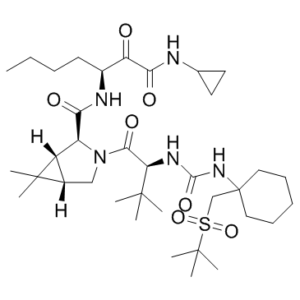
Narlaprevir (formerly also known as SCH-900518) is a novel, potent, selective, orally bioavailable and second generation inhibitor of HCV NS3 protease with Ki value of 6 nM and EC90=40 nM. Narlaprevir acts by forming a reversible covalent bond with the active-site serine. It has an overall inhibition constant (K*(i)) of 7 nM and a dissociation half-life of 1 to 2 h. SCH 900518 inhibited replicon RNA at a 90% effective concentration (EC(90)) of 40 nM.
Physicochemical Properties
| Molecular Formula | C36H61N5O7S |
| Molecular Weight | 707.96384 |
| Exact Mass | 707.429 |
| CAS # | 865466-24-6 |
| PubChem CID | 11857239 |
| Appearance | White to off-white solid powder |
| Density | 1.2±0.1 g/cm3 |
| Index of Refraction | 1.558 |
| LogP | 3.61 |
| Hydrogen Bond Donor Count | 4 |
| Hydrogen Bond Acceptor Count | 7 |
| Rotatable Bond Count | 15 |
| Heavy Atom Count | 49 |
| Complexity | 1400 |
| Defined Atom Stereocenter Count | 5 |
| SMILES | CCCC[C@@H](C(=O)C(=O)NC1CC1)NC(=O)[C@@H]2[C@@H]3[C@@H](C3(C)C)CN2C(=O)[C@H](C(C)(C)C)NC(=O)NC4(CCCCC4)CS(=O)(=O)C(C)(C)C |
| InChi Key | RICZEKWVNZFTNZ-LFGITCQGSA-N |
| InChi Code | InChI=1S/C36H61N5O7S/c1-10-11-15-24(27(42)30(44)37-22-16-17-22)38-29(43)26-25-23(35(25,8)9)20-41(26)31(45)28(33(2,3)4)39-32(46)40-36(18-13-12-14-19-36)21-49(47,48)34(5,6)7/h22-26,28H,10-21H2,1-9H3,(H,37,44)(H,38,43)(H2,39,40,46)/t23-,24-,25-,26-,28+/m0/s1 |
| Chemical Name | (1R,2S,5S)-3-(N-(((1-((tert-butylsulfonyl)methyl)cyclohexyl)amino)carbonyl)-3-methyl-l- valyl)-N-((1s)-1-((cyclopropylamino)(oxo)acetyl)pentyl)-6,6-dimethyl-3- azabicyclo(3.1.0)hexane-2-carboxamide |
| Synonyms | SCH-900518; SCH 900518; SCH900518 |
| HS Tariff Code | 2934.99.9001 |
| Storage |
Powder-20°C 3 years 4°C 2 years In solvent -80°C 6 months -20°C 1 month |
| Shipping Condition | Room temperature (This product is stable at ambient temperature for a few days during ordinary shipping and time spent in Customs) |
Biological Activity
| ln Vitro | Ketoamides are efficiently inhibited by nallaprevir (SCH 900518), with a Ki value of 7 nM [2]. Replicon RNA is efficiently inhibited by nalaprevir (SCH 900518), with an EC90 value of 40 nM [2]. |
| ln Vivo | Narlaprevir (SCH 900518), when administered orally (rat 10 mg/kg, dog 3 mg/kg, monkey 3 mg/kg), demonstrates a moderate oral bioavailability (rat 46%, dog 29%) [1]. After intravenous dosing (four mg/kg in rats and one mg/kg in dogs), nallaprevir (SCH 900518) has an intermediate half-life (4.8 hours in rats and 2 hours in dogs) [1]. |
| Animal Protocol |
Animal/Disease Models: Rats, dogs, monkeys[1] Doses: rats PO/IV 10/4 mg/kg; dogs PO/IV 3/1 mg/kg; monkeys PO 3 mg/kg Route of Administration: intravenous (iv) (iv)(iv ) or po (oral gavage) Experimental Results: T1/2 in rats and dogs were 4.8 and 2 hrs (hrs (hours)) respectively. |
| References |
[1]. Discovery of Narlaprevir (SCH 900518): A Potent, Second Generation HCV NS3 Serine Protease Inhibitor. ACS Med Chem Lett. 2010 Feb 15;1(2):64-9. [2]. Preclinical characterization of the antiviral activity of SCH 900518 (narlaprevir), a novel mechanism-based inhibitor of hepatitis C virus NS3 protease. Antimicrob Agents Chemother. 2010 Jun;54(6):2365-70. [3]. Bardoxolone and bardoxolone methyl, two Nrf2 activators in clinical trials, inhibit SARS-CoV-2 replication and its 3C-like protease. Signal Transduct Target Ther. 2021 May 29;6(1):212. |
| Additional Infomation | Narlaprevir is an azabicyclohexane that is (1R,5S)-6,6-dimethyl-3-azabicyclo[3.1.0]hexane substituted by [(3S)-1-(cyclopropylamino)-1,2-dioxoheptan-3-yl]aminoacyl and N-({1-[(tert-butylsulfonyl)methyl]cyclohexyl}carbamoyl)-3-methyl-L-valyl groups at positions 2S and 3, respectively. It is a hepatitis C virus (HCV) NS3/4A serine protease inhibitor (Ki = 6 nM) that is used for the treatment of chronic hepatitis C. It has a role as a hepatitis C protease inhibitor, an antiviral drug, an EC 3.4.22.69 (SARS coronavirus main proteinase) inhibitor and an anticoronaviral agent. It is a sulfone, a member of ureas, a tertiary carboxamide, an azabicyclohexane, a pyrrolidinecarboxamide, a secondary carboxamide and a member of cyclopropanes. |
Solubility Data
| Solubility (In Vitro) | DMSO : ≥ 50 mg/mL (~70.63 mM) |
| Solubility (In Vivo) |
Solubility in Formulation 1: ≥ 2.5 mg/mL (3.53 mM) (saturation unknown) in 10% DMSO + 40% PEG300 + 5% Tween80 + 45% Saline (add these co-solvents sequentially from left to right, and one by one), clear solution. For example, if 1 mL of working solution is to be prepared, you can add 100 μL of 25.0 mg/mL clear DMSO stock solution to 400 μL PEG300 and mix evenly; then add 50 μL Tween-80 to the above solution and mix evenly; then add 450 μL normal saline to adjust the volume to 1 mL. Preparation of saline: Dissolve 0.9 g of sodium chloride in 100 mL ddH₂ O to obtain a clear solution. Solubility in Formulation 2: ≥ 2.5 mg/mL (3.53 mM) (saturation unknown) in 10% DMSO + 90% Corn Oil (add these co-solvents sequentially from left to right, and one by one), clear solution. For example, if 1 mL of working solution is to be prepared, you can add 100 μL of 25.0 mg/mL clear DMSO stock solution to 900 μL of corn oil and mix evenly. (Please use freshly prepared in vivo formulations for optimal results.) |
| Preparing Stock Solutions | 1 mg | 5 mg | 10 mg | |
| 1 mM | 1.4125 mL | 7.0625 mL | 14.1251 mL | |
| 5 mM | 0.2825 mL | 1.4125 mL | 2.8250 mL | |
| 10 mM | 0.1413 mL | 0.7063 mL | 1.4125 mL |