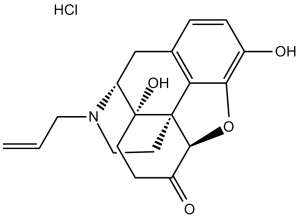
Naloxone HCl is an inverse opioid agonist drug used to counteract the effects of opiate overdose. Naloxone is useful both in acute opioid overdose and in reducing respiratory or mental depression due to opioids. It is included as a part of emergency overdose response kits distributed to heroin and other opioid drug users, and this has been shown to reduce rates of deaths due to overdose. Naloxone cannot be absorbed via the GI tract, so it is commonly combined with a number of oral opioid preparations, including buprenorphine and pentazocine.
Physicochemical Properties
| Molecular Formula | C19H21NO4.HCL | |
| Molecular Weight | 363.84 | |
| Exact Mass | 363.123 | |
| CAS # | 357-08-4 | |
| Related CAS # | Naloxone;465-65-6;Naloxone-d5;1261079-38-2 | |
| PubChem CID | 5464092 | |
| Appearance | White to off-white solid powder | |
| Boiling Point | 532.8ºC at 760 mmHg | |
| Melting Point | 200-2050C | |
| Flash Point | 276.1ºC | |
| LogP | 2.041 | |
| Hydrogen Bond Donor Count | 3 | |
| Hydrogen Bond Acceptor Count | 5 | |
| Rotatable Bond Count | 2 | |
| Heavy Atom Count | 25 | |
| Complexity | 594 | |
| Defined Atom Stereocenter Count | 4 | |
| SMILES | C=CCN1CC[C@]23[C@@H]4C(=O)CC[C@]2([C@H]1CC5=C3C(=C(C=C5)O)O4)O.Cl |
|
| InChi Key | RGPDIGOSVORSAK-STHHAXOLSA-N | |
| InChi Code | InChI=1S/C19H21NO4.ClH/c1-2-8-20-9-7-18-15-11-3-4-12(21)16(15)24-17(18)13(22)5-6-19(18,23)14(20)10-11;/h2-4,14,17,21,23H,1,5-10H2;1H/t14-,17+,18+,19-;/m1./s1 | |
| Chemical Name | (4R,4aS,7aR,12bS)-4a,9-dihydroxy-3-prop-2-enyl-2,4,5,6,7a,13-hexahydro-1H-4,12-methanobenzofuro[3,2-e]isoquinolin-7-one;hydrochloride | |
| Synonyms |
|
|
| HS Tariff Code | 2934.99.9001 | |
| Storage |
Powder-20°C 3 years 4°C 2 years In solvent -80°C 6 months -20°C 1 month Note: Please store this product in a sealed and protected environment, avoid exposure to moisture. |
|
| Shipping Condition | Room temperature (This product is stable at ambient temperature for a few days during ordinary shipping and time spent in Customs) |
Biological Activity
| Targets |
Opioid receptors (μ, δ, κ) [1][3][4] |
||
| ln Vitro |
|
||
| ln Vivo |
In rats, naloxone (2.0 mg/kg with continuous infusion of 1.7 mg/kg/h) significantly improves the neurobehavioral outcome, and this effect lasts for up to 4 weeks after damage. The administration of naloxone results in a slight and insignificant rise in mean arterial blood pressure (MAP) [1]. In rats, naloxone (0.4 mg/kg) enhances memory and counteracts the amnestic effects of adrenaline and ACTH[2]. In cats, naloxone therapy reduces the potency of the first tetanus in a dose-dependent way. Maximum twitch depression is unaffected by naloxone (5 or 10 mg/kg, iv), but it reduces PTP depression with repeated morphine doses[3]. In a rat experimental brain injury (fluid percussion injury) model: Administration of Naloxone HCl produced beneficial effects on long-term neurobehavioral outcomes. Compared with the vehicle control group, Naloxone HCl improved motor function, balance ability, and learning/memory performance in rats, as evaluated by neurobehavioral tests including beam walking and Morris water maze during the 4-week follow-up period after brain injury [1] - In animal models of memory consolidation: Naloxone HCl modulated memory consolidation either alone or in combination with ACTH, epinephrine, or β-endorphin. When administered immediately after training on a passive avoidance task, Naloxone HCl altered the retention of the learned behavior. The magnitude and direction of the effect were dependent on the administration timing and the combination with other hormones [3] - In animal models of neuromuscular function: Naloxone HCl dose-dependently reversed morphine-induced neuromuscular inhibition. Morphine administration led to reduced neuromuscular transmission (e.g., decreased diaphragmatic contraction amplitude and impaired skeletal muscle twitch response to neural stimulation), while acute administration of Naloxone HCl antagonized these inhibitory effects, restoring normal neuromuscular function [4] |
||
| Animal Protocol |
|
||
| Toxicity/Toxicokinetics |
In the tested animal models, Naloxone HCl did not cause significant acute toxicity at the administered doses (0.01 mg/kg to 1 mg/kg). No abnormalities in vital signs, body weight, or gross organ morphology were observed in Naloxone HCl-treated groups compared to controls [1][3][4] - Naloxone HCl effectively antagonized morphine-induced toxic effects, including neuromuscular suppression and potential respiratory depression (inferred from reversal of neuromuscular inhibition), without inducing additional adverse reactions [4] |
||
| References |
[1]. Beneficial effect of the nonselective opiate antagonist naloxone hydrochloride and the thyrotropin-releasing hormone (TRH) analog YM-14673 on long-term neurobehavioral outcome following experimental brain injury in the rat. J Neurotrau. [2]. Endocannabinoid activation of CB1 receptors contributes to long-lasting reversal of neuropathic pain by repetitive spinal cord stimulation. Eur J Pain. 2017 May;21(5):804-814. [3]. Effect of ACTH, epinephrine, beta-endorphin, naloxone, and of the combination of naloxone or beta-endorphinwith ACTH or epinephrine on memory consolidation. Psychoneuroendocrinology. 1983;8(1):81-7. [4]. Neuromuscular effects of morphine and naloxone. J Pharmacol Exp Ther. 1973 Jan;184(1):136-42. |
||
| Additional Infomation |
Naloxone hydrochloride is a hydrochloride resulting from the formal reaction of equimolar amounts of naloxone and hydrogen chloride. A specific opioid antagonist, it is used to reverse the effects of opioids, both following their use of opioids during surgery and in cases of known or suspected opioid overdose. It has a role as an antidote to opioid poisoning, a mu-opioid receptor antagonist and a central nervous system depressant. It contains a naloxone(1+). Naloxone Hydrochloride is the hydrochloride salt of naloxone, a thebaine derivate with opioid antagonist activity. Naloxone binds to opioid receptors in the CNS in a competitive manner, reversing or inhibiting characteristic opioid effects, including analgesia, euphoria, sedation, respiratory depression, miosis, bradycardia, and physical dependence. This agent binds to mu-opioid receptors with a high affinity, and a lesser degree to kappa- and gamma-opioid receptors. A specific opiate antagonist that has no agonist activity. It is a competitive antagonist at mu, delta, and kappa opioid receptors. See also: Naloxone (has active moiety); Naloxone Hydrochloride; Oxycodone Hydrochloride (component of); Naloxone hydrochloride; pentazocine hydrochloride (component of) ... View More ... Drug Indication Treatment of opioid-induced constipation Naloxone HCl is a non-selective competitive antagonist of opioid receptors (μ, δ, κ), exerting its pharmacological actions by blocking the binding of both endogenous opioids (e.g., β-endorphin) and exogenous opioids (e.g., morphine) to these receptors [1][3][4] - Preclinical data from the traumatic brain injury model suggest that Naloxone HCl may exert neuroprotective effects by inhibiting opioid-mediated pathways involved in secondary brain damage (e.g., inflammation, excitotoxicity) [1] - The modulation of memory consolidation by Naloxone HCl indicates that the endogenous opioid system plays a regulatory role in memory formation and retention [3] - A key preclinical finding is the ability of Naloxone HCl to reverse opioid-induced neuromuscular dysfunction, supporting its clinical utility in treating opioid overdoses characterized by respiratory and neuromuscular depression [4] |
Solubility Data
| Solubility (In Vitro) |
|
|||
| Solubility (In Vivo) |
Note: Listed below are some common formulations that may be used to formulate products with low water solubility (e.g. < 1 mg/mL), you may test these formulations using a minute amount of products to avoid loss of samples. Injection Formulations (e.g. IP/IV/IM/SC) Injection Formulation 1: DMSO : Tween 80: Saline = 10 : 5 : 85 (i.e. 100 μL DMSO stock solution → 50 μL Tween 80 → 850 μL Saline) *Preparation of saline: Dissolve 0.9 g of sodium chloride in 100 mL ddH ₂ O to obtain a clear solution. Injection Formulation 2: DMSO : PEG300 :Tween 80 : Saline = 10 : 40 : 5 : 45 (i.e. 100 μL DMSO → 400 μLPEG300 → 50 μL Tween 80 → 450 μL Saline) Injection Formulation 3: DMSO : Corn oil = 10 : 90 (i.e. 100 μL DMSO → 900 μL Corn oil) Example: Take the Injection Formulation 3 (DMSO : Corn oil = 10 : 90) as an example, if 1 mL of 2.5 mg/mL working solution is to be prepared, you can take 100 μL 25 mg/mL DMSO stock solution and add to 900 μL corn oil, mix well to obtain a clear or suspension solution (2.5 mg/mL, ready for use in animals). Injection Formulation 4: DMSO : 20% SBE-β-CD in saline = 10 : 90 [i.e. 100 μL DMSO → 900 μL (20% SBE-β-CD in saline)] *Preparation of 20% SBE-β-CD in Saline (4°C,1 week): Dissolve 2 g SBE-β-CD in 10 mL saline to obtain a clear solution. Injection Formulation 5: 2-Hydroxypropyl-β-cyclodextrin : Saline = 50 : 50 (i.e. 500 μL 2-Hydroxypropyl-β-cyclodextrin → 500 μL Saline) Injection Formulation 6: DMSO : PEG300 : castor oil : Saline = 5 : 10 : 20 : 65 (i.e. 50 μL DMSO → 100 μLPEG300 → 200 μL castor oil → 650 μL Saline) Injection Formulation 7: Ethanol : Cremophor : Saline = 10: 10 : 80 (i.e. 100 μL Ethanol → 100 μL Cremophor → 800 μL Saline) Injection Formulation 8: Dissolve in Cremophor/Ethanol (50 : 50), then diluted by Saline Injection Formulation 9: EtOH : Corn oil = 10 : 90 (i.e. 100 μL EtOH → 900 μL Corn oil) Injection Formulation 10: EtOH : PEG300:Tween 80 : Saline = 10 : 40 : 5 : 45 (i.e. 100 μL EtOH → 400 μLPEG300 → 50 μL Tween 80 → 450 μL Saline) Oral Formulations Oral Formulation 1: Suspend in 0.5% CMC Na (carboxymethylcellulose sodium) Oral Formulation 2: Suspend in 0.5% Carboxymethyl cellulose Example: Take the Oral Formulation 1 (Suspend in 0.5% CMC Na) as an example, if 100 mL of 2.5 mg/mL working solution is to be prepared, you can first prepare 0.5% CMC Na solution by measuring 0.5 g CMC Na and dissolve it in 100 mL ddH2O to obtain a clear solution; then add 250 mg of the product to 100 mL 0.5% CMC Na solution, to make the suspension solution (2.5 mg/mL, ready for use in animals). Oral Formulation 3: Dissolved in PEG400 Oral Formulation 4: Suspend in 0.2% Carboxymethyl cellulose Oral Formulation 5: Dissolve in 0.25% Tween 80 and 0.5% Carboxymethyl cellulose Oral Formulation 6: Mixing with food powders Note: Please be aware that the above formulations are for reference only. InvivoChem strongly recommends customers to read literature methods/protocols carefully before determining which formulation you should use for in vivo studies, as different compounds have different solubility properties and have to be formulated differently. (Please use freshly prepared in vivo formulations for optimal results.) |
| Preparing Stock Solutions | 1 mg | 5 mg | 10 mg | |
| 1 mM | 2.7485 mL | 13.7423 mL | 27.4846 mL | |
| 5 mM | 0.5497 mL | 2.7485 mL | 5.4969 mL | |
| 10 mM | 0.2748 mL | 1.3742 mL | 2.7485 mL |