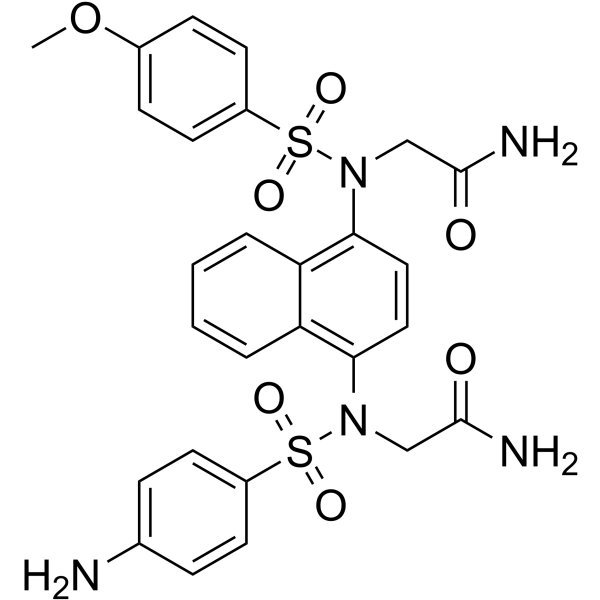
Physicochemical Properties
| Molecular Formula | C27H27N5O7S2 |
| Molecular Weight | 597.67 |
| Exact Mass | 597.135 |
| CAS # | 2254492-08-3 |
| PubChem CID | 164513524 |
| Appearance | White to off-white solid powder |
| LogP | 1.8 |
| Hydrogen Bond Donor Count | 3 |
| Hydrogen Bond Acceptor Count | 10 |
| Rotatable Bond Count | 11 |
| Heavy Atom Count | 41 |
| Complexity | 1120 |
| Defined Atom Stereocenter Count | 0 |
| SMILES | C(N(C1C2=CC=CC=C2C(N(CC(N)=O)S(=O)(=O)C2=CC=C(C=C2)OC)=CC=1)S(=O)(=O)C1C=CC(N)=CC=1)C(N)=O |
| InChi Key | DFIZGWXPFCOCFG-UHFFFAOYSA-N |
| InChi Code | InChI=1S/C27H27N5O7S2/c1-39-19-8-12-21(13-9-19)41(37,38)32(17-27(30)34)25-15-14-24(22-4-2-3-5-23(22)25)31(16-26(29)33)40(35,36)20-10-6-18(28)7-11-20/h2-15H,16-17,28H2,1H3,(H2,29,33)(H2,30,34) |
| Chemical Name | 2-[[4-[(2-amino-2-oxoethyl)-(4-methoxyphenyl)sulfonylamino]naphthalen-1-yl]-(4-aminophenyl)sulfonylamino]acetamide |
| HS Tariff Code | 2934.99.9001 |
| Storage |
Powder-20°C 3 years 4°C 2 years In solvent -80°C 6 months -20°C 1 month |
| Shipping Condition | Room temperature (This product is stable at ambient temperature for a few days during ordinary shipping and time spent in Customs) |
Biological Activity
| ln Vitro | On primary cortical neurons, NXPZ-2 (0-200 μM, 7 days) exhibits no discernible toxicity[1]. |
| ln Vivo | The learning and memorizing function of AD mice is improved by NXPZ-2 (Male ICR mice, 52.5/105/210 mg/kg, po, once daily for 7 days). This includes increased spontaneous alternation, increased numbers of active avoidance times, shortened escape latency, increased time spent in the target quadrant, and increased platform crossings[1]. With no apparent impact on mouse organs, NXPZ-2 (Male ICR mice, 52.5/105/210 mg/kg, po, once daily for 7 days) restores the brain structure damage and reduces the number of dead neurons in AD mice. NXPZ-2 (Male ICR mice, 52.5/105/210 mg/kg, po, once daily for 7 days) improves cognitive dysfunction by raising Nrf2 in the peripheral blood and central nervous system, which reduces oxidative stress and encourages Nrf2's cytoplasmic translocation to the nucleus[1]. |
| Cell Assay |
Cell Cytotoxicity Assay[1] Cell Types: primary cortical neuron Tested Concentrations: 0, 1.6, 8, 40 and 200 μM Incubation Duration: 7 days Experimental Results: Had no obvious toxicity on primary cortical neuron [1]. |
| Animal Protocol |
Animal/Disease Models: Male ICR mice, AD model[1]. Doses: 52.5 mg/kg, 105 mg/kg , 210 mg/kg. Route of Administration: Po, one time/day for 7 days. Experimental Results: demonstrated statistically increased spontaneous alternation and no influence on basal motivation, displayed an increased number of active avoidance times, which improved the learning and memory ability of AD mice. Cell number and morphology in NPZX-2-treated groups were restored, dead neuron numbers of AD mice was lowered. Increased serum Nrf2 level, displays more Nrf2 in the hippocampal and cortical nucleus and less expression level in the hippocampal and cortical cytoplasm. Increased Nrf2 -ARE binding in both hippocampus and frontal cortex, dose-dependently restored SOD, GSH, and MDA levels, and diminished AD marker protein (p-Tau)[1]. |
| References |
[1]. Direct inhibition of Keap1-Nrf2 Protein-Protein interaction as a potential therapeutic strategy for Alzheimer's disease. Bioorg Chem. 2020 Oct;103:104172. |
Solubility Data
| Solubility (In Vitro) | May dissolve in DMSO (in most cases), if not, try other solvents such as H2O, Ethanol, or DMF with a minute amount of products to avoid loss of samples |
| Solubility (In Vivo) |
Note: Listed below are some common formulations that may be used to formulate products with low water solubility (e.g. < 1 mg/mL), you may test these formulations using a minute amount of products to avoid loss of samples. Injection Formulations (e.g. IP/IV/IM/SC) Injection Formulation 1: DMSO : Tween 80: Saline = 10 : 5 : 85 (i.e. 100 μL DMSO stock solution → 50 μL Tween 80 → 850 μL Saline) *Preparation of saline: Dissolve 0.9 g of sodium chloride in 100 mL ddH ₂ O to obtain a clear solution. Injection Formulation 2: DMSO : PEG300 :Tween 80 : Saline = 10 : 40 : 5 : 45 (i.e. 100 μL DMSO → 400 μLPEG300 → 50 μL Tween 80 → 450 μL Saline) Injection Formulation 3: DMSO : Corn oil = 10 : 90 (i.e. 100 μL DMSO → 900 μL Corn oil) Example: Take the Injection Formulation 3 (DMSO : Corn oil = 10 : 90) as an example, if 1 mL of 2.5 mg/mL working solution is to be prepared, you can take 100 μL 25 mg/mL DMSO stock solution and add to 900 μL corn oil, mix well to obtain a clear or suspension solution (2.5 mg/mL, ready for use in animals). Injection Formulation 4: DMSO : 20% SBE-β-CD in saline = 10 : 90 [i.e. 100 μL DMSO → 900 μL (20% SBE-β-CD in saline)] *Preparation of 20% SBE-β-CD in Saline (4°C,1 week): Dissolve 2 g SBE-β-CD in 10 mL saline to obtain a clear solution. Injection Formulation 5: 2-Hydroxypropyl-β-cyclodextrin : Saline = 50 : 50 (i.e. 500 μL 2-Hydroxypropyl-β-cyclodextrin → 500 μL Saline) Injection Formulation 6: DMSO : PEG300 : castor oil : Saline = 5 : 10 : 20 : 65 (i.e. 50 μL DMSO → 100 μLPEG300 → 200 μL castor oil → 650 μL Saline) Injection Formulation 7: Ethanol : Cremophor : Saline = 10: 10 : 80 (i.e. 100 μL Ethanol → 100 μL Cremophor → 800 μL Saline) Injection Formulation 8: Dissolve in Cremophor/Ethanol (50 : 50), then diluted by Saline Injection Formulation 9: EtOH : Corn oil = 10 : 90 (i.e. 100 μL EtOH → 900 μL Corn oil) Injection Formulation 10: EtOH : PEG300:Tween 80 : Saline = 10 : 40 : 5 : 45 (i.e. 100 μL EtOH → 400 μLPEG300 → 50 μL Tween 80 → 450 μL Saline) Oral Formulations Oral Formulation 1: Suspend in 0.5% CMC Na (carboxymethylcellulose sodium) Oral Formulation 2: Suspend in 0.5% Carboxymethyl cellulose Example: Take the Oral Formulation 1 (Suspend in 0.5% CMC Na) as an example, if 100 mL of 2.5 mg/mL working solution is to be prepared, you can first prepare 0.5% CMC Na solution by measuring 0.5 g CMC Na and dissolve it in 100 mL ddH2O to obtain a clear solution; then add 250 mg of the product to 100 mL 0.5% CMC Na solution, to make the suspension solution (2.5 mg/mL, ready for use in animals). Oral Formulation 3: Dissolved in PEG400 Oral Formulation 4: Suspend in 0.2% Carboxymethyl cellulose Oral Formulation 5: Dissolve in 0.25% Tween 80 and 0.5% Carboxymethyl cellulose Oral Formulation 6: Mixing with food powders Note: Please be aware that the above formulations are for reference only. InvivoChem strongly recommends customers to read literature methods/protocols carefully before determining which formulation you should use for in vivo studies, as different compounds have different solubility properties and have to be formulated differently. (Please use freshly prepared in vivo formulations for optimal results.) |
| Preparing Stock Solutions | 1 mg | 5 mg | 10 mg | |
| 1 mM | 1.6732 mL | 8.3658 mL | 16.7316 mL | |
| 5 mM | 0.3346 mL | 1.6732 mL | 3.3463 mL | |
| 10 mM | 0.1673 mL | 0.8366 mL | 1.6732 mL |