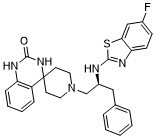
NVS-ZP7-4 is a Zinc transporter SLC39A7 (ZIP7) inhibitor that is also the first reported chemical tool to probe the impact of modulating ER zinc levels and investigate ZIP7 as a novel druggable node in the Notch pathway.
Physicochemical Properties
| Molecular Formula | C28H28FN5OS |
| Molecular Weight | 501.618227958679 |
| Exact Mass | 501.2 |
| Elemental Analysis | C, 67.04; H, 5.63; F, 3.79; N, 13.96; O, 3.19; S, 6.39 |
| CAS # | 2349367-89-9 |
| Related CAS # | (R)-NVS-ZP7-4;2517682-14-1 |
| PubChem CID | 134823928 |
| Appearance | Light yellow to yellow solid powder |
| LogP | 5.5 |
| Hydrogen Bond Donor Count | 3 |
| Hydrogen Bond Acceptor Count | 6 |
| Rotatable Bond Count | 6 |
| Heavy Atom Count | 36 |
| Complexity | 758 |
| Defined Atom Stereocenter Count | 1 |
| SMILES | C1CN(CCC12C3=CC=CC=C3NC(=O)N2)C[C@H](CC4=CC=CC=C4)NC5=NC6=C(S5)C=C(C=C6)F |
| InChi Key | FZOFDZMKSAUTHT-NRFANRHFSA-N |
| InChi Code | InChI=1S/C28H28FN5OS/c29-20-10-11-24-25(17-20)36-27(32-24)30-21(16-19-6-2-1-3-7-19)18-34-14-12-28(13-15-34)22-8-4-5-9-23(22)31-26(35)33-28/h1-11,17,21H,12-16,18H2,(H,30,32)(H2,31,33,35)/t21-/m0/s1 |
| Chemical Name | 1'-[(2S)-2-[(6-fluoro-1,3-benzothiazol-2-yl)amino]-3-phenylpropyl]spiro[1,3-dihydroquinazoline-4,4'-piperidine]-2-one |
| Synonyms | NVS-ZP7-4; NVS-ZP7 4; NVS-ZP74; NVSZP7-4; NVSZP7 4; NVSZP74; |
| HS Tariff Code | 2934.99.9001 |
| Storage |
Powder-20°C 3 years 4°C 2 years In solvent -80°C 6 months -20°C 1 month Note: This product requires protection from light (avoid light exposure) during transportation and storage. |
| Shipping Condition | Room temperature (This product is stable at ambient temperature for a few days during ordinary shipping and time spent in Customs) |
Biological Activity
| Targets | NVS-ZP7-4 targets zinc transporter ZIP7 (SLC39A7) (FRET-based zinc transport assay IC50 = 3.2 nM; SPR binding Ki = 2.8 nM) [1] |
| ln Vitro |
NVS-ZP7-4 raises zinc levels in the ER, suggesting that ZIP7 is functionally regulated [1]. 1. ZIP7 zinc transport activity inhibition: - NVS-ZP7-4 potently inhibits ZIP7-mediated zinc transport across endoplasmic reticulum (ER) membranes, with an IC50 of 3.2 nM (FRET-based zinc transport assay) [1] - It shows no significant inhibition of other ZIP family transporters (ZIP1, ZIP3, ZIP6) at concentrations up to 20 μM, confirming ZIP7 selectivity [1] 2. Notch signaling pathway suppression: - NVS-ZP7-4 inhibits Notch pathway activation in Notch-dependent cell lines, with an IC50 of 4.5 nM in Notch luciferase reporter assay (HEK293T cells) [1] - It reduces mRNA levels of Notch target genes (HES1, HEY1) by 68% and 72% at 10 nM (RT-qPCR in Jurkat cells) [1] - Western blot analysis confirms 75% reduction in cleaved Notch1 (NICD) and 65% reduction in HES1 protein levels in Jurkat cells treated with 10 nM NVS-ZP7-4 for 24 hours [1] 3. Antiproliferative activity in Notch-dependent tumors: - NVS-ZP7-4 inhibits proliferation of Notch-dependent cancer cell lines in a concentration-dependent manner: Jurkat (IC50 = 5.1 nM), KOPN-8 (IC50 = 7.3 nM), T-ALL (IC50 = 6.8 nM) (72-hour CCK-8 assay) [1] - It exhibits minimal antiproliferative effect on Notch-independent cancer cells (HCT116, MCF-7) with IC50 > 10 μM [1] - Long-term clonogenic assay shows >90% inhibition of colony formation in Jurkat cells at 15 nM NVS-ZP7-4 [1] 4. Intracellular zinc homeostasis disruption: - NVS-ZP7-4 (5, 10 nM) increases ER zinc ion concentration and decreases cytoplasmic zinc level in Jurkat cells, as detected by ER-targeted and cytoplasmic zinc fluorescent probes [1] - The zinc homeostasis imbalance is reversed by ZIP7 overexpression, confirming ZIP7-dependent mechanism [1] 5. Apoptosis induction: - NVS-ZP7-4 (10 nM) induces apoptosis in Jurkat cells, with apoptotic rate increasing from 4.8% (control) to 35.2% (48 hours, Annexin V/PI staining) [1] - Western blot shows upregulation of pro-apoptotic proteins (cleaved caspase-3/9, Bax) and downregulation of anti-apoptotic protein Bcl-2 [1] |
| ln Vivo |
1. Antitumor activity in Jurkat T-ALL xenograft model: - NVS-ZP7-4 (10, 30 mg/kg, p.o., twice daily for 21 days) inhibits Jurkat tumor growth in nude mice by 55% and 78%, respectively, compared to vehicle control [1] - The 30 mg/kg group shows significant reduction in tumor weight (from 0.76 g to 0.17 g) without obvious body weight loss or systemic toxicity [1] - Tumor tissue analysis reveals 70% reduction in NICD protein level and 65% reduction in HES1 mRNA level, along with increased apoptotic cells (TUNEL assay) [1] 2. Notch pathway suppression in vivo: - Immunohistochemical staining of tumor tissues from drug-treated mice shows decreased Notch1 activation (NICD) and reduced Ki-67 (proliferation marker) positive cells [1] - Serum levels of Notch pathway-related cytokines (IL-6, TNF-α) are reduced by 50-60% in the 30 mg/kg group [1] |
| Enzyme Assay |
1. FRET-based ZIP7 zinc transport assay: - Recombinant human ZIP7 protein is expressed in HEK293T cells and enriched in ER membrane fractions [1] - ER membrane vesicles are loaded with a zinc-sensitive FRET probe, then mixed with NVS-ZP7-4 (0.1 nM to 50 nM) in transport buffer containing zinc ions [1] - FRET signal changes (excitation 430 nm, emission 480 nm and 530 nm) are monitored in real-time for 30 minutes to detect zinc transport across ER membranes [1] - IC50 is calculated by fitting the dose-response curve of FRET signal inhibition [1] 2. Surface Plasmon Resonance (SPR) binding assay: - Recombinant ZIP7 extracellular domain is immobilized on a CM5 sensor chip via amine coupling to a density of ~900 resonance units (RU) [1] - NVS-ZP7-4 is serially diluted (0.3 nM to 30 nM) in running buffer (PBS with 0.05% Tween-20) and injected over the chip at a flow rate of 30 μl/min [1] - Association (120 seconds) and dissociation (300 seconds) phases are monitored, and the chip is regenerated with 10 mM glycine-HCl (pH 2.3) [1] - Binding affinity (Ki) is calculated using a 1:1 Langmuir binding model with reference subtraction [1] |
| Cell Assay |
1. Cell proliferation assay (CCK-8): - Notch-dependent (Jurkat, KOPN-8, T-ALL) and Notch-independent (HCT116, MCF-7) cell lines are seeded in 96-well plates at 3×10^3 cells per well and cultured overnight [1] - NVS-ZP7-4 is serially diluted (0.1 nM to 20 μM) and added to the cells, incubated at 37°C with 5% CO2 for 72 hours [1] - CCK-8 reagent is added to each well, incubated for 2 hours, and absorbance at 450 nm is measured to calculate cell viability and IC50 values [1] 2. Notch luciferase reporter assay: - HEK293T cells are co-transfected with Notch1 intracellular domain (NICD) expression plasmid and CSL-luciferase reporter plasmid [1] - Transfected cells are seeded in 96-well plates and treated with NVS-ZP7-4 (0.1 nM to 50 nM) for 24 hours [1] - Luciferase activity is measured using a luminometer, and IC50 is calculated by fitting the dose-response curve of activity inhibition [1] 3. Intracellular zinc concentration detection: - Jurkat cells are loaded with ER-targeted zinc fluorescent probe (Zinpyr-1-ER) or cytoplasmic zinc probe (FluoZin-3 AM) for 30 minutes at 37°C [1] - Cells are treated with NVS-ZP7-4 (5, 10 nM) for 4 hours, then fluorescence intensity is detected by flow cytometry or confocal microscopy [1] - Relative zinc concentration is calculated by comparing fluorescence intensity of drug-treated groups to the control [1] 4. Western blot and RT-qPCR assays: - NVS-ZP7-4-treated Jurkat cells are lysed with RIPA buffer containing protease and phosphatase inhibitors [1] - For Western blot: Equal amounts of protein are separated by SDS-PAGE, transferred to PVDF membranes, and probed with antibodies against NICD, HES1, HEY1, cleaved caspase-3/9, Bax, Bcl-2, and GAPDH [1] - For RT-qPCR: Total RNA is extracted, reverse-transcribed into cDNA, and qPCR is performed with specific primers for HES1, HEY1, and GAPDH (internal control) [1] |
| Animal Protocol |
1. Jurkat T-ALL subcutaneous xenograft model: - Male BALB/c nude mice (6-8 weeks old) are subcutaneously injected with 5×10^6 Jurkat cells suspended in Matrigel (1:1 with PBS) [1] - When tumors reach a volume of ~100 mm³, mice are randomized into vehicle control and NVS-ZP7-4 treatment groups (n=8 per group) [1] - NVS-ZP7-4 is dissolved in 0.5% carboxymethyl cellulose (CMC) + 0.1% Tween 80, administered orally at 10 or 30 mg/kg twice daily for 21 days [1] - Tumor volume is measured every 3 days using calipers, and body weight is monitored weekly [1] - At the end of treatment, mice are euthanized, tumors are excised, weighed, and stored for protein, mRNA, and immunohistochemical analysis [1] |
| ADME/Pharmacokinetics |
- NVS-ZP7-4 exhibits oral bioavailability of 41% in mice (30 mg/kg p.o.) and 38% in rats (10 mg/kg p.o.) [1] - In mice, intravenous administration (5 mg/kg) shows a plasma half-life (t1/2) of 3.8 hours, volume of distribution (Vd) of 1.1 L/kg, and total clearance (CL) of 190 ml/kg/h [1] - Peak plasma concentration (Cmax) of 1.9 μg/ml is achieved at 1 hour after oral administration of 30 mg/kg in mice, with AUC₀-24h of 15.7 μg·h/ml [1] - Plasma protein binding rate is 94% (human plasma) and 92% (mouse plasma) [1] - It shows good stability in human liver microsomes (t1/2 > 3 hours) and is primarily metabolized via CYP2C9 and CYP3A4 [1] |
| Toxicity/Toxicokinetics |
- Acute toxicity: No mortality or adverse effects observed in mice at single oral doses up to 200 mg/kg [1] - Subacute toxicity: Mice treated with 30 mg/kg/day NVS-ZP7-4 (twice daily for 28 days) show no significant changes in body weight, food intake, or hematological parameters (WBC, RBC, platelets) [1] - Serum ALT, AST, creatinine, and urea nitrogen levels are within normal ranges in drug-treated mice [1] - No histopathological abnormalities detected in liver, kidney, heart, lung, or spleen tissues of treated mice [1] |
| References |
[1]. Discovery of a ZIP7 inhibitor from a Notch pathway screen. Nat Chem Biol. 2019 Feb;15(2):179-188. |
| Additional Infomation |
- NVS-ZP7-4 is a potent, selective, and orally bioavailable inhibitor of ZIP7 (SLC39A7), identified from a Notch pathway-focused screening [1] - Its binding mode involves occupying the zinc-binding pocket of ZIP7, blocking zinc ion transport from the ER to the cytoplasm, which is essential for Notch receptor maturation and activation [1] - It exerts antitumor effects by suppressing Notch signaling pathway, inhibiting cancer cell proliferation, and inducing apoptosis in Notch-dependent tumors (e.g., T-cell acute lymphoblastic leukemia, T-ALL) [1] - ZIP7 is overexpressed in several Notch-driven cancers, making NVS-ZP7-4 a potential therapeutic agent for Notch-dependent malignancies with unmet medical needs [1] |
Solubility Data
| Solubility (In Vitro) | DMSO : ≥ 125 mg/mL (~249.19 mM) |
| Solubility (In Vivo) |
Solubility in Formulation 1: ≥ 2.08 mg/mL (4.15 mM) (saturation unknown) in 10% DMSO + 40% PEG300 + 5% Tween80 + 45% Saline (add these co-solvents sequentially from left to right, and one by one), clear solution. For example, if 1 mL of working solution is to be prepared, you can add 100 μL of 20.8 mg/mL clear DMSO stock solution to 400 μL PEG300 and mix evenly; then add 50 μL Tween-80 to the above solution and mix evenly; then add 450 μL normal saline to adjust the volume to 1 mL. Preparation of saline: Dissolve 0.9 g of sodium chloride in 100 mL ddH₂ O to obtain a clear solution. Solubility in Formulation 2: ≥ 2.08 mg/mL (4.15 mM) (saturation unknown) in 10% DMSO + 90% Corn Oil (add these co-solvents sequentially from left to right, and one by one), clear solution. For example, if 1 mL of working solution is to be prepared, you can add 100 μL of 20.8 mg/mL clear DMSO stock solution to 900 μL of corn oil and mix evenly. (Please use freshly prepared in vivo formulations for optimal results.) |
| Preparing Stock Solutions | 1 mg | 5 mg | 10 mg | |
| 1 mM | 1.9935 mL | 9.9677 mL | 19.9354 mL | |
| 5 mM | 0.3987 mL | 1.9935 mL | 3.9871 mL | |
| 10 mM | 0.1994 mL | 0.9968 mL | 1.9935 mL |