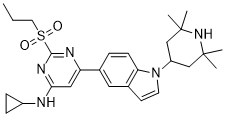
NVS-CECR2-1 is a novel and potent inhibitor of CECR2 (cat eye syndrome chromosome region, candidate 2) with an IC 50 of 47 nM. CECR2 (cat eye syndrome chromosome region, candidate 2) gene previously was identified as being in the chromosome 22q11 region, duplicated in the human disorder cat eye syndrome.
Physicochemical Properties
| Molecular Formula | C27H37N5O2S |
| Molecular Weight | 495.68 |
| Exact Mass | 495.266 |
| CAS # | 1992047-61-6 |
| Related CAS # | 1992047-61-6;NVS-CECR2-1 HCl; |
| PubChem CID | 117072550 |
| Appearance | White to off-white solid powder |
| Density | 1.3±0.1 g/cm3 |
| Boiling Point | 712.7±70.0 °C at 760 mmHg |
| Flash Point | 384.8±35.7 °C |
| Vapour Pressure | 0.0±2.3 mmHg at 25°C |
| Index of Refraction | 1.659 |
| LogP | 4.14 |
| Hydrogen Bond Donor Count | 2 |
| Hydrogen Bond Acceptor Count | 6 |
| Rotatable Bond Count | 7 |
| Heavy Atom Count | 35 |
| Complexity | 836 |
| Defined Atom Stereocenter Count | 0 |
| InChi Key | XVECNLUKQDKOST-UHFFFAOYSA-N |
| InChi Code | InChI=1S/C27H37N5O2S/c1-6-13-35(33,34)25-29-22(15-24(30-25)28-20-8-9-20)18-7-10-23-19(14-18)11-12-32(23)21-16-26(2,3)31-27(4,5)17-21/h7,10-12,14-15,20-21,31H,6,8-9,13,16-17H2,1-5H3,(H,28,29,30) |
| Chemical Name | N-cyclopropyl-2-propylsulfonyl-6-[1-(2,2,6,6-tetramethylpiperidin-4-yl)indol-5-yl]pyrimidin-4-amine |
| Synonyms | NVSCECR21 NVS1NVS CECR2 1 NVS-1 NVS 1 NVS-CECR2-1 |
| HS Tariff Code | 2934.99.9001 |
| Storage |
Powder-20°C 3 years 4°C 2 years In solvent -80°C 6 months -20°C 1 month Note: This product requires protection from light (avoid light exposure) during transportation and storage. |
| Shipping Condition | Room temperature (This product is stable at ambient temperature for a few days during ordinary shipping and time spent in Customs) |
Biological Activity
| ln Vitro | NVS-CECR2-1 diminishes all pancreatic viability at 1-4 μM for 72 hours [1]. NVS-CECR2-1 (1-6 μM; 72 hours) was developed to boost mitochondria within cells [1]. In SW48 cells, NVS-CECR2-1 (10 μM; 2 hr) suppresses CECR2 BRD's chromatin binding. Its IC50 value is predicted to be 0.64 μM. NVS-CECR2-1 (0.5–4 μM; 10 days) decreases the clonogenic activity of SW48 cells in a dose-dependent manner. NVS-CECR2-1 (5, 10, 15 μM; 2 hours) cleaves chromatin from chromatin in a linear manner. a distance from CECR2 that doesn't impact BRG1[1]. -CECR2-1 removes CECR2 from intracellular chromatin and prevents the CECR2 BRD from binding to chromatin [1]. |
| Cell Assay |
Cell viability assay[1] Cell Types: colon (SW48, HT29 and HCT116), lung (H460), urinary epithelium (SV-HUC-1), cervix (HeLa) and bone (U2OS), human embryonic kidney (HEK) 293 T cell Tested Concentrations: 1, 1.5, 2, 2.5, 3, 4 μM Incubation Duration: 72 hrs (hours) Experimental Results: Viability diminished in all cancer cells analyzed in a dose-dependent manner. demonstrated dose-dependent cytotoxicity against HEK 293 T cells. Apoptosis analysis [1] Cell Types: SW48 cells Tested Concentrations: 0.5, 1, 1.5, 2, 4, 6 μM Incubation Duration: 72 hrs (hours) Experimental Results: Apoptosis increased in a dose-dependent manner, exceeding 80% of cells at 6°C Apoptosis occurs at μM and has little effect on necrosis. |
| References |
[1]. Cytotoxic activity of bromodomain inhibitor NVS-CECR2-1 on human cancer cells. Sci Rep. 2020 Oct 1;10(1):16330. |
Solubility Data
| Solubility (In Vitro) | DMSO : ~66.67 mg/mL (~134.50 mM) |
| Solubility (In Vivo) |
Solubility in Formulation 1: ≥ 2.5 mg/mL (5.04 mM) (saturation unknown) in 10% DMSO + 90% Corn Oil (add these co-solvents sequentially from left to right, and one by one), clear solution. For example, if 1 mL of working solution is to be prepared, you can add 100 μL of 25.0 mg/mL clear DMSO stock solution to 900 μL of corn oil and mix evenly. (Please use freshly prepared in vivo formulations for optimal results.) |
| Preparing Stock Solutions | 1 mg | 5 mg | 10 mg | |
| 1 mM | 2.0174 mL | 10.0872 mL | 20.1743 mL | |
| 5 mM | 0.4035 mL | 2.0174 mL | 4.0349 mL | |
| 10 mM | 0.2017 mL | 1.0087 mL | 2.0174 mL |